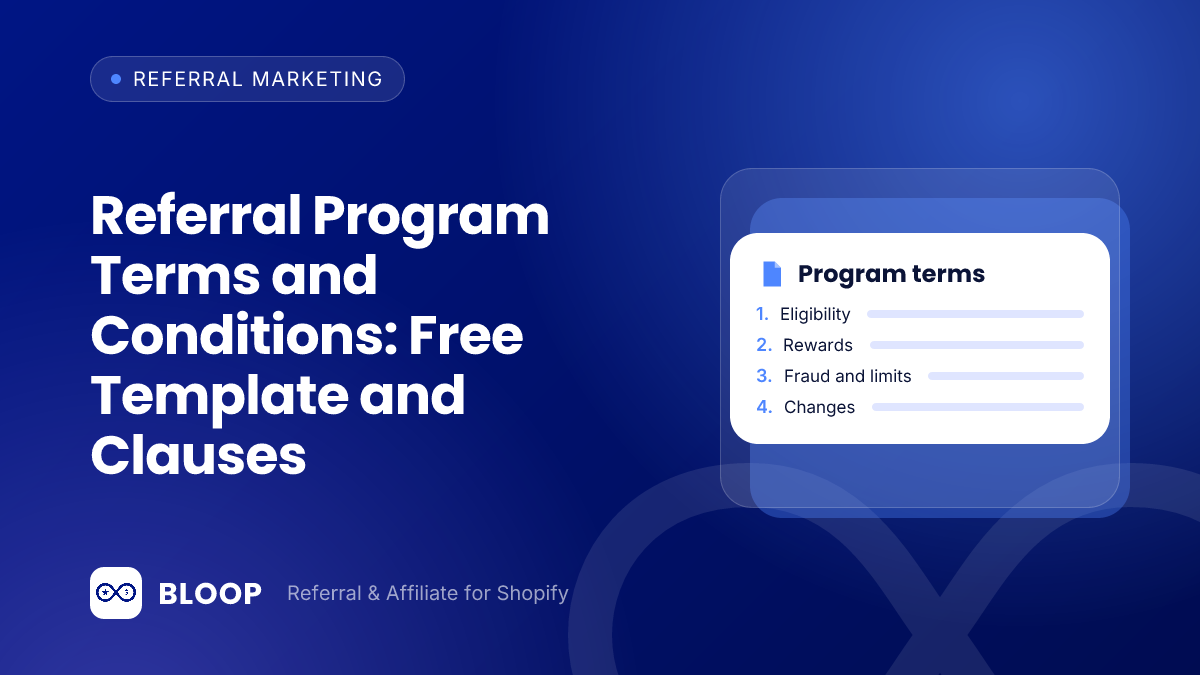
Referral program terms and conditions are a short public document that says who can take part, how a reward is earned, when it is paid or taken back, and what happens if someone cheats or you change the program. Write them before launch, link them from every place the offer appears, and match each clause to a setting you can actually enforce in your store. A good set fits on one page and answers the questions your support inbox would otherwise get.
Below is a clause-by-clause template with [placeholders], a table that explains why each clause exists, three real terms pages for reference, the FTC disclosure facts that apply to rewarded sharing, and a checklist for matching the text to your BLOOP settings. This is general information, not legal advice. Have a lawyer review the final version, especially if you sell outside the US.
Key takeaways
- Write terms you can enforce. A promise in the terms with no matching setting in the app becomes a support argument. Align each clause with a real control, such as the review period or the fraud hold.
- Cover the awkward cases. Returns, cancellations, partial refunds, self-referral and program changes are what customers ask about. Eligibility alone is not enough.
- Rewarded sharing is an endorsement. The FTC says to disclose a financial relationship with a brand, and the advertiser is “ultimately responsible for what others do on your behalf.”
- Cash rewards bring paperwork. The IRS 1099-NEC filing threshold is at least $2,000 in a year for nonemployee compensation, so keep records and ask your accountant.
Why a referral program needs terms
A referral program makes a promise to two people: the customer who shares and the friend who buys. Terms turn that promise into something both can read, and they give you a single page to point to when a reward is refused. Five reasons come up again and again.
- They set the money limit. Caps, expiry and exclusions decide what a reward can cost you. Shopify’s discount code settings let you limit the number of uses, set a minimum order amount, choose valid dates and restrict products, so the text should say what you configured.
- They back up fraud decisions. If you reject a self-referral, the customer can read the rule they broke. See our guides to referral fraud and self-referral.
- They answer refund questions in advance. A friend who returns the order should not leave the referrer unsure whether the reward stays.
- They make disclosure easier. The FTC expects rewarded recommenders to disclose the relationship, and your terms are a natural place to say so and to give wording.
- They protect your right to change the program. Rewards and rates change. A clause that lets you change or end the program, with notice, avoids a fight later.
Terms also keep the offer honest at the point of sale. BLOOP’s documentation warns that a reward restricted to one collection still renders as a flat percentage unless you write the display text, so the customer only finds the restriction at checkout. It describes a vague promise that fails at checkout as costing “more in support tickets and trust than the discount was ever worth.” Terms and display text should say the same thing.
Clause by clause: what each one protects
Use this table to decide which clauses your program needs. The right column names the BLOOP setting that supports the clause, taken from BLOOP’s documentation. If you do not use BLOOP, look for the equivalent control in your own tool.
| Clause | Why it matters | Where you enforce it in BLOOP |
|---|---|---|
| 1. Eligibility | Says who can refer and who counts as a new customer | Audience setting: all customers, members or a Shopify customer segment; only first-time customers can claim a referee reward |
| 2. How to earn | Defines what counts as a successful referral | Referral counts when the order is Paid (default) or Fulfilled |
| 3. The reward | States type, value, scope and minimums | Reward type, value, products and minimum requirements |
| 4. Limits and caps | Caps your cost per person or per promotion | Tiers, recurring cycle limit, minimum requirements |
| 5. Self-referral and fraud | Gives you the right to reject and ban | Fraud Center signals, 14-day hold, ban |
| 6. Returns, cancellations, reward timing | Explains when a reward is issued or taken back | Review period (default 6 hours), revocation on cancel or refund |
| 7. Expiry | Keeps liabilities from sitting forever | Reward code expiry and reminder emails |
| 8. Stacking | Stops combining with other offers | Shopify discount combination settings |
| 9. Changes and termination | Lets you adjust or end the program | Campaign switch and edits (your policy, not a setting) |
| 10. Taxes | Makes recipients responsible for their own taxes and sets paperwork rules for cash | Cash rewards are tracked in BLOOP; you pay them yourself |
| 11. Privacy and communications | Explains data use and email contact | Referral emails and invitations |
| 12. Governing law | Names the legal jurisdiction | Your policy, set with your lawyer |
The template
Copy the text under each heading into one page, replace every item in square brackets and delete clauses that do not apply. Keep the sentences short. Call the program by one name only. The template assumes a store that gives a discount to a new customer and a reward to the referrer, so edit it if your structure differs.
Title and scope
[Store name] Refer-a-Friend Program Terms. Last updated [date]. These terms apply to the [program name] run by [legal entity name] (“we”, “us”). By sharing a referral link or code, or by using one, you agree to these terms.
1. Eligibility
To refer a friend you must be [at least 18 years old / of legal age in your place of residence] and [a customer who has completed at least one order / a registered account holder] with [store name]. A “friend” is a person who has never placed an order with us. A friend who already has an order on file does not qualify, and the referrer earns nothing for that purchase. This program is open to residents of [countries or states].
Why this wording: BLOOP’s documentation says only first-time customers qualify as referees, and that an existing customer who checks out with a referrer’s shared code does not become a referral. Huel’s page, as of October 2026, states “Referee must be a new customer,” “18+, US only.” Name your audience setting here too: BLOOP’s default recommendation is a customer segment requiring at least one prior purchase, so that every referrer has actually used the product.
2. How to earn a reward
You earn a reward when a friend uses your personal link or code and places a qualifying first order. A qualifying order is one that [meets the minimum of [amount] / contains at least [number] items], is [paid / fulfilled], and is not cancelled or refunded. Each order is counted once. Your friend must use your link or code before checkout; we cannot add it afterward.
3. The rewards
Your friend receives [discount value, for example 15% off] on their first order of [scope: all products / selected collections]. You receive [reward type: store credit / a discount code / a free product / cash] worth [value] when your friend’s order qualifies. [Rewards apply to one-time purchases only / to the first [number] subscription orders.] Rewards have no cash value unless stated, cannot be exchanged, and cannot be transferred.
Use BLOOP’s reward vocabulary so the text matches the dashboard: referrers can earn a discount coupon, store credit, a free product, cash or a custom reward, and friends can get a discount coupon or a free product. There is no gift card reward type. If your reward is restricted to some products, say so here and in the reward display text. For subscriptions, BLOOP’s recurring cycle limit runs from 0 to 99, where 0 means unlimited, so state the real number.
4. Limits
[There is no limit to the number of friends you may refer. / You can earn rewards for up to [number] successful referrals [per year / in total].] Each discount code is single use and can be applied to one order. Codes may not be combined with other discounts or promotions unless we say so in the offer.
5. Self-referral and misuse
You may not refer yourself, your household members, or any email address, account, payment method or shipping address that you own or control. You may not use fake, purchased or scraped contact details, post your code on coupon sites without our permission, or send unsolicited messages. If we reasonably suspect misuse, we may hold a reward for up to [14] days to review it, reject it, remove it, and end your participation. A decision to end participation is final. [Contact [email] if you believe we made a mistake.]
This mirrors how BLOOP’s Fraud Center works. It holds a flagged reward for 14 days, tags the order, and lets you approve or reject it. An exact match between the buyer’s email and the referrer’s email is rejected straight away, and a ban permanently disables the referrer’s link and code and cancels pending rewards. Be careful with shared-network signals, since a household can trip them honestly, so describe a review, not an automatic penalty.
6. Returns, cancellations and when rewards are issued
Rewards are issued after your friend’s order is [paid / fulfilled] and any review period of up to [hours or days] ends. If your friend’s order is cancelled, or refunded in full or in a substantial part, we may remove the reward. If the reward has already been used or paid, we may [deduct its value from a future reward / take no action]. A partial refund below [threshold] does not remove the reward.
Pick the numbers from your settings. BLOOP’s default review period is 6 hours, a referral counts when the order is Paid by default or Fulfilled if you choose, and by default a reward is revoked when the order is cancelled or refunded. BLOOP treats an order as refunded when 90% or more of its item value is refunded, and shipping is not counted. For example, on an order with $72.00 of items and $8.00 of shipping, a $60 refund of items is 83.3% and does not count as refunded, while a $65 refund is 90.3% and does. Sitka Seafood Market’s terms, as of October 2026, state the same idea plainly: “If a Referred Friend’s order is refunded or canceled, the associated Member credit will be removed.”
7. Expiry
[Discount codes expire [number] days after they are issued. We may send a reminder before they expire. / Store credit does not expire.] Expired rewards cannot be reinstated.
Check the law where you sell before you set an expiry on store credit or anything that works like value held for the customer, because rules differ by state and country. Shopify’s store credit help says you set the expiration date per issuance, there is no store-wide default, and credit “expires at the end of the day in your store’s timezone.” It also says only the full credit amount can be applied as a payment method and customers cannot select a partial amount, which is worth explaining to customers who expect to split a balance. Sitka’s terms go the other way on purpose: its credit, in its words, “doesn’t expire.”
8. Stacking
Referral rewards [cannot / can] be combined with other discount codes, sale prices or promotions. Where combining is not allowed, the discount that gives the customer the greater value at checkout applies.
Dollar Shave Club’s terms, as of October 2026, say each code applies to one item and cannot be combined or “stacked” with another referrer code, promotion or discount on the same product. In Shopify, whether a discount combines with other classes is a setting on the discount itself, so check it matches your sentence.
9. Changes and ending the program
We may change these terms or the rewards, or pause or end the program, at any time. We will post changes on this page and update the date at the top. Rewards already issued before a change keep the terms in force when they were issued. [Unredeemed rewards at the end of the program [stay valid for [number] days / are forfeited].]
Real terms vary in how strongly they favor the store. As of October 2026, Dollar Shave Club says it “may modify, suspend, or terminate the Program, the rewards, or a user’s ability to participate in the Program, in whole or in part, at any time and for any reason, with or without notice,” and that unredeemed codes are forfeited. Sitka says it “reserves the right to modify or discontinue this program, and these terms, at any time.” A middle path, which is fairer to customers, is to keep earned rewards valid for a stated period after the program ends.
10. Taxes
You are responsible for any taxes on rewards you receive. [If you receive cash rewards, we may ask for tax information, such as a completed Form W-9, before payment, and we may report payments where the law requires.]
Only the cash route normally raises reporting questions. The IRS instructions for Forms 1099-MISC and 1099-NEC say to file Form 1099-NEC for each person to whom you paid at least $2,000 during the year in nonemployee compensation, and that prizes and awards for services performed as a nonemployee are reported there. Whether a customer’s referral reward is that kind of payment depends on the facts, so ask your accountant before you offer cash. BLOOP tracks cash rewards but does not pay them, so you control timing and records.
11. Privacy and communications
When you refer a friend, we process your name, email address, referral link and activity, and your friend’s email address and order, to run the program, issue rewards and prevent misuse. See our Privacy Policy at [URL]. We may email you about your rewards. Each marketing email includes an unsubscribe link. If you invite a friend by email, only send invitations to people who know you, and do not use purchased lists.
Two facts shape this clause. The California Attorney General’s CCPA page lists consumer rights to know, delete, opt out of sale or sharing, correct, and limit use of sensitive information, and says covered businesses must give a “notice at collection” that states what personal information they collect and why. The same page gives the thresholds that decide who is covered, so check whether your store meets them. On email, the FTC’s CAN-SPAM guide says the law covers all commercial messages, requires a clear opt-out and a valid postal address, and says the company whose product is promoted and the company that sends the message may both be responsible. BLOOP’s documentation notes that invitation emails have a daily ceiling per referrer and per store to protect sender reputation.
12. Disclosure and governing law
If you share your link publicly, for example on social media, a blog or a video, you must clearly disclose that you earn a reward when someone buys, for example by writing “I earn a reward if you use my link” next to the link. These terms are governed by the laws of [state or country], and disputes will be handled in [courts or venue], except where your local law says otherwise.
Governing law is a placeholder because the right answer depends on your entity and customers. Do not copy a jurisdiction from another store.
The FTC facts behind the disclosure clause
The disclosure clause is the one merchants skip most often, so here is what the FTC says in its own words. Its Disclosures 101 guide says: “Disclose when you have any financial, employment, personal, or family relationship with a brand.” The disclosure should be “with the endorsement message itself” and “so it’s hard to miss,” and plain words such as “advertisement,” “ad” and “sponsored” work. The same guide says “it’s your responsibility to make these disclosures,” which tells the recommender what to do.
The Endorsement Guides Q&A adds the advertiser side. On small gifts or incentives, “The answer depends on whether knowing about that gift or incentive would affect the weight or credibility your readers give to your recommendation. If it could, you should disclose it.” The disclosure “should catch users’ attention and be placed where they aren’t likely to miss it.” And for brands: “Advertisers need to have reasonable programs in place to train and monitor members of their network.” The Q&A says to explain what members can and cannot say, to instruct them on how to disclose, to periodically search for what they are saying and to take appropriate action on questionable practices. It also says “Your company is ultimately responsible for what others do on your behalf.”
What this means for a small referral program in practice. A private text to a friend with your code is a low-risk case, but a public post with a tracked link is not. Provide a share message that already mentions the reward, tell customers to keep any disclosure, and review public posts that use your codes. If you invite customers to review products, do not tie the reward to a positive review. The FTC’s Consumer Reviews and Testimonials Rule Q&A lists as a prohibited practice “Compensation or other incentives conditioned on the writing or creation of consumer reviews expressing a particular sentiment,” with an effective date of October 21, 2024. Keep reviews and referrals as separate asks. For affiliates, who are paid commissions rather than rewards, see our affiliate program terms and conditions guide.
Three real terms pages to compare
Reading what other stores publish shows how much variety is normal. The table uses only each brand’s own page, opened in October 2026. Terms change, so treat it as a snapshot and never copy another company’s wording.
| Brand | Reward and eligibility | Limits and fraud rules | Change and expiry |
|---|---|---|---|
| Dollar Shave Club | Referrer gets a single-use code for 50% off one eligible non-razor product; participants 18+ and US residents; referrers keep an account in good standing | Up to ten valid referrals (nine codes plus one milestone free product); no stacking; self-referral and fake or purchased emails prohibited | May modify, suspend or terminate at any time; unredeemed codes forfeited on termination |
| Sitka Seafood Market | $35 credit per successful referral; friend gets $35 off first box; subscription orders of $100 or more only | No limit on referrals; same-email referrals do not qualify; credit removed if the friend’s order is refunded or cancelled | Credit does not expire; program can be modified or discontinued at any time |
| Huel | “Give 25%. Get 25%.”; 18+, US only | Discount codes single use; referee must be a new customer | Full terms and privacy policy linked from the page |
Three observations. Every one of them states who can take part and what a new customer means. Two put a money limit on the reward in the text itself (a code count or a minimum order). And all three keep a right to change or end the program or point to a longer terms page. Your own page can be shorter than a full legal document, as long as it covers those same points.
Match the terms to your BLOOP settings
Before you publish, walk through this list with the campaign open. It takes about 20 minutes and removes the most common mismatches.
- Audience: does the eligibility clause match the audience setting (all customers, members or a customer segment)?
- Reward: does the clause state the same type, value, product scope and minimum as the Referrer reward and Referee reward screens?
- Timing: does the review period, Paid or Fulfilled choice and revocation rule in Referral, Settings match clause 6?
- Display text: does the reward display wording say the same thing, including restrictions?
- Fraud: do the Fraud Center signals you switched on match the misuse examples, and is someone assigned to review the queue within the 14-day hold?
- Cash: if you offer cash, do you have a payment method, a payout schedule and a records process before the first reward?
- Placement: is the terms link on the referral page, the popup, the thank-you page block and the emails?
On placement, the sensible split is to put the full text on its own page and link it, rather than pasting it into the widget. Customers should see the offer in one line and the rules one click away. Our feature page on the referral popup and referral page shows where each surface lives.
A worked example: pricing the clauses
All numbers here are assumptions for illustration. A first order is $60 and your profit on it is $27. The friend gets 15% off, which is $9.00 ($60 x 0.15). The referrer earns $10 in store credit. Rewards total $19.00, leaving $8.00 of profit before other costs. BLOOP’s advice is to keep the referrer reward plus the referee reward below the profit on a referred order, and $19.00 is below $27.00, so the offer passes.
| Scenario | Without a clause | With a clause |
|---|---|---|
| Friend returns the order a week later | Referrer keeps $10, you lose $27 profit and pay $19 in rewards | Clause 6 removes the unused credit, so you are out only the discount that was applied |
| A referrer refers 40 friends in a month | Cost is 40 x $10 = $400 in credit and 40 x $9 = $360 in discounts | A cap of 10 referrals limits credit to $100 |
| Code stacks with a 20% sale | Margin falls further than planned | Clause 8 and the discount combination setting block it |
| Referrer uses a second email | Reward paid for a purchase that was not new | Clause 5 gives you the right to reject, and the Fraud Center flags the pattern for review |
The 40-friend row shows the point. $400 plus $360 is $760 in rewards, against $27 x 40 = $1,080 of profit, which still leaves $320. A cap of 10 limits the credit at $100, but it also limits how much a real advocate can earn, so set the cap where your best customers would still feel rewarded. BLOOP’s FlexiTiers can raise the reward at higher referral counts if you want to keep paying top advocates. Our guide to store credit versus discount rewards and the referral rewards feature page help you choose the reward before you write it into the terms.
Common mistakes
- Copying another store’s terms. Their settings, jurisdiction and risk differ from yours. Use their page only to check you have covered the same topics.
- Promising what the app cannot do. For example, BLOOP has no gift card reward type, so do not promise one. Use store credit or describe a custom reward you fulfill yourself.
- Hiding the terms. A link only in the footer of a long page is easy to miss. Link it where the offer appears.
- Changing terms silently. Update the date at the top and keep an archive of earlier versions. When a dispute comes, you need the version that applied.
- Treating fraud signals as proof. A shared household network can trip a signal honestly. Say you review cases, and then actually review them.
What it costs to run with BLOOP
BLOOP has a Free plan at $0 that includes 10 referral orders and 10 affiliate orders, and the Shopify listing names fraud prevention and A/B testing among BLOOP’s features. Premium is $59.90 per month with unlimited orders and a 7-day free trial. Details are on the pricing page. If you run an affiliate program alongside referral, the terms are different, so use the affiliate guide linked above for that side.
Ready to launch? Install BLOOP from the Shopify App Store, set the reward, timing and fraud rules first, and then write the terms to match them.
Frequently Asked Questions
Do I legally need terms and conditions for a referral program?
No single rule says every referral program needs a separate document, but you do need to avoid misleading offers, honor what you promise, and follow disclosure, email and privacy laws. Written terms are the practical way to do that. Ask a lawyer about your own situation.
How long should referral program terms be?
One page is enough for most Shopify stores. Cover eligibility, how rewards are earned, limits, self-referral, returns, expiry, stacking, changes, taxes, privacy and governing law, and keep each clause to a few sentences.
Can I change the terms after launch?
You can if your terms reserve that right, and most published terms do, as Dollar Shave Club and Sitka Seafood Market show. Post the new date, keep earlier versions and say what happens to rewards already issued.
What happens to a reward if the friend returns the order?
That is up to your terms and settings. In BLOOP the default is to revoke a reward when the order is cancelled or refunded, and an order counts as refunded once 90% or more of its item value is refunded. A reward that has already been used or paid is not taken back automatically, so say what you will do in that case.
Do referral rewards need an FTC disclosure?
When a customer shares your link publicly and earns a reward, the FTC says to disclose a financial relationship with a brand, in the endorsement message itself. A private message to a friend is lower risk, but the FTC’s test is whether knowing about the incentive would affect how credible the recommendation looks.
Do cash referral rewards require tax forms?
They can. The IRS 1099-NEC instructions set a filing threshold of at least $2,000 a year for nonemployee compensation, but whether a given reward counts depends on the facts. Collect tax information before paying cash, and ask your accountant.