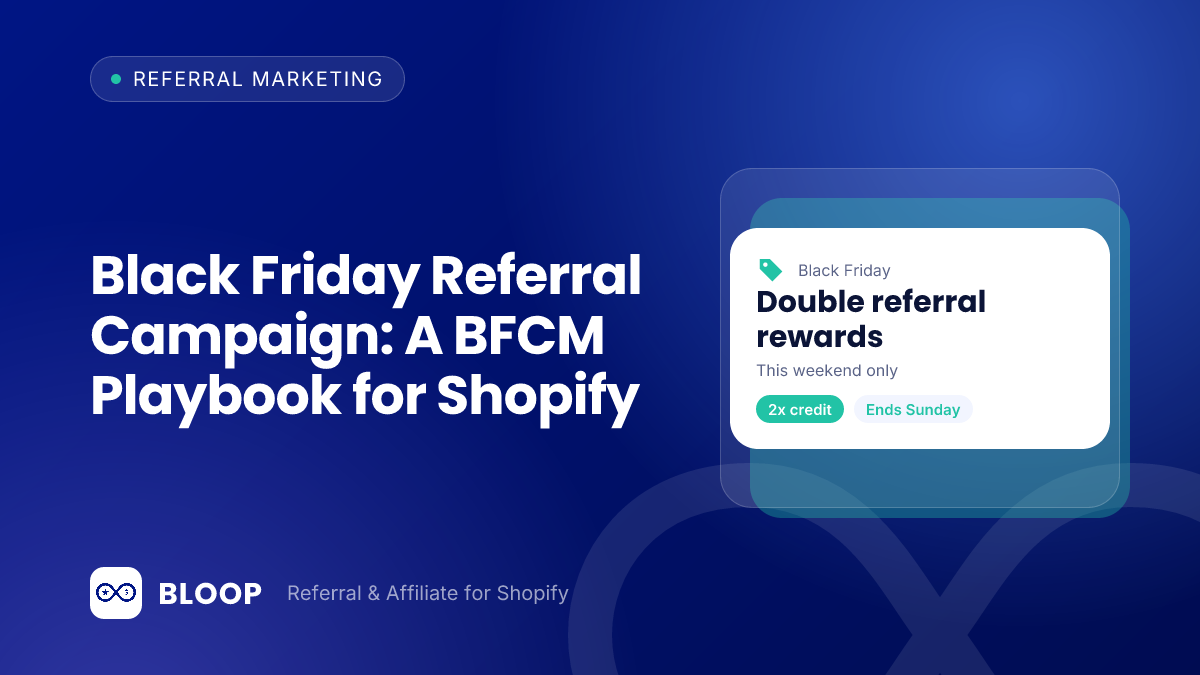
A Black Friday referral campaign works best when you plan it as a six-week project, not a four-day sale: invite past customers in early November, run a short double-reward window around Thanksgiving weekend, cap the offer with margin and inventory limits, and use December to turn one-time deal shoppers into repeat buyers. This playbook gives you the 2026 dates, the arithmetic for sizing rewards, and an email and SMS calendar you can copy.
In 2026, Black Friday Cyber Monday (BFCM) runs from Thursday, November 26 (Thanksgiving) to Monday, November 30 (Cyber Monday). From today, October 1, that is exactly 56 days away, or eight weeks. The earlier posts on this blog explain how to choose referral incentives, how to write a referral email and how to measure referral program ROI. This one covers only what changes in BFCM season: the calendar, the temporary reward boost, the guardrails and the weeks after the sale.
Every figure not labeled as an assumption comes from a page I opened: Shopify’s BFCM reports, Adobe’s press releases, Shopify’s help center, the FTC and two brands’ public pages. The worked examples use made-up store numbers, so replace them with your own.
Key takeaways
- Start in the first week of November, not on Black Friday. Adobe’s data shows Cyber Week is a minority of the season.
- Boost rewards for about five days, referrer side first. A boost that lasts weeks becomes your new baseline.
- Keep referee discount plus referrer reward below the profit on a referred order. In the example below, a $30 incentive leaves $20 and a $50 incentive leaves $0.
- Set the maximum number of referred orders per hero product before launch.
- Plan the email and SMS calendar by date, with at least eight touches before Cyber Monday.
- Judge the result at 90 days. Shopify warns that BFCM customers tend to have lower lifetime value.
What the BFCM data says about timing
Start with scale. Shopify’s BFCM 2025 report shows $14.6 billion in sales, a 27% increase in sales from 2024. It also says 81+ million consumers worldwide bought from Shopify-powered brands, that sales peaked at $5.1 million per minute at 12:01 p.m. EST on Black Friday, that 15,800+ entrepreneurs made their first sale on Shopify and that more than 94,900 merchants had their highest-selling day ever on Shopify.
Shopify’s BFCM 2024 report gives the baseline: $11.5 billion in sales, 76+ million customers, a peak of $4.6 million per minute and an average cart value of $108.56. The 2025 page lists the average cart price as $114.70, a gap of $6.14 (about 5.7%), against 81+ million versus 76+ million buyers (about 6.6% more).
| Metric | BFCM 2024 | BFCM 2025 | Source |
|---|---|---|---|
| Shopify merchant sales | $11.5 billion | $14.6 billion | Shopify BFCM reports |
| Customers who bought | 76+ million | 81+ million | Shopify BFCM reports |
| Peak sales per minute | $4.6 million | $5.1 million | Shopify BFCM reports |
| Average cart | $108.56 | $114.70 | Shopify BFCM reports |
Now the timing. Adobe’s Cyber Monday 2025 release says consumers spent a total of $14.25 billion online for Cyber Monday, up 7.1% YoY, and that Cyber Week (the 5-day period from Thanksgiving to Cyber Monday) brought in $44.2 billion online overall (up 7.7% YoY). It lists Black Friday at $11.8 billion, up 9.1% YoY, and Thanksgiving at $6.4 billion, up 5.3% YoY.
Adobe’s full-season recap says consumers spent $257.8 billion online from Nov. 1 to Dec. 31, up 6.8% year-over-year, and that 25 days saw consumers spend more than $4 billion in a single day, up from 18 days in 2024. Combining the releases gives these planning facts (my arithmetic, not Adobe’s):
| Calculation | Steps | Result |
|---|---|---|
| Weekend days between Black Friday and Cyber Monday | $44.2B Cyber Week – $6.4B Thanksgiving – $11.8B Black Friday – $14.25B Cyber Monday | $11.75 billion (Saturday and Sunday together) |
| Cyber Week share of the holiday season | $44.2B / $257.8B = 0.1715 | 17.1% |
| Spend outside Cyber Week | 100% – 17.1% | 82.9% |
| Cyber Monday share of Cyber Week | $14.25B / $44.2B = 0.3224 | 32.2% |
Saturday and Sunday together ($11.75 billion) are about the size of Black Friday alone ($11.8 billion), so a campaign that goes quiet after Friday leaves that money behind. The 82.9% outside Cyber Week is why December needs a plan too.
Shopify’s merchant advice agrees on a stretched calendar. In its founder strategies article, Sean Frank of Ridge plans sales from November 15 through December 15.
The 2026 timeline, week by week
The table turns the data into dates (weekdays checked against the 2026 calendar). Keep the order of phases: list building, a short boost, then retention.
| Dates (2026) | Phase | What happens | Referral offer |
|---|---|---|---|
| Oct 12 – Nov 1 | Prepare | Set margin and inventory caps, test the referral flow, write emails and SMS | Normal |
| Mon Nov 2 – Sun Nov 15 | Seed | Invite customers who bought in the last 12 months; reminder on Nov 9 | Normal, no boost |
| Mon Nov 16 – Sun Nov 22 | Early boost | Referrers earn double for one week, a thank-you to your best customers | Referrer reward doubled |
| Mon Nov 23 – Wed Nov 25 | Pre-sale | Remind link holders; preview the BFCM offer; confirm stock | Boost off |
| Thu Nov 26 – Mon Nov 30 | BFCM window | Referee boost live all five days | Referee boost plus referrer double |
| Tue Dec 1 – Sun Dec 6 | Last call | Push to people who clicked but did not buy | Normal |
| Mon Dec 7 – Dec 31 | Retention | Welcome flow, second-order offer, review request | Normal, referral reminder |
Why not boost all of November? A boost that runs for weeks becomes the price customers expect, and you lose urgency later. Short windows with an end date also let you test: compare the week of Nov 16 with the week of Nov 9.
The BLOOP pages cited in this post do not mention a scheduler that switches reward amounts on a date, so treat each boost as a manual task: put the start and end in your calendar, change the setting, and check how it treats referrals started earlier. Do a dry run in the first week of November.
Design the offer: double-reward windows and stacking
A double-reward window raises one side of the offer for a short time. BLOOP supports referrer rewards as a discount coupon, store credit, a free product, cash (tracked in BLOOP, paid by you) or a custom reward, and referee rewards as a discount coupon or a free product, per its rewards documentation. That page also gives the rule to start from: add the referrer and referee rewards together, and keep that combined cost below your profit on a referred order.
Worked example: the four offer levels
Assumptions for a made-up store: the average first order is $100 at full price, product cost is $38, and fulfillment and payment fees are $12. Profit on a referred order before any incentive is $100 – $38 – $12 = $50.
| Offer level | Referee discount | Referrer reward | Combined incentive | Profit left per order | Incentive as share of the $50 profit |
|---|---|---|---|---|---|
| Normal | 10% = $10 | $10 | $20 | $50 – $20 = $30 | $20 / $50 = 40% |
| BFCM double reward | 10% = $10 | $20 | $30 | $50 – $30 = $20 | $30 / $50 = 60% |
| BFCM aggressive | 20% = $20 | $20 | $40 | $50 – $40 = $10 | $40 / $50 = 80% |
| Too rich | 25% = $25 | $25 | $50 | $50 – $50 = $0 | $50 / $50 = 100% |
The “too rich” row is where stores land by accident: each side sounds modest, but together they equal your entire profit, before refunds and ad spend. The double-reward level is the ceiling here.
For the cost difference between credit and coupons, read store credit versus discount rewards.
Worked example: stacking with the sitewide sale
Most stores run a sitewide sale, and the referee offer can land on top of it. Shopify’s discount combinations page says customers can use a maximum of 5 product or order discount codes and 1 shipping discount code on the same order, and that product discounts apply first to individual items, then order discounts apply to the revised subtotal, with shipping discounts last.
Take the same $100 order with a 20% sitewide product discount and a 10% referee order discount that is allowed to combine:
- Step 1, product discount: $100 x 0.80 = $80.00.
- Step 2, order discount on the revised subtotal: $80.00 x 0.90 = $72.00.
- Step 3, profit before the referrer reward: $72 – $38 product cost – $12 fulfillment and fees = $22.
- Step 4, subtract a $10 referrer reward: $22 – $10 = $12 left.
- Step 5, compare with the table: the same order without the sitewide sale and with the normal offer leaves $30.
A stacked order earns $18 less ($30 – $12). The new customer’s effective discount is $28 on $100, or 28%, not the 10% on the referral page. Decide before launch whether referral codes may stack with the sale, and say so in your terms.
Guardrails that protect margin, stock and the program
Margin guardrail
Pick one rule and apply it to every offer. In the example the combined incentive may not exceed 60% of pre-incentive profit. Run each offer through the free referral ROI calculator first, including the effect of stacking.
Inventory guardrail
Referral traffic is demand you invited, so it must fit what you can ship. Peter Dering of Peak Design warns in the Shopify founder article that “If you haven’t pre-bought inventory, you can really get caught with your pants down and miss a ton of sales.”
Here is a way to turn that into a number, using assumed figures for one hero product:
| Step | Calculation | Result |
|---|---|---|
| Units in stock or inbound | Given | 1,200 units |
| Hold-back for returns, exchanges and December | 1,200 x 0.15 | 180 units |
| Sellable units | 1,200 – 180 | 1,020 units |
| Forecast demand from non-referral channels | Given | 700 units |
| Capacity left for referral orders | 1,020 – 700 | 320 units |
| Units per referred order | Given | 1.3 units |
| Maximum referred orders | 320 / 1.3 = 246.15 | 246 orders (round down) |
The campaign example below expects 288 referred orders, or 374.4 units at 1.3 per order, which exceeds the 320 units of capacity. This store can restock, move the free-product reward to another item, or stop promoting the offer on the hero product at the cap. Making that choice in October costs nothing; on Black Friday it costs orders.
Fraud guardrail
Big rewards attract abuse. BLOOP’s fraud prevention guide names automatic signals such as self-referral email matches, repeated IPs and high volume in a week. IP and browser blocking are left off by default and should be turned on only if abuse appears. For offer-level protection it recommends minimum purchases, reward review periods and a restricted referrer audience, noting that store credit gated to existing customers carries less risk than a high-value cash reward.
Two settings matter most. The reward timing docs say the review period defaults to 6 hours and can be lengthened for high-value cash rewards or after abuse. And BLOOP treats an order as refunded when 90% or more of its item value has been refunded (shipping is not counted), then revokes rewards on cancel or refund under the default setting. Background reading: referral fraud and self-referral.
During Nov 26 to Dec 2, check held referrals daily.
Affiliates and creators during BFCM
If you also run an affiliate program, BFCM changes the commission math because the customer pays less. BLOOP’s commission rules describe a default attribution window of 30 days. By default commission applies to product prices after discounts, plus shipping, taxes and tips, and the docs note that excluding shipping and tax is common because you rarely want to pay commission on money that never lands as profit. For rate benchmarks see affiliate commission rates for Shopify.
Worked example: commission base
Assumptions: a $100 product sold at 30% off, so the item subtotal is $70.00, plus $8.00 shipping and $5.60 tax. The affiliate rate is 15%.
| Commission base | Calculation | Commission | Profit after product cost and fulfillment ($70 – $50) |
|---|---|---|---|
| Item subtotal only | $70.00 x 0.15 | $10.50 | $20.00 – $10.50 = $9.50 |
| Order total with shipping and tax | $83.60 x 0.15 | $12.54 | $20.00 – $12.54 = $7.46 |
Paying on the order total costs $2.04 more per order ($12.54 – $10.50) and eats about 10% of the $20 profit. The order total is $70.00 + $8.00 + $5.60 = $83.60. Tell affiliates before the sale which base you use.
What real brands publish
Two brands publish terms that show how to run a seasonal offer. I opened each page; terms can change, so check the links yourself.
Ooni: a three-day Black Friday referral window
Ooni publishes a Black Friday referral program terms page. When I opened it in October 2026 it still listed 2022 dates: a 20% referral code available between 18 and 20 November 2022, and a $20 voucher for first purchases made between 18 and 28 November 2022. Referred friends get a one-time 20% discount code valid on a first purchase. The referrer gets a $20 voucher when the friend spends more than $200 on a first purchase. Vouchers are one-time use, cannot be redeemed for cash and cannot be combined with other discount codes.
Two details are worth copying. The window is short and dated, and the page says users must not publicly post any unique referral link online, with a payback clause for breaches. The page says the $200 threshold is measured on the first purchase before any discounts apply. Your terms should state the same.
In numbers, since the threshold is measured before discounts: a friend spending exactly $200 gets $200 x 0.20 = $40 off, the referrer earns $20, and the combined incentive is $40 + $20 = $60, or 30% of $200 ($60 / $200 = 0.30).
Kinsta: a Black Friday affiliate offer
Kinsta’s Black Friday affiliate article says affiliates earn a one-time bonus ranging from $50 to $500, depending on the hosting plan referred, plus 10% recurring commissions for the lifetime of the client account, and that the full one-time bonus is unaffected by the customer discount. The article adds that the 10% recurring commission is based on the hosting plan subscribed to after the discount. Kinsta sells hosting, so that model does not transfer directly to physical products, but the lesson does: state in advance whether commission uses the discounted or list price.
The email and SMS calendar
In its post-BFCM retention article, Shopify says merchants who integrated SMS into their Black Friday email marketing strategy experienced a 20% YoY increase in ecommerce revenue during BFCM, accounting for more than $100 million in gross merchandise value. In the founder article, Sean Frank says you can “send as many emails as you want” during this period because unsubscribe rates stay consistent. That is one founder’s experience, so watch your own unsubscribe rate.
This calendar keeps the referral message distinct from the sale message. Copy ideas are in the referral email template guide linked in the intro.
| Date (2026) | Channel | Audience | Message |
|---|---|---|---|
| Mon Nov 2 | Customers with 1+ orders in the last 12 months | Announce the referral program, show the reward, one button to get the link | |
| Mon Nov 9 | Opened Nov 2, did not copy link | Reminder with a one-line explanation of how it works | |
| Mon Nov 16 | Email + SMS | Everyone who has a referral link | Double reward for referrers this week only; end date shown |
| Fri Nov 20 | SMS | Customers who shared but have no referred order | Short nudge with link, ends Sunday |
| Tue Nov 24 | Referral link holders | “Sale starts Thursday; friends get the BFCM offer through your link” | |
| Thu Nov 26 (evening) | Email + SMS | Everyone | BFCM referral window is live, ends Monday midnight |
| Fri Nov 27 | Referrers with at least one referred order | Progress: how many friends used the link, how much earned | |
| Sun Nov 29 | SMS | Link holders with no referred order | Last full day before Cyber Monday |
| Mon Nov 30 | Email + SMS | Everyone | Final hours, end time stated clearly |
| Tue Dec 1 | Clickers who did not buy | Last call at normal referral reward |
Most customers see fewer than 10 messages because each send targets a segment. Put the reward terms in a plain footer line: amount, minimum order, expiry and whether it stacks. Give referrers a few sharing ideas.
Worked example: a full campaign, step by step
Assumptions for a made-up store: 4,000 past customers are invited; 10% become active sharers; each sharer produces 0.75 referred first orders; 4% of referred orders are cancelled or refunded and have rewards revoked; the double-reward offer applies ($10 referee discount, $20 referrer reward); you pay BLOOP Premium at $59.90 per month for November and December.
| Step | Calculation | Result |
|---|---|---|
| Active sharers | 4,000 x 0.10 | 400 |
| Referred first orders | 400 x 0.75 | 300 |
| Cancelled or refunded orders | 300 x 0.04 | 12 |
| Valid referred orders | 300 – 12 | 288 |
| Revenue after referee discount | 288 x $90 | $25,920 |
| Product cost plus fulfillment and fees | 288 x $50 | $14,400 |
| Profit before referrer rewards | $25,920 – $14,400 | $11,520 |
| Referrer rewards | 288 x $20 | $5,760 |
| Profit after rewards | $11,520 – $5,760 | $5,760 |
| App cost, two months | 2 x $59.90 | $119.80 |
| Profit after app cost | $5,760 – $119.80 | $5,640.20 |
The $50 cost per order is the $38 product cost plus $12 fulfillment and fees. Check: $50 – $10 discount – $20 reward = $20, and 288 x $20 = $5,760. The cost per new customer is $30 ($10 + $20), which you can compare with your paid acquisition cost.
The model ignores shipping revenue, taxes and ad spend, and it treats rewards at face value. The 288 orders are an assumption, and a smaller list may produce far fewer. On plans, the Free plan at $0 covers 10 referee orders and 10 affiliate orders, so a campaign of this size needs Premium ($59.90 per month, 7-day free trial); see the pricing page linked below.
After BFCM: where the real profit is
Shopify’s retention article says that most customers acquired during BFCM have a lower lifetime value, partly because these customers were being opportunistic and taking advantage of your promotions. So the $5,640.20 is only part of the result. The rest depends on how many of the 288 buy again.
Worked example: the 90-day view
Assumptions: a reorder averages $95 with 50% profit, which is $47.50. Because of the lower-lifetime-value warning, here are three reorder rates for the 288 customers:
| Reorder rate within 90 days | Reorders | Reorder profit | Total profit (campaign $5,640.20 + reorders) |
|---|---|---|---|
| 10% | 288 x 0.10 = 28.8 | 28.8 x $47.50 = $1,368.00 | $7,008.20 |
| 20% | 288 x 0.20 = 57.6 | 57.6 x $47.50 = $2,736.00 | $8,376.20 |
| 25% | 288 x 0.25 = 72 | 72 x $47.50 = $3,420.00 | $9,060.20 |
Even at 10% the campaign is profitable here, but the $2,052.00 spread between the first and last rows ($9,060.20 – $7,008.20) is why December needs as much care as November.
A December retention sequence
- Dec 1 to Dec 3: thank-you email to every referred customer, with order details and a note on how to refer others.
- Dec 7: second-order offer with a deadline (for example, free shipping on the next order for 14 days). Keep the offer smaller than the referee discount.
- Dec 14: a product guide related to what they bought.
- Dec 21: a review request, then a reminder that their own referral link still works at the normal reward.
- January: tag customers with two or more orders as your next referrer segment, since they have already shown repeat intent.
Disclosure and terms
If referrers or affiliates get a reward, the FTC expects a clear disclosure. The FTC’s endorsement guides Q&A says disclosures must be easy to notice and understand, and that even modest gifts, including discount codes, need disclosure if knowing about them would affect the weight or credibility readers give the recommendation. Add a line to your share message such as “I get a reward if you buy through my link.”
Ready to run it
If you want the program running before the sale, BLOOP has a 7-day free trial, and the Free plan lets you test the flow. More than 2,000 Shopify merchants use it, with 190+ ratings on the Shopify App Store. Start with the pricing plans, set the “BFCM double reward” level from the table, and run a dry run in the first week of November.
Frequently Asked Questions
When should I launch a Black Friday referral campaign?
Launch the base program in the first week of November. In 2026 that means about November 2, a short boost in the week of November 16 and the main window from Thursday, November 26 to Monday, November 30. About 82.9% of holiday online spend falls outside Cyber Week (my calculation from Adobe’s numbers), so early and late weeks both matter.
How big should a double-reward offer be?
Size it from profit. Add the referee discount to the referrer reward and keep the total well below your profit on a referred order. In the example here, a $30 total on $50 of profit leaves $20 per order, while a $50 total leaves nothing.
Can referral discounts stack with my Black Friday sale?
Only if your discount settings allow it. A stacked 20% plus 10% on a $100 item brings the price to $72, an effective 28% off. Test a real checkout and say in your terms whether the code stacks.
How do I stop fraud during the busiest days?
Keep automatic fraud signals on, add a minimum purchase, and lengthen the reward review period for cash rewards. Check held referrals daily from November 26 to December 2. Review each held case on its evidence rather than rejecting on sight.
How do I judge whether the campaign worked?
Measure at 90 days, not at Cyber Monday. Count valid referred orders, subtract discounts, rewards and app fees, then add the profit from reorders. Shopify says BFCM customers tend to have lower lifetime value, so use conservative reorder rates in your model.