A referral program for a subscription business should pay its reward on a paid first order or after a renewal, and it should cap any recurring discount at a few billing cycles. The real cost of a subscription referral is not the first coupon, it is every renewal that the coupon keeps discounting.
This guide is for Shopify store owners who sell coffee, meal kits, razors, supplements or any other repeat-delivery product. It covers when to pay the reward, how to cap recurring discounts, how to turn churn into a lifetime value (LTV) and a reward budget, and what three public subscription referral pages offer today. Every store figure in the worked examples is hypothetical, and every research or brand fact links to the page where I read it. For one-time products, the referral program ROI guide covers the simpler case.
Key takeaways
- Pay the referrer when the friend’s first order is paid, or after a renewal if early cancellations are a problem, and revoke the reward if the order is canceled or refunded.
- Never leave a recurring discount unlimited. In the worked example below, an $8 discount on every renewal of a $40 plan consumes 50.0% of expected LTV, while a 3-cycle cap consumes 19.3%.
- With a steady monthly churn rate, expected orders per subscriber equal 1 ÷ churn, so 15% churn means 6.67 orders and 10% churn means 10 orders.
- Set the combined reward budget as a share of LTV, not of the first order, and test it against a worst-case churn rate.
- Real subscription brands cap, gate or time-limit their referral rewards. Dollar Shave Club caps referrals, Sitka Seafood Market sets a minimum order, and Bottomless delays the friend’s reward to the first automatic reorder.
Why subscriptions change the referral math
In a one-time store, a referral reward is compared with the profit on one order. In a subscription store, the referred customer may buy for a year or more, so the allowed reward is larger. At the same time the discount can repeat on every renewal, so the risk is larger too.
Retention is the reason subscription brands care about referrals at all. Amy Gallo wrote in Harvard Business Review (October 29, 2014) that “acquiring a new customer is anywhere from five to 25 times more expensive than retaining an existing one”, and the same article cites Frederick Reichheld’s finding that increasing customer retention rates by 5% increases profits by 25% to 95%. Those are cross-industry figures, not subscription-box benchmarks, so use them as a reason to measure retention, not as a forecast for your store.
Do referred customers stay longer? One long study says a little. Researchers tracked about 10,000 customers of a German bank and reported in the Journal of Marketing (January 2011) that the probability of still being an active customer after 33 months was 82.0% for referred customers and 79.2% for nonreferred customers. The same paper found that a referred customer’s higher contribution margin erodes over time, and that the value differential varies across customer segments. A bank is not a coffee subscription, so treat the result as one data point and measure your own referred cohort.
There are three practical differences from a one-time store:
- The reward can repeat. A discount coupon on a subscription can apply to every future payment unless you stop it.
- The customer can leave without notice. Shopify states that customers can resume, skip, or cancel their subscriptions, so a signup is not a guaranteed stream of orders.
- Payment failures also end subscriptions. Cards expire and renewals fail, which is involuntary churn, and a referral reward paid on a customer whose card fails twice is wasted.
What real subscription brands offer
Three brands publish their referral terms on pages anyone can open. I read each page in October 2026, and the offers below are what those pages said then, not what the brands offer today or in future. Terms change, so check the linked page before copying anything.
| Brand | Referrer gets | Friend gets | Conditions on the page |
|---|---|---|---|
| Dollar Shave Club | Single-use code for 50% off one eligible non-razor product per valid referral, up to nine codes, and one free product on the tenth valid referral | 30% off a new subscription | Friend must be a new subscriber, maximum of 10 valid referrals, codes cannot be combined with other offers |
| Sitka Seafood Market | $35 credit for every friend who subscribes through the link | $35 off the first box plus free salmon burgers for the first year of the subscription | Minimum subscription order of $100 or more, new subscribers only, one-time boxes excluded |
| Bottomless | A free referral credit | A free bag for their first automatic reorder | Coffee subscriptions only, different addresses required, credit valid on orders within 1.5x the price of the referrer’s most recent order when the credit was received |
What each page teaches
Dollar Shave Club gives the referrer a code for 50% off a non-razor product, and the page says each code is single-use, has no cash value and cannot be applied to past purchases. In effect the reward steers referrers toward add-on products rather than discounting the core plan, and the cap of ten valid referrals puts a ceiling on exposure per customer. The friend’s offer is a discount on a new subscription, available only to someone who is not an existing or former subscriber.
Sitka Seafood Market pays a cash-like account credit. Its terms say the credit is placed on the account as soon as the friend places an order, usually within an hour or two, and that if the friend’s order is refunded or canceled, the credit tied to that referral is removed. The credit also does not expire. The friend’s perk of free salmon burgers lasts for the first year, which is a natural cap on a recurring benefit: the extra cost ends on a date, not on the customer’s cancellation.
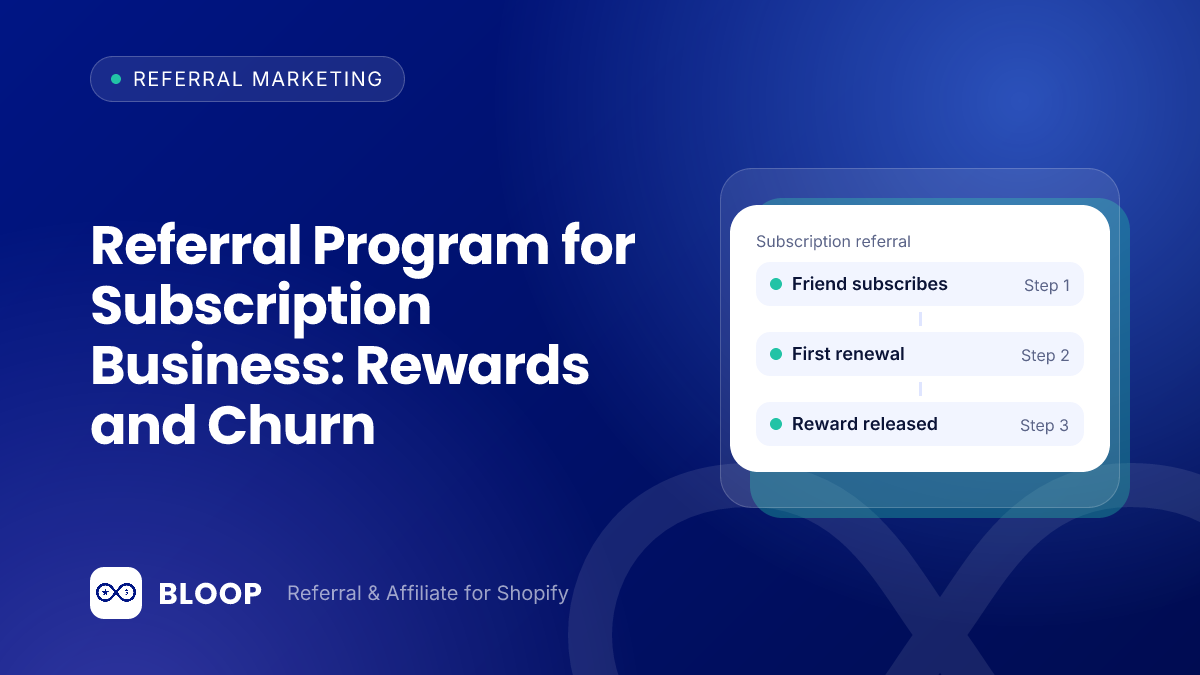
Bottomless shows the “nth renewal” idea in practice. The page describes the friend’s reward as a free bag for their first automatic reorder, so the benefit arrives only after the customer has set up repeat delivery. The page also limits the referrer’s credit to orders within 1.5x the price of their most recent order at the time the credit was received, and gives a $20 order with credit valid up to $30 as its example.
Across the three, notice what is missing: none of the pages describes a discount that repeats on every renewal for life. The terms are credits, single-use codes, free items or an offer on a new subscription.
First order or nth renewal: when to pay the reward
You have three timing choices. Each trades speed of thanks against protection from signup-and-cancel behavior.
| Trigger | Referrer waits | Protects against | Main risk |
|---|---|---|---|
| Reward when first order is paid | Hours | Nothing beyond refunds | Friend cancels after one box |
| Reward when first order is fulfilled | Days | Orders that never ship | Slower thank-you |
| Reward after the first or second renewal | A billing cycle or more | Quick cancellations | Referrers lose interest while waiting |
BLOOP’s reward-timing page lists “Paid” as the default and “Fulfilled” for stores that want to wait until shipping, plus a review period before approval that defaults to 6 hours. The page does not mention subscriptions or renewal-count triggers, so do not plan around paying on the nth renewal without confirming with support. What BLOOP does document is revocation: by default the reward is revoked when the order is canceled or refunded, and an order counts as refunded when 90% or more of its item value has been refunded.
Worked example: what waiting is worth
Assume 100 referred customers, a monthly churn rate of 15%, and a referrer reward of $15 in store credit. Under constant churn, the share of customers still ordering falls by 15% each month, so the share who place order 2 is 100% × 0.85 = 85% and order 3 is 85% × 0.85 = 72.25%.
| Reward trigger | Rewards paid | Math | Total reward cost | Cost per customer who reached order 3 |
|---|---|---|---|---|
| First paid order | 100 | 100 × $15 | $1,500.00 | $1,500.00 ÷ 72.25 = $20.76 |
| After order 2 | 85 | 85 × $15 | $1,275.00 | $1,275.00 ÷ 72.25 = $17.65 |
| After order 3 | 72.25 | 72.25 × $15 | $1,083.75 | $1,083.75 ÷ 72.25 = $15.00 |
Paying after order 3 saves $1,500.00 – $1,083.75 = $416.25 per 100 referrals, a 27.75% reduction. The table does not model the cost of slower thanks: if referrers share less because they wait, you may lose referrals that would have stuck. A middle path is to pay on the paid first order but set the review period and revocation rules so that a cancellation within the review window removes the reward.
Recurring discounts: the risk most stores miss
The most expensive mistake in subscription referral is a coupon that applies to every renewal. It feels generous at launch and quietly halves the margin on the whole cohort.
Shopify’s developer documentation shows the mechanism that makes this possible. A recurring selling plan pricing policy “applies after the fixed pricing policy” and has an afterCycle field defined as the cycle after which the pricing policy applies. In plain terms, subscription pricing can change after a set number of cycles, so a time-limited discount is a standard design, not a workaround. The Shopify Subscriptions app supports dollar amount, percentage, buy X get Y, or fixed-amount discounts on subscription products.
BLOOP gives you the same control on reward coupons. Its rewards page lets you set whether a reward applies to one-time purchases, subscriptions or both. When subscriptions are in scope, a recurring cycle limit appears, the number of recurring payments the reward applies to, from 0 to 99. The page notes that 0 means unlimited, so the discount rides every renewal forever, and that a limit of 1 to 3 cycles gives the referrer a real benefit without discounting the subscription for its lifetime. It also warns that choosing Both when your store sells only one way means the discount silently fails to apply.
Worked example: what a 20% recurring discount really costs
Assume a $40 plan, a contribution margin of $16 per order (40%), and monthly churn of 15%. Expected orders per subscriber are 1 ÷ 0.15 = 6.67, so undiscounted LTV is 6.67 × $16 = $106.67. A 20% discount is 0.20 × $40 = $8 per discounted order.
The expected number of discounted orders for a cycle limit N is (1 – 0.85^N) ÷ 0.15, because each order is placed only if the customer survived all earlier renewals.
| Cycle limit | Expected discounted orders | Discount cost per subscriber | Share of undiscounted LTV | LTV after discount |
|---|---|---|---|---|
| 1 cycle | 1.00 | 1.00 × $8 = $8.00 | 7.5% | $98.67 |
| 3 cycles | 2.57 | 2.5725 × $8 = $20.58 | 19.3% | $86.09 |
| 6 cycles | 4.15 | 4.1523 × $8 = $33.22 | 31.1% | $73.45 |
| 12 cycles | 5.72 | 5.7184 × $8 = $45.75 | 42.9% | $60.92 |
| Unlimited (0) | 6.67 | 6.6667 × $8 = $53.33 | 50.0% | $53.33 |
A 3-cycle cap costs 19.3% of lifetime value, while unlimited costs 50.0%. The difference is $53.33 – $20.58 = $32.75 per subscriber, which is more than twice the $16 margin of a single order.
If you would rather avoid a repeating coupon altogether, a one-time store credit or a free product keeps the recurring price untouched. The store credit vs discount rewards guide compares the two reward types.
Churn math: from LTV to a reward budget
You need three numbers: contribution margin per order, monthly churn and the share of LTV you are willing to spend on acquisition. Contribution margin is price minus product cost, shipping, payment fees and packaging, which is the profit one more order really adds.
The formula for a steady churn rate is:
- Expected orders = 1 ÷ monthly churn
- LTV = contribution margin per order × expected orders
- Reward budget = LTV × the share you are willing to spend
The formula assumes every customer places one order and then survives each month with probability 1 minus churn, which gives a geometric series that sums to 1 ÷ churn. Churn is rarely constant from month to month, so use a measured figure from your own cohort when you have one.
Worked example: reward budget at four churn rates
Using the $16 margin from above and a 25% budget:
| Monthly churn | Expected orders (1 ÷ churn) | LTV (× $16) | Reward budget (25% of LTV) |
|---|---|---|---|
| 8% | 12.50 | $200.00 | $50.00 |
| 10% | 10.00 | $160.00 | $40.00 |
| 15% | 6.67 | $106.67 | $26.67 |
| 20% | 5.00 | $80.00 | $20.00 |
| 25% | 4.00 | $64.00 | $16.00 |
The table is the reason a flat reward does not fit every product. A store at 8% churn can afford $50 in combined rewards, and a store at 25% churn can afford $16. BLOOP’s rewards page gives the same rule in one sentence: add the referrer and referee rewards together, and keep that combined cost below your profit on a referred order. For subscriptions, read “profit on a referred order” as expected profit over the lifetime you are willing to count.
Worked example: net value per referred customer
Now price the whole offer. The referee gets $10 off the first order, so the referee pays $30 and the margin on order 1 is $16 – $10 = $6. The referrer gets a $15 store credit. Orders 2 onward earn the full $16, and the expected number of those orders is (1 ÷ churn) – 1.
Net value = $6 + $16 × (1 ÷ churn – 1) – $15
| Monthly churn | Orders after the first | Margin from those orders | Net value per referred customer |
|---|---|---|---|
| 10% | 9.00 | 9.00 × $16 = $144.00 | $6 + $144.00 – $15 = $135.00 |
| 15% | 5.67 | 5.6667 × $16 = $90.67 | $6 + $90.67 – $15 = $81.67 |
| 20% | 4.00 | 4.00 × $16 = $64.00 | $6 + $64.00 – $15 = $55.00 |
| 25% | 3.00 | 3.00 × $16 = $48.00 | $6 + $48.00 – $15 = $39.00 |
| 40% | 1.50 | 1.50 × $16 = $24.00 | $6 + $24.00 – $15 = $15.00 |
The offer is still positive at 40% monthly churn. Break-even, where net value is zero, needs $16 × (1 ÷ churn – 1) = $9, so 1 ÷ churn = 1.5625 and churn = 64%. The takeaway is that this offer survives most churn rates because the reward is a one-time credit and the discount lasts one order.
Add a recurring discount and the answer changes. If the referee’s offer were the unlimited 20% discount from the earlier example instead of the $10 coupon, lifetime margin at 15% churn would be $53.33, and net value would be $53.33 – $15 = $38.33, against $81.67 with the one-time coupon.
What if referred customers churn less?
Suppose referred customers churn at 13% instead of 15%. Expected orders rise from 1 ÷ 0.15 = 6.67 to 1 ÷ 0.13 = 7.69, a gain of 1.03 orders, or 1.03 × $16 = $16.41 of extra LTV. Compare a referred cohort with a similar cohort acquired through ads over at least three renewals before you raise rewards on the strength of it. The free referral ROI calculator does the first-order version of this calculation, and the referral program ROI guide covers attribution.
Failed payments: the churn nobody rewards
A reward paid on a customer who then fails to renew because of a declined card is a loss that has nothing to do with your offer. Shopify lets merchants adjust the number of billing reattempts and the interval between reattempts, and choose to skip, pause, or cancel the subscription when all retry attempts have failed. For comparison, Stripe’s billing documentation says that the recommended default setting is 8 tries within 2 weeks for Smart Retries.
Two rules follow. First, if you gate the referrer reward on a renewal, decide whether a renewal that succeeds on a retry counts, so referrers are not penalized for a failed card. Second, separate voluntary cancellations from failed payments when you measure churn, because the fixes are different: better offers and onboarding for the first, retry settings and card-update reminders for the second.
How to set up a subscription referral program, step by step
- Measure churn and margin first. Pull monthly churn for the last six months and the contribution margin per order. Without them the budget table above is guesswork.
- Choose the combined budget. Take 20% to 30% of LTV as a starting range, then check it against the worst churn rate you have seen.
- Pick reward types. A store credit or a free product keeps the discount off your recurring price. A discount coupon needs a cycle limit. Choose the type that matches your margin.
- Set the purchase type. In BLOOP, choose whether the reward applies to one-time purchases, subscriptions or both, and choose Both only if your store sells both ways.
- Set the recurring cycle limit to 1 to 3. Do not leave it at 0, which is unlimited.
- Choose the timing and revocation. Keep Paid, or choose Fulfilled if you want to wait for shipping, and keep revocation on canceled or refunded orders.
- Place a test order with your subscription app. Check that the coupon applies on the first order and on the second charge, because behavior depends on how your subscription app creates renewal orders.
- Review the cohort after three renewals. Compare referred and non-referred cohorts on churn, margin and refund rate, then adjust.
Compliance and fraud for subscription offers
Recurring billing has its own legal baseline in the United States. Under the Restore Online Shoppers’ Confidence Act, a seller must clearly and conspicuously disclose all material terms of the transaction before obtaining billing information, obtain express informed consent before charging, and provide simple mechanisms to stop recurring charges. That applies to your subscription itself, so put the renewal terms next to any referral offer on the landing page. This is general information, not legal advice, so check the rules for your state and country.
For abuse, subscriptions attract a specific pattern: sign up with a discount, receive one box, cancel. Three controls help:
- Revoke on cancel or refund. Sitka removes the credit if the friend’s order is refunded or canceled, and BLOOP revokes by default on cancel or refund.
- Require a new customer and a different address. Bottomless requires different addresses for referrer and friend, and Sitka makes the same email address ineligible.
- Cap the number of rewards. Dollar Shave Club caps valid referrals at ten per referrer.
For more on detection, see the referral fraud guide.
Affiliates on subscription products
If you pay affiliates as well as customers, the same logic applies to commission. BLOOP’s commission-rules page says the default commission base is what the customer paid (product prices after discounts, plus shipping, taxes and tips), and that each campaign can enforce a maximum affiliate commission per customer to limit total earnings from a single buyer across all their orders. Docs do not say whether commission is paid on renewals, so confirm that with support before you promise it to partners.
Here is why a per-customer cap matters, using the earlier $40 plan, an assumed 15% commission applied to the product price only, and 15% monthly churn. Commission per order is 0.15 × $40 = $6.00.
| Commission policy | Expected commission per customer | Share of LTV ($106.67) |
|---|---|---|
| First order only | 1 × $6.00 = $6.00 | 5.6% |
| Capped at $18 (three orders) | 2.5725 × $6.00 = $15.44 | 14.5% |
| Every order, no cap | 6.6667 × $6.00 = $40.00 | 37.5% |
An uncapped affiliate would take 37.5% of lifetime margin before any customer discount. For the rate side of the decision, see affiliate commission rates for Shopify, and for the choice between customer referrals and partners, see referral program vs affiliate program.
Metrics to track every month
| Metric | Formula | Why it matters for subscriptions |
|---|---|---|
| Referred monthly churn | Referred subscribers lost ÷ referred subscribers at start of month | Shows whether referred customers stay longer |
| Reward cost per referred customer | Total reward cost ÷ referred customers | Compare to the budget table |
| Orders per referred subscriber | Total referred orders ÷ referred subscribers | Tracks real LTV against the 1 ÷ churn estimate |
| Revoked reward rate | Rewards revoked ÷ rewards earned | Flags signup-and-cancel behavior |
| Net value per referred customer | Margin from referred orders – rewards – discounts | The final test |
Start with one cap and one test
If you do one thing this week, set the recurring cycle limit to 3 or lower on every reward that touches a subscription. If you want a tool that tracks the referral link, the reward and the revocation for you, BLOOP’s referral program runs on Shopify and has a Free plan at $0 (10 referee orders and 10 affiliate orders), and Premium at $59.90 per month with a 7-day free trial, as listed on the pricing page. More than 2,000 Shopify merchants use it, and it has 190+ ratings on the Shopify App Store.
Frequently Asked Questions
Should a subscription referral reward be paid on the first order or on a renewal?
Pay on the paid first order if you want fast thank-yous and your early cancellations are low. Wait for the first or second renewal if many referred customers cancel after one box. In the worked example, waiting until order 3 saved $416.25 per 100 referrals, but it can slow sharing, so test it.
Should I give referred customers a discount on every renewal?
Almost never. In the example, an unlimited 20% discount took 50.0% of expected LTV and a 3-cycle cap took 19.3%. If you want a lasting perk, use a free item or a time-limited benefit like the first year of free salmon burgers that Sitka Seafood Market lists on its page.
What recurring cycle limit should I use in BLOOP?
BLOOP’s documentation says a limit of 1 to 3 cycles gives the referrer a real benefit without discounting the subscription for its lifetime. Do not leave the limit at 0, because that means unlimited.
How do I calculate lifetime value for a subscription?
Multiply the contribution margin per order by the expected number of orders. With steady monthly churn, expected orders equal 1 ÷ churn, so $16 margin at 15% churn is $16 × 6.67 = $106.67. Use measured churn from your own customers when you have it.
Do referred subscribers really stay longer?
One study of a German bank found 82.0% of referred customers still active after 33 months against 79.2% of nonreferred customers. That is one company in one industry, so measure your own referred cohort before you change rewards because of it.
Does BLOOP pay the referrer on each renewal?
BLOOP’s documentation says a reward can apply to subscriptions with a recurring cycle limit, and it describes reward timing as Paid or Fulfilled with a review period. It does not describe paying on a renewal count, so confirm with BLOOP support if you need that design.
Can referral rewards on subscriptions be taken back?
Yes, in BLOOP. By default a reward is revoked when the order is canceled or refunded, and an order counts as refunded at 90% or more of its item value. Sitka Seafood Market’s terms work the same way for its credit.