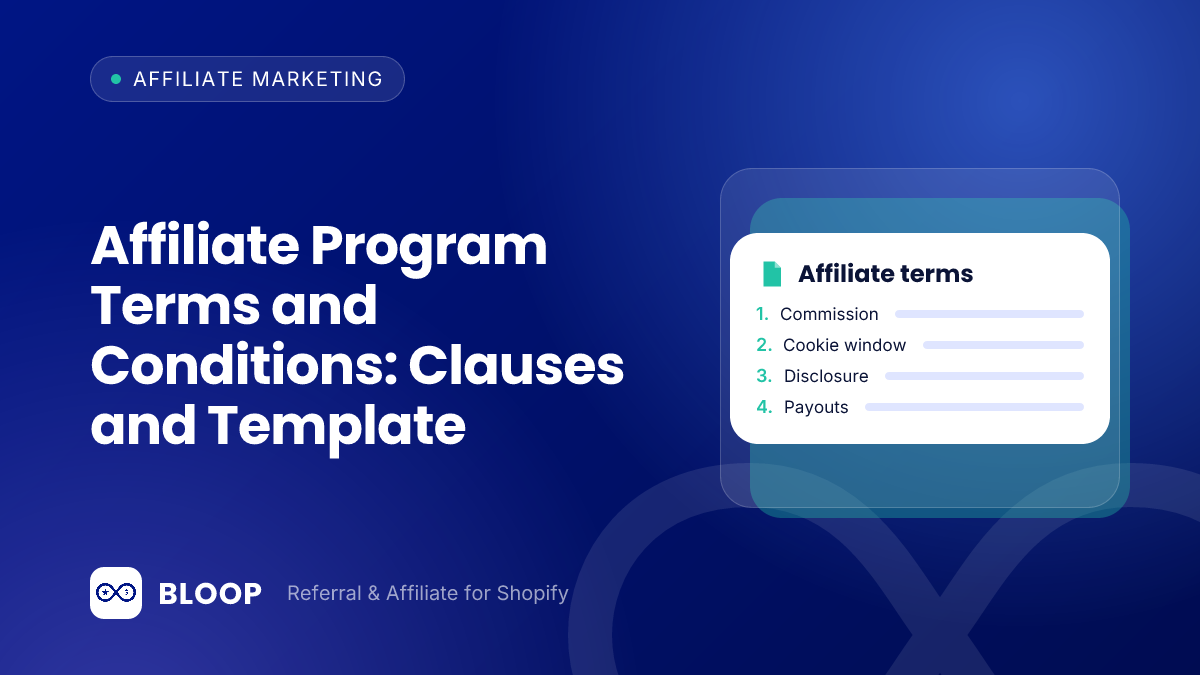
Affiliate program terms and conditions are the written agreement that tells affiliates how you track sales, what you pay, when you pay it, which promotion methods are banned and when you can end the relationship. For a Shopify store, a good one covers eight things: commission rate and base, attribution window, payment timing, refunds, prohibited methods, disclosure, self-referral and termination.
This guide goes clause by clause, with worked arithmetic for the numbers that cause disputes, a table of what real public programs say, the FTC disclosure rules, and a template you can copy. Rates and terms quoted from brand pages are “as of October 2026” and each is linked to the page where we read it. Most of this is about writing the agreement. For how to set the rates themselves, see our guide to affiliate commission rates for Shopify stores.
Key takeaways
- Write the commission base down, not just the rate. In the example below, the same 15% pays $17.70 or $15.00 on one order depending on whether shipping and tax are inside the base.
- Name the attribution window in days or hours. Public programs range from a 24-hour session (Amazon) to 180 days (HubSpot).
- Set a refund hold before commissions become payable, and say what happens to commission already paid.
- Ban the methods that steal credit: brand-keyword bidding, coupon sites, cookie stuffing and self-referral. Shopify’s affiliate terms prohibit the first three and exclude stores the affiliate owns.
- Require disclosure next to every affiliate link. The FTC says a connection that affects credibility “must be disclosed clearly and conspicuously”, and advertisers are expected to monitor their affiliates.
- Give yourself a termination right and a right to change terms, with notice. This is not legal advice; have a lawyer review the final text.
What affiliate terms and conditions do (and what they are not)
Your terms are a contract between your store and each affiliate. They answer the questions that otherwise become arguments by email: “Why was this order not credited?”, “Why was my commission reversed?”, “Can I run ads on your brand name?”
They are different from your customer-facing referral rules. A referral program rewards customers who share a link, usually with a coupon, store credit or a free product, and the rules can be a few lines on a landing page. An affiliate program pays outside publishers, creators and partners in cash on sales, so the stakes are higher: money moves, advertising happens in your name, and the FTC treats a paid link as a material connection. If you are unsure which model you run, read referral program vs affiliate program first.
The core clauses and what each one decides
The table lists the core clauses, what each settles, and what goes wrong when it is missing. Later sections cover the ones that cause the most disputes.
| Clause | What it decides | What goes wrong without it |
|---|---|---|
| Commission rate and base | Percentage or flat amount, and what it applies to (items, shipping, tax, discounts) | Disputes over a few dollars per order that add up to a few hundred |
| Attribution window | How long a click stays credited, and whether the last click wins | Credit claimed on orders placed weeks after a stale click |
| Payment terms | Minimum balance, schedule, method, who pays fees and taxes | Affiliates chasing you for payouts, forgotten small balances |
| Refunds and chargebacks | Hold period, reversal of commission, clawback of paid commission | Paying commission on orders that were returned |
| Prohibited methods | Brand bidding, coupon sites, cookie stuffing, spam, misleading claims | Affiliates capturing demand you already had |
| Disclosure | Required wording and placement of the affiliate relationship | FTC exposure for you and the affiliate |
| Self-referral | No commission on the affiliate’s own or household purchases | Affiliates earning a discount on their own orders |
| Termination | Who can end it, notice period, what happens to unpaid commission | Awkward exits with unclear final payments |
Commission: write down the base, not only the rate
“15% commission” is incomplete. Fifteen percent of what? BLOOP’s documentation says that by default, commission is calculated on what the customer paid: “product prices after discounts, plus shipping, taxes and tips.” The same page shows the cost of getting this wrong: a 15% rate on a base that wrongly includes $12 of shipping and $8 of tax overpays $3 on every order (15% × $20 = $3.00). You can exclude shipping, taxes, tips, discounts or specific products in the commission settings, so the terms should say which you chose.
Worked example: one order, three bases
Take a hypothetical order: items $120.00, a $20.00 discount code, $10.00 shipping and $8.00 tax, with a 15% rate. Each base produces a different payout.
| Base | Calculation | Base amount | Commission at 15% |
|---|---|---|---|
| Everything the customer paid | $120.00 – $20.00 + $10.00 + $8.00 | $118.00 | $118.00 × 0.15 = $17.70 |
| Items after discount (no shipping or tax) | $120.00 – $20.00 | $100.00 | $100.00 × 0.15 = $15.00 |
| Items before discount | $120.00 | $120.00 | $120.00 × 0.15 = $18.00 |
The gap between the first two rows is $17.70 – $15.00 = $2.70 per order. On 500 orders a year that is 500 × $2.70 = $1,350. Choose the base that matches how you calculate margin, then state it in one sentence, such as: “Commission is calculated on the order’s item subtotal after discounts, excluding shipping, taxes and tips.”
Attribution window: how long a click counts
The attribution window (cookie duration) decides who gets credit when a shopper clicks, leaves and buys later. Amazon’s program policies define a qualifying session as one ending when “24 hours elapse from that click”, with a separate rule that a customer who adds a product to the cart can still complete that order “no later than 89 days after their initial click-through”. HubSpot’s affiliate page advertises “30% recurring commission for up to one year and a 180-day cookie window”. BLOOP’s default is 30 days, and its docs suggest 7 to 14 days for impulse purchases and 60 to 90 days for considered ones, per the commission rules page.
Payment terms: threshold, schedule and the refund hold
A payment clause has four numbers: the minimum balance, the payment schedule, the refund hold and the currency or method. HubSpot’s page says “A minimum balance of $10 USD is required before withdrawals can be made”. Amazon’s policies say it will pay commission “approximately 60 days following the end of each calendar month”, and that it reserves the right to hold commission until the total reaches the minimum. Blendtec’s page says “Commission fees are paid on a monthly basis through AvantLink”.
If you pay affiliates yourself, remember that BLOOP records payouts but does not send money. Its payout guide states “Bloop never moves money itself”, so your terms should name the method you will use (bank transfer, PayPal or another) and who covers transfer fees. For the mechanics, see how to pay affiliates.
Worked example: when does the first payout happen?
Assume a 15% rate on an item base of $100 per order, a $50 minimum payout and a 30-day refund hold. Each order earns $100 × 0.15 = $15.00. Three orders give 3 × $15.00 = $45.00, which is below $50, so a fourth order is needed: 4 × $15.00 = $60.00. The hold means each commission becomes payable 30 days after its order.
| Order date (hypothetical) | Commission | Payable on (order date + 30 days) | Cumulative payable balance |
|---|---|---|---|
| October 3 | $15.00 | November 2 | $15.00 |
| October 10 | $15.00 | November 9 | $30.00 |
| October 17 | $15.00 | November 16 | $45.00 |
| October 24 | $15.00 | November 23 | $60.00 |
The balance first clears the $50 minimum on November 23, so a monthly payment run would send $60.00 at the next scheduled date after that. Putting this timeline in the terms answers the most common affiliate email (“where is my money?”) before it is sent. BLOOP’s payout guide recommends the same ordering: it suggests you “Pay after the refund window has passed” so you do not have to claw back commission on returns.
Refunds, chargebacks and clawbacks
Decide in advance what happens when an order is cancelled, refunded or charged back. Shopify’s terms say it will not pay fees on amounts refunded to merchants, on fraudulent sales or on revenue subject to chargebacks, and that if fees were paid in error it can reclaim them or set them off against future payments.
BLOOP treats an order as refunded once the refund covers almost all of it. Its reward-timing docs say that “Bloop treats an order as refunded when 90% or more of its item value has been refunded”, and its payout guide says it rejects commission on cancelled or fully refunded orders and recalculates an unpaid commission after a partial refund. Your terms can mirror this.
| Scenario (item value $100, 15% rate) | What happens | Commission |
|---|---|---|
| No refund | Commission stands | $100 × 0.15 = $15.00 |
| Partial refund of $40 (40%, below 90%) | Unpaid commission recalculated on the remaining $60 | $60 × 0.15 = $9.00 |
| Refund of $90 (90%) | Treated as refunded, commission rejected | $0.00 |
| Full refund of $100 | Commission rejected | $0.00 |
| Refund after commission was paid | Offset against the affiliate’s next payout | Next payout of $75.00 – $15.00 = $60.00 |
The last row is a drafting choice, not something every program does. If you want the right to offset, the terms must say so.
Prohibited methods: the clause that protects your margin
Most affiliate disputes are about credit, not rates. An affiliate who bids on your brand name in Google Ads, or posts your code on a coupon site, can collect a commission on a shopper who was already on the way to your store. Name these methods and state the penalty.
Shopify’s own affiliate agreement is a useful model because it is specific. Its section on unauthorized activities says an affiliate will not “promote or advertise Shopify or Shopify Related Entities on coupon, deal, or discount sites”, will not use its link directly in pay-per-click advertising, will not purchase search keywords or domain names using Shopify trademarks, and will not create sub-affiliate networks without express written permission. Amazon’s policies similarly say affiliates “will not bid on or purchase keywords, search terms, or other identifiers” that include Amazon’s trademarks. HubSpot’s agreement bans cookie stuffing and pop-ups and says an affiliate “will not use your own Affiliate Link to purchase HubSpot products for yourself”.
| Prohibited method | Why it matters | Where a real program says it |
|---|---|---|
| Brand-keyword bidding | Captures people already searching for you | Shopify (7.1.3), Amazon policies |
| Coupon, deal and discount sites | Intercepts shoppers at checkout | Shopify (7.1.1) |
| Affiliate link directly in paid ads | Lets affiliates outbid you on your own terms | Shopify (7.1.2) |
| Sub-affiliate networks without permission | You lose control of who promotes you | Shopify (7.1.4) |
| Cookie stuffing, false or misleading links | Creates credit without a real click | Shopify (7.1.5), HubSpot |
| Self-referral | Turns the affiliate rate into a personal discount | HubSpot; Shopify (6.2, stores the affiliate owns) |
What would brand bidding cost you?
Suppose an affiliate runs ads on your brand name and receives 200 orders a month at an item base of $100 and a 15% rate. Commission is 200 × $100 × 0.15 = $3,000. If some of those buyers would have bought anyway, that share is wasted spend.
| Share who would have bought anyway | Wasted orders (of 200) | Wasted commission |
|---|---|---|
| 40% | 200 × 0.40 = 80 | 80 × $15.00 = $1,200 |
| 60% | 200 × 0.60 = 120 | 120 × $15.00 = $1,800 |
| 80% | 200 × 0.80 = 160 | 160 × $15.00 = $2,400 |
The shares are hypothetical; your own branded-search data tells you the real one. Related problems are self-referral and fraud, covered in self-referral and affiliate fraud.
FTC disclosure rules your terms should pass on
In the US, an affiliate who earns money from a link has a “material connection” with you. The FTC’s Endorsement Guides, 16 CFR 255.5, say that when a connection “might materially affect the weight or credibility of the endorsement, and that connection is not reasonably expected by the audience, such connection must be disclosed clearly and conspicuously.” For website owners, the FTC’s Q&A says “You should disclose your relationship to the retailer clearly and conspicuously on your site, so readers can decide how much weight to give your endorsement.”
Placement matters. The FTC’s influencer guidance says “The disclosure should be placed with the endorsement message itself.” On wording, the Q&A says that starting a post with “Ad:” or “Paid ad” or “#ad” or “Advertising:” or “Advertisement” would likely be effective. Amazon requires a specific sentence from its associates: “As an Amazon Associate I earn from qualifying purchases.” Shopify’s terms explain the principle in its own contract, saying compliance requires that the affiliate clearly and conspicuously disclose that it is being compensated.
Your responsibility as the brand
Disclosure is not only the affiliate’s problem. The Endorsement Guides say that “Advertisers are subject to liability for misleading or unsubstantiated statements made through endorsements or for failing to disclose unexpected material connections between themselves and their endorsers.” The same section lists steps advertisers should take, including to “Monitor their endorsers’ compliance”, and the FTC’s Q&A says “Advertisers need to have reasonable programs in place to train and monitor members of their network.”
In practice: require disclosure next to every link, give a sample line, reserve the right to remove non-compliant affiliates, and spot-check affiliate pages on a schedule.
Real programs compared: what public terms say
The table compares three agreements that are published in full. All three were read in October 2026, and they show how much room there is in each clause.
| Clause | Amazon Associates | Shopify Affiliate Program | HubSpot Affiliate Program |
|---|---|---|---|
| Attribution | 24-hour session; 89 days for cart orders | Affiliate is credited only for merchants who access Shopify from their link | 180-day cookie window (program page) |
| Payment | About 60 days after month end, with a minimum balance | Paid via Impact; may be withheld during fraud or risk review | Minimum balance of $10 USD for withdrawals |
| Coupon sites | Offering customers incentives is restricted | Prohibited | Not found in the pages read |
| Brand-keyword bidding | Prohibited for Amazon trademarks | Prohibited | Ads that compete with HubSpot’s own advertising are prohibited |
| Termination | Either party may end it | Any party may end it with immediate effect | 15 days written notice from either side |
The termination row is worth reading closely. Shopify’s agreement says “any Party may terminate this Agreement at any time, with or without cause, effective immediately upon notice”, while HubSpot’s says “Both you and we may terminate this Agreement on fifteen (15) days written notice”. A notice period is friendlier to affiliates; an immediate right protects you faster against fraud. Amazon keeps the right to change its rules: “We reserve the right to modify any of the terms and conditions contained in this Agreement at any time and in our sole discretion”.
What consumer-brand pages publish
Direct-to-consumer brands usually publish a short summary and send applicants to a network, so the full terms sit elsewhere. These are the figures and details visible on each brand’s own page in October 2026.
| Brand | Commission shown | Other terms on the page | Where full terms live |
|---|---|---|---|
| Blendtec | 8% | 45-day cookie; monthly payment through AvantLink | AvantLink program page |
| Stanley 1913 | 10% | 30-day cookies | AvantLink program page |
| Beardbrand | 15% | 30-day cookie duration | AvantLink; email for details |
| Magic Spoon | 20% | Minimum of about 10 cases of cereal or around $400 in revenue a month | Impact |
| Allbirds | “commission on all net sales” (rate not shown) | Separate paths for social ambassadors and media publications | Superfiliate and Impact |
Two lessons follow. First, the rate and the window are the only terms most brands put on the public page, so your own page can stand out by also stating the payment schedule, the refund hold and the prohibited methods.
A copyable affiliate terms template
Replace every [PLACEHOLDER]. This is a drafting aid for small Shopify stores and not legal advice. Terms law varies by country and state, so have a qualified lawyer review the final version.
1. Parties and eligibility. These terms are between [STORE LEGAL NAME] (“we”) and the person or business that applies to join our affiliate program (“you”). We may approve or reject any application. You must be at least [18] years old, hold one account, and give accurate information about your website or social profiles.
2. Commission. You earn [15]% of the [item subtotal after discounts, excluding shipping, taxes and tips] of each qualifying order placed by a customer who arrived through your tracked link or code. Commission applies to [first orders only / all orders within [NUMBER] days]. Commission per customer is capped at [CAP, or delete this sentence].
3. Attribution. A click on your link is credited for [30] days. If a customer uses more than one affiliate link or code, the [last eligible click] receives credit. Orders are credited only when placed on [STORE DOMAIN].
4. Approval, refunds and returns. Commission becomes payable [30] days after the order date, provided the order has not been cancelled, refunded, charged back or found to be fraudulent. If an order is cancelled or [90]% or more of its item value is refunded, no commission is payable. If a smaller refund is issued before payment, we will recalculate the commission on the remaining value. If a refund or chargeback occurs after payment, we may deduct the amount from future payments.
5. Payment. We pay approved commission once your balance reaches [$50], on [the 15th of each month], by [PAYMENT METHOD] in [CURRENCY]. You are responsible for any taxes on your earnings and for providing tax information we reasonably request. We may withhold payment while we investigate suspected fraud or breach of these terms.
6. Prohibited methods. You may not: (a) bid on or buy search keywords, domains or social handles that contain [BRAND NAME] or close variations; (b) promote us on coupon, deal or cash-back sites, or publish codes on public coupon listings, unless we approve in writing; (c) use your link directly in paid advertising without written approval; (d) use cookie stuffing, pop-ups, forced clicks, bots or misleading links; (e) place orders for yourself or people in your household using your own link or code; (f) recruit sub-affiliates; (g) send unsolicited email or spam.
7. Disclosure. You must clearly and conspicuously disclose your financial relationship with us next to every affiliate link or code, in the same place as the recommendation and in the same language. For example: “[SAMPLE DISCLOSURE, e.g. I earn a commission if you buy through this link.]” You must follow applicable endorsement laws, including the US FTC Endorsement Guides, and we may remove you if your pages are not compliant.
8. Termination. Either of us may end this agreement by [15] days’ written notice. We may end it immediately if you breach these terms. After termination, we will pay approved commission earned before the termination date, minus any amounts we are entitled to withhold or recover under these terms.
9. Changes. We may update these terms or the commission rate by emailing the address on your account at least [14] days before the change takes effect. Orders placed before the effective date follow the old terms.
10. Liability and law. The program is provided as is, to the extent allowed by law. These terms are governed by the laws of [JURISDICTION]. Contact: [EMAIL].
How to publish and run your terms in 6 steps
- Draft from the template, then cut anything you will not enforce.
- Match the settings to the text. In the app, set the commission rate, the base exclusions, the cookie duration and any cap so they say the same thing as sections 2 and 3.
- Publish the terms at a stable URL on your store, such as [STORE]/pages/affiliate-terms, and link it from the signup page and from approval emails.
- Approve applicants manually at first. Review each website or channel against section 6 before you send tracking links, in the way Shopify reviews each application.
- Record every payout the moment you send it. BLOOP’s payout guide says the Pending view “is only trustworthy if you record payouts the moment you send them”.
- Set a calendar reminder to spot-check affiliate pages each month for disclosure and prohibited methods, and keep dated notes.
Before you roll out, you can estimate what the program will cost with the free referral ROI calculator and set the commission to a level your margin supports.
Where BLOOP fits
BLOOP is a Shopify app for referral and affiliate programs. The Free plan costs $0 and includes 10 referee orders and 10 affiliate orders, and the Premium plan is $59.90 per month with unlimited orders, with a 7-day free trial. More than 2,000 Shopify merchants use it, and it has 190+ ratings on the Shopify App Store. You set the commission rate, cookie window and exclusions to match your terms, and BLOOP tracks the orders and keeps the pending and paid balances; you send the money. To start, use the free plan or the 7-day trial.
Frequently Asked Questions
Do I need written terms for a small affiliate program?
Yes. Even five affiliates can disagree about what counts as a sale or when they get paid. A one-page agreement that covers commission base, attribution, payment, refunds, prohibited methods and disclosure prevents most of those disputes.
Should I ban coupon sites in my affiliate program?
Many programs do. Shopify’s terms prohibit promotion on coupon, deal and discount sites. The trade-off is that coupon sites can convert shoppers who are already at checkout, so decide based on your margin and whether you want to pay commission on those sales. If you allow them, restrict them to codes you supply.
How long should the cookie window be?
Match it to how long your customers take to decide. BLOOP defaults to 30 days and its docs suggest 7 to 14 days for impulse purchases and 60 to 90 days for considered ones. Public programs vary from Amazon’s 24-hour session to HubSpot’s 180-day window, so there is no single right answer.
Can I refuse to pay commission on refunded orders?
Yes, if your terms say so. State the refund hold, say what happens to partial refunds, and say whether you can deduct from future payments if a refund occurs after payout. Shopify’s terms say it will not pay fees on refunded amounts, which is a useful model for your own wording.
Do affiliates have to disclose that they earn commission?
In the US, yes, when the connection is not reasonably expected by the audience, under the FTC’s Endorsement Guides. The disclosure should be clear and placed with the recommendation. Your terms should require it and you should check that affiliates follow it, because the guides also address the advertiser’s responsibility.