For most Shopify stores, the best setup is a discount code for the new customer and store credit for the person who referred them. A discount code lowers your margin on one order that would not have happened otherwise, while store credit costs nothing until the referrer comes back and spends it, but it leaves a balance on their account and has stricter checkout rules.
This post is a focused comparison of those two reward types, built on Shopify’s help pages, peer-reviewed research and the public referral pages of three retailers, all checked in October 2026. If you are still deciding between incentive types in general (cash, free products, tiers), start with our guide to the most effective referral incentives or the list of referral incentive ideas, then come back here once you have narrowed it to credit versus codes.
Key takeaways
- Shopify applies store credit in full or not at all, and the customer must be signed in. A discount code has no such limits, but it is governed by discount combination settings.
- With a $60 order, $30 product cost and a $10 referrer reward, a redeemed reward only pays for itself if at least one in three redeemed orders is a sale you would not have made anyway.
- Research supports rewarding both sides and sizing the reward so it is not trivially small, and it warns that money rewards can work worse for weaker brands.
- Real retailers split too: Credo Beauty uses single-use codes, LOOKFANTASTIC uses credit that expires after 12 months, and RMRC uses a percentage-based store credit.
Store credit vs discount code: the short comparison
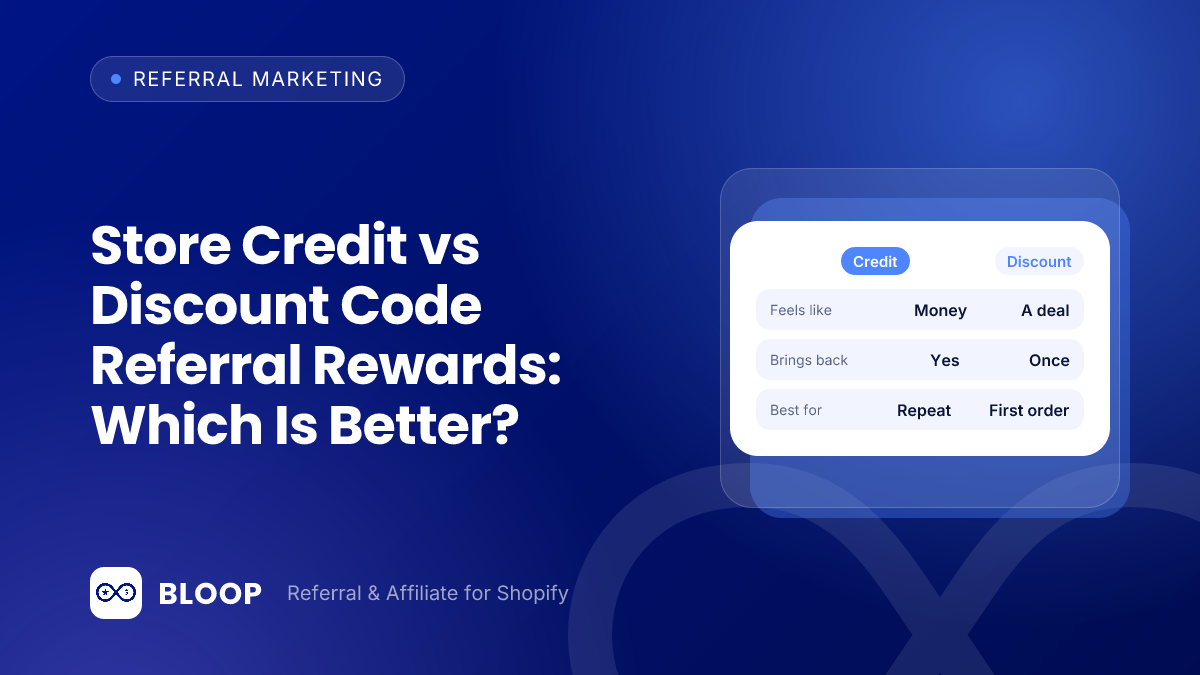
| Factor | Discount code | Store credit |
|---|---|---|
| Best for | Convincing a new customer to make a first order | Thanking the referrer and bringing them back |
| When it costs you | At checkout, on the order that uses it | When the balance is redeemed on a later order |
| If it is never used | Costs nothing | Costs nothing, but the balance stays on the account |
| Outstanding balance | None (an unused code is just a code) | Yes, until spent or expired |
| Customer must be signed in | No | Yes, to use it at checkout |
| Partial use at checkout | Not applicable (fixed or percentage off) | No, the full available amount is applied |
| Pull toward a repeat purchase | Weak, it is spent on the first order | Strong, it can only be spent in your store |
| Stacking with other promotions | Governed by Shopify discount combination settings | Not a discount, it is a payment method |
How each reward works on Shopify
Discount codes
Shopify sorts every discount into one of three classes: product discounts, order discounts and shipping discounts. According to Shopify’s discount combinations documentation, you choose which classes a given discount may combine with. A few details matter for referral rewards:
- Customers can use a maximum of 5 product or order discount codes and 1 shipping discount code on the same order.
- If two or more percentage-off order discounts apply to the same order, both percentages are calculated on the original subtotal.
- You can have a maximum of 25 active automatic discounts, and that total includes app-based discounts.
In Shopify’s own example, a 10% order discount and a 20% order discount on a $100 order are both calculated on the original subtotal, so the total comes to $70. So two 10% order discounts do not compound to 19%, they add up to 20% of the original subtotal: $12 off a $60 cart, not $11.40. If your referral code is allowed to combine with a sitewide sale, the real cost of a referral can be much higher than the number on the reward card.
Store credit
Store credit is a balance attached to a customer account. Shopify’s store credit help page describes the rules that affect a referral program:
- Customers can use it as a payment method only when signed in through customer accounts or using Shop Pay.
- Only the full store credit amount can be applied as a payment method, and customers cannot select a partial amount.
- Shopify says store credit expiration is set per issuance, so you choose an expiry date or no expiry each time you issue it. Unlike gift cards, there is no store-wide default expiry setting.
- For Shopify stores created on or after May 12, 2025, orders that include store credit as a payment method are charged third-party transaction fees on the order amount paid with store credit, and the fee is waived on Shopify Plus with Shopify Payments activated.
- Shopify only lets you issue store credit amounting to less than $15,000 USD on a single customer account.
The transaction fee line is worth checking against your own setup. If your store falls under it, a credit-funded order carries a processing cost that a plain discount code does not, so add it to your cost per referral. Check the rate that applies to your own plan and payment setup.
Gift cards as a third option
Gift cards behave differently from store credit. Shopify’s gift card settings page is explicit. By default Shopify gift cards do not expire, and if you set an expiry date the cards expire after five years unless you change the length. Its redemption page is just as clear. The balance on a gift card can be spent on more than one order, and gift cards can be used together with discount codes. We cover that route in our guide to a gift card referral program.
What BLOOP supports
BLOOP, a Shopify app for referral and affiliate programs, offers both reward types, and the rewards documentation splits them by side of the referral. A referrer (the existing customer) can earn a discount coupon, store credit, a free product, cash or a custom reward. A referee (the new customer) can receive a discount coupon or a free product, and only first-time customers can claim it. Store credit is applied to the referrer’s account automatically through Shopify, while cash is tracked in BLOOP but paid by you. Store credit is not a referee option, which fits the split recommended here anyway.
Margin impact: a worked comparison
The numbers below are a hypothetical example, not benchmarks. Assume an average order value (AOV) of $60 and a product cost of $30, so the gross profit on a full-price order is $60 – $30 = $30 (a 50% gross margin). Payment processing and shipping are ignored to keep the arithmetic readable.
| Scenario | Calculation | Gross profit |
|---|---|---|
| Full-price order, no reward | $60 – $30 | $30 |
| Referee uses a $10 discount code | ($60 – $10) – $30 | $20 |
| Referrer later spends $10 store credit on a $60 order | ($60 – $10) – $30 | $20 |
| Both rewards used (first order plus the referrer’s later order) | $20 + $20, versus $30 + $30 at full price | $40 total, $20 below full price |
At face value, $10 of credit and a $10 discount cost you the same: $10 of revenue on the order where they are used. The differences come from when and whether that happens.
- The discount is paid by an order you might not have won. The referee was not going to buy at full price, so the $10 buys a customer. You are comparing $20 of profit with $0, not with $30.
- The credit is paid by an order you may have won anyway. If the referrer was likely to buy again regardless, the credit is a discount on a sale you would have made. That is why we suggest sizing credit modestly.
- Credit only costs money if it is redeemed. Issue $10 of credit and the expected cost is $10 multiplied by the share that gets spent: $10 at 100% redemption, $5 at 50%, $0 at 0%.
BLOOP’s documentation gives a simple guardrail: add the referrer and referee rewards together and keep that combined cost below your profit on a referred order. In the example, $10 + $10 = $20, which is below the $30 full-price profit, so a $10 and $10 structure passes. A $20 and $20 structure would not ($40 against $30). Once the program is live, watch your referral conversion rate to see whether the reward is doing its job.
The break-even question for the referrer reward
The referrer reward is the harder one to judge, because the order that redeems it may or may not be new business. Call the share of redeemed orders that would not have happened without the reward x. An incremental sale earns $20 ($60 order, minus the $10 reward, minus $30 cost) instead of nothing, so it adds $20. A non-incremental sale would have earned $30 and now earns $20, so it loses $10. The net effect per redeemed reward is 20x – 10(1 – x), which simplifies to 30x – 10 and equals zero when x = 1/3.
| Share of redeemed orders that are new business | Calculation | Net profit per redeemed $10 reward |
|---|---|---|
| 20% | 0.2 x $20 – 0.8 x $10 | -$4.00 |
| 33.3% (break-even) | 0.333 x $20 – 0.667 x $10 | $0.00 |
| 50% | 0.5 x $20 – 0.5 x $10 | +$5.00 |
| 75% | 0.75 x $20 – 0.25 x $10 | +$12.50 |
A larger reward raises the bar. At a $20 reward on the same $60 order, an incremental sale earns $10 and a non-incremental one loses $20, so the break-even share rises to two thirds (0.667 x $10 = $6.67 against 0.333 x $20 = $6.67).
A 12-month ledger for 100 referrals
To see the timing difference, take 100 successful referrals over one year, with a $10 discount code for every referee and a $10 reward for every referrer. The assumptions are placeholders you should replace with your own data:
- Same $60 AOV and $30 product cost. The 100 referees would not have bought otherwise, so each first order earns ($60 – $10) – $30 = $20.
- 35% of referrer codes are redeemed within 12 months, and 55% of referrer credits are. Credit sits in a signed-in account, so we assume it gets used more often than a code in an email. This is an assumption, not a measured figure.
- Half of redeemed referrer orders are new business, so each redemption nets +$5 (from the table above).
- For credit, an illustrative 2% third-party transaction fee applies, which is $10 x 2% = $0.20 per redemption. Your fee depends on your plan and may be zero.
| Line | Referrer gets a code | Referrer gets store credit |
|---|---|---|
| Referee side: 100 first orders | 100 x $20 = $2,000 | 100 x $20 = $2,000 |
| Referrer rewards issued (face value) | 100 x $10 = $1,000 | 100 x $10 = $1,000 |
| Rewards redeemed | 35 | 55 |
| Net profit from redemptions | 35 x $5 = $175 | 55 x $5 = $275 |
| Illustrative transaction fees | $0 | 55 x $0.20 = $11 |
| Total gross profit after rewards | $2,000 + $175 = $2,175 | $2,000 + $275 – $11 = $2,264 |
| Reward cost actually paid (referee discounts plus redeemed referrer rewards) | $1,000 + 35 x $10 = $1,350 | $1,000 + 55 x $10 = $1,550, plus $11 fees |
| Reward cost per referred customer | $1,350 / 100 = $13.50 | $1,561 / 100 = $15.61 |
| Unspent value outstanding at month 12 | None on the books | 45 x $10 = $450 of balances on customer accounts |
Under these assumptions, credit earns $89 more in total ($2,264 – $2,175) even though it costs $2.11 more per referred customer ($15.61 – $13.50), because the extra redemptions are profitable at a 50% incremental share. Change one input and the answer flips. If only 25% of redeemed orders are new business, each redemption nets 0.25 x $20 – 0.75 x $10 = -$2.50, so the code scenario loses 35 x $2.50 = $87.50 and the credit scenario loses 55 x $2.50 = $137.50 before fees. A reward that gets used more is then a more expensive reward.
Redemption alone also moves the cost: 30 of 100 credits redeemed cost $300 and 100 redeemed cost $1,000. To rebuild this with your own figures, follow our post on referral program ROI.
Liability and breakage
A discount code that nobody uses leaves no trace on your books. Store credit does: it is a balance you have promised to honor in product. Liability is the total unspent credit sitting on customer accounts, which is $450 in the ledger above. Ask your accountant how outstanding credit should be recorded for your business, because that varies by region and is outside what this post can answer.
Breakage is the share of issued value that is never redeemed. The term comes from gift card accounting. An estimated $1.18 billion worth of gift cards sold in 2013 were expected to never be redeemed, according to CEB TowerGroup. The figure comes from a Journal of Accountancy article on gift card revenue recognition. In the Journal of Accountancy example, a company that sells $2,400 of gift cards expects redemptions of $2,160 and estimated breakage of $240. Those are 90% and 10% of the $2,400. Under the proportionate method it books breakage as redemptions happen, so when $162 of the expected $2,160 has been redeemed (7.5%), it books 7.5% of $240, which is $18.
Treat that as vocabulary, not a template: gift cards are bought with cash, while referral credit is given away, so the accounting can differ. The commercial point carries over. Breakage makes credit cheaper than its face value, but do not build the program on it, because a reward that quietly expires teaches referrers not to bother again.
Expiry also meets regulation. The federal gift card rule in 12 CFR 1005.20 sets an expiration date of at least five years after issuance for covered gift certificates, and it treats a loyalty, award, or promotional gift card differently. Whether a given referral credit is covered depends on how it is issued and described, and state or country rules may differ, so confirm with a lawyer before you pick a short expiry.
Reversals matter too. In BLOOP, a reward is revoked by default when the referred order is canceled or refunded, and an order counts as refunded when 90% or more of its item value has been refunded (shipping is not counted). For store credit, revocation deducts up to the reward amount from whatever store credit the referrer still has, so credit already spent is not clawed back. Rewards are earned when the order is Paid by default (or Fulfilled if you choose), and the review period defaults to 6 hours, so for high-value rewards a longer period gives returns time to surface. Pair this with protection against referral fraud and self-referral, since credit that is easy to farm becomes a real liability.
What the research says about reward framing
No study we found tests “store credit versus discount code” head to head on a Shopify store, so be wary of anyone who quotes a clean percentage for it. The peer-reviewed work that does exist speaks to neighboring questions.
Are referred customers worth the reward? In a 2011 Journal of Marketing paper, Schmitt, Skiera and Van den Bulte report the following. The authors tracked approximately 10,000 customers of a leading German bank for almost three years and found that the average value of a referred customer was at least 16% higher than that of a nonreferred customer with similar demographics and time of acquisition. The margin advantage eroded over time, while the retention advantage persisted. In that bank’s program, an existing customer who brought in a new customer received a 25 euro voucher usable at several German retailers, and the paper puts the lifetime value of a nonreferred customer at 253 euros over six years. The value gap of about 40 euros is 15.8% of 253 euros. It was a bank and a voucher for other retailers, so the study supports paying something for referrals, not a reward format.
Does rewarding the referrer change their behavior? In the field experiment reported by Garnefeld, Eggert, Helm and Tax, recommenders’ defection rates fell from 19% to 7% within a year and their average monthly revenue grew by 11.4% compared with a matched control group. The paper appeared in the Journal of Marketing in 2013, concerns a telecommunications provider, and does not compare reward types, but it fits the idea that a referral changes how the referrer relates to the brand.
How are money rewards perceived? Jin and Huang found in four experiments that monetary rewards led to less referral generation and acceptance than in-kind rewards, especially for weak brands, but that money performed equally well when the reward was sufficiently large and even better when both the recommender and the receiver were rewarded. The paper is from the International Journal of Research in Marketing (2014). Verlegh, Ryu, Tuk and Feick propose that rewards can adversely affect how receivers respond to a referral because receivers infer ulterior motives, and that rewarding both the referral provider and receiver, or providing symbolic rewards, can eliminate the negative effect. Their paper is from the Journal of the Academy of Marketing Science (2013).
Our reading, not a finding: the two-sided structure here matches the repeated result that rewarding both parties helps. Store credit is money-like rather than in-kind, so keep the weak-brand warning in mind if your brand is new. BLOOP also supports a free product as a reward, the closest in-kind option and worth testing against credit.
What real brands offer (as of October 2026)
Three retailers publish their referral terms openly. We opened each page in October 2026, and rates and terms change, so check the linked pages before copying anything.
| Retailer | Referrer reward | Friend reward | Notable terms |
|---|---|---|---|
| Credo Beauty | Reward code, $10 off a future order of $50 or more | $10 off a first order of $50 or more | Codes cannot be stacked, unused value is forfeited after redemption |
| LOOKFANTASTIC | 10 pounds of credit | 10 pounds off selected products on a first order of 25 pounds or more | Credit expires after 12 months |
| RMRC | Store credit of 2% of the order subtotal after discounts | Not compared here | Credit removed if the order is canceled or returned |
As of October 2026, Credo Beauty gives the referrer a reward code for $10 off a future merchandise order of $50 or more and gives the referred customer $10 off a first merchandise order totaling $50 or more. Its terms say that once any part of a code is redeemed, the unused value is exhausted and does not roll over. The $10 is 20% of the $50 minimum, and there is no balance to carry.
As of October 2026, LOOKFANTASTIC gives the referrer 10 pounds of credit to spend on the site, states that rewarded credit expires after 12 months, and gives the friend 10 pounds off selected products on a first order of 25 pounds or more. This is the split recommended in this post, with a 12-month expiry. The friend’s 10 pounds is 40% of the 25-pound minimum.
As of October 2026, RMRC gives the referrer a store credit worth 2% of the product total, and its own example is a $400 purchase that earns the referrer an $8 store credit. A percentage reward scales with the basket, though 2% of a $60 order is only $1.20. None of these pages publishes redemption results, so they show how retailers structure an offer, not which structure wins.
Repeat purchase: where store credit earns its place
A discount code given to the referee is spent immediately, on the order that created the customer. It does nothing to bring the referrer back. Store credit does, because it can only be spent with you and sits in an account the customer has to sign in to use. We do not have a universal conversion figure to quote, so measure it yourself: compare the second-order rate of referrers who received credit with those who received a code or no reward.
Credit fits categories with a natural reorder cycle (beauty, supplements, coffee, pet food). For one-off purchases such as furniture, credit may sit unused, and a discount code may do better.
How to choose in six steps
- Calculate the gross profit on your average order (price minus product cost, and shipping if you absorb it), which is $30 in the running example.
- Set the combined referrer and referee reward below that profit, as in the $10 and $10 example.
- Give the referee a discount code, since they need a reason to make the first purchase. Add a minimum order value if your margin is thin, as Credo Beauty and LOOKFANTASTIC do.
- Give the referrer store credit if customers typically reorder within a few months, or a discount code if they usually buy once. Pick an expiry that matches your reorder cycle, after checking the rules where you sell.
- Test the checkout with your existing promotions: a sitewide percentage sale, an automatic discount and a free shipping code. Read the final total each time.
- Track redemption and second-order rates for 60 to 90 days, and compare the break-even share (one third in the example) with how many redeemed orders look like new business before changing anything.
Common mistakes
- Letting the referral code stack with everything. Check combination settings, especially percentage-off order discounts.
- Setting a long unlimited discount on subscriptions. BLOOP’s documentation warns that a recurring cycle limit of 0 means the discount applies to every renewal forever, which is rarely intended.
- Skipping the referee reward. BLOOP’s documentation says two-sided rewards work better than referrer-only ones, so always give the referee something too.
If you want to run this setup without building it by hand, BLOOP’s referral program app for Shopify supports discount and store credit rewards on its Free plan (which includes 10 referee orders and 10 affiliate orders), and the pricing page lists the Premium plan, $59.90 per month with unlimited orders and a 7-day free trial. More than 2,000 Shopify merchants use BLOOP, and it has 190+ ratings on the Shopify App Store.
Frequently Asked Questions
Is store credit or a discount code better for referral rewards?
Neither wins everywhere. A discount code works best for the new customer because it pushes the first purchase, and store credit works best for the referrer because it brings them back to spend it. Whichever you choose, keep the combined referrer and referee reward below your profit on a referred order.
Does store credit expire on Shopify?
Only if you set an expiry date when you issue it. Shopify has no store-wide default expiry for store credit, so each issuance carries its own setting. Gift cards differ: they do not expire by default, and a merchant-set expiry defaults to five years.
Can a customer combine store credit with a discount code?
Shopify treats store credit as a payment method rather than a discount, so discount combination settings do not control it. Confirm the exact behavior with a test order in your own store, because checkout details can change. The customer must be signed in, and the full credit amount is applied.
Can I offer store credit to the new customer instead?
In BLOOP the referee reward options are a discount coupon or a free product, and store credit is available as a referrer reward. A friend-facing discount can also carry a minimum order value, as the Credo Beauty and LOOKFANTASTIC pages show.
What happens to the reward if the referred order is refunded?
In BLOOP, rewards are revoked by default when the referred order is canceled or refunded, and an order counts as refunded when 90% or more of its item value has been refunded. For store credit, BLOOP deducts up to the reward amount from whatever credit the referrer still has, so credit that was already spent cannot be clawed back.