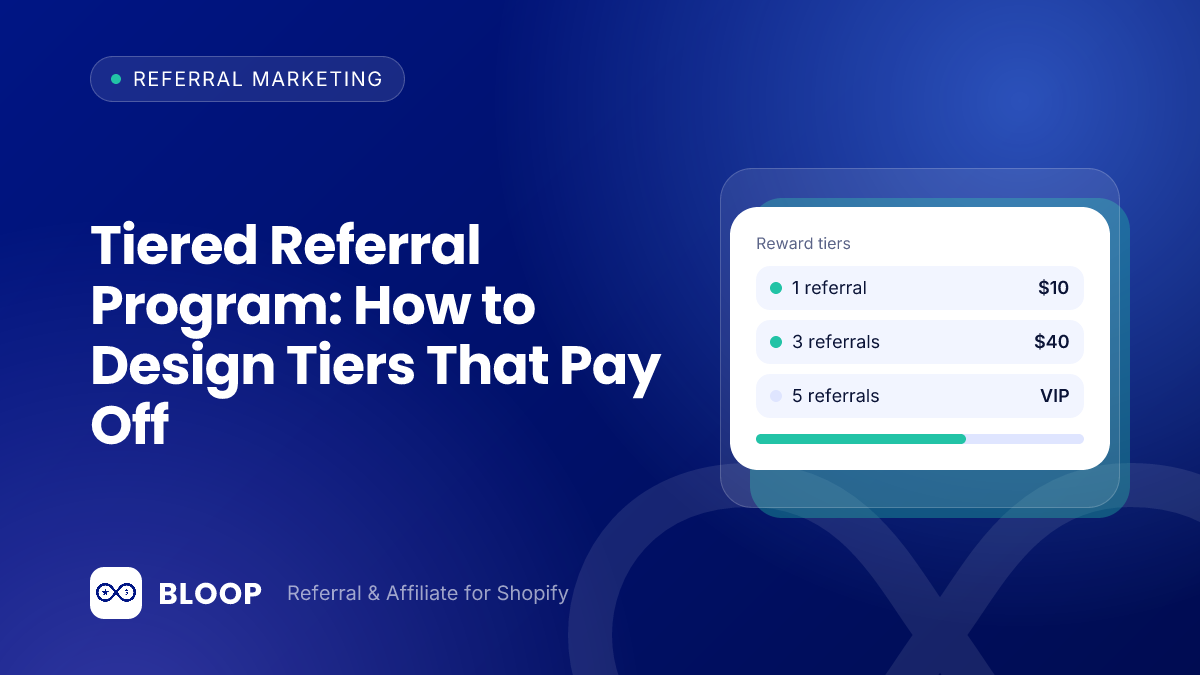
A tiered referral program pays a referrer more as their number of successful referrals grows: for example $5 for each of the first two friends, $10 for friends three to five, and $20 from the sixth friend on. It works when the top tiers are priced from your margin per new customer and the first tier is still worth earning. Keep three or fewer tiers, count only completed purchases, and check the cost per acquired customer at every tier before you launch.
This guide explains how tiers work, how to choose thresholds, and how to run the math for each tier and for the whole program. It also covers the pitfalls, the tax and disclosure basics for paying rewards, and how BLOOP’s FlexiTiers feature handles it on Shopify. The numbers in the tables are illustrations built on stated assumptions, not benchmarks.
Key takeaways
- A tier changes the referrer’s reward, not the friend’s. Reward the person who keeps sharing, and keep the friend’s welcome offer the same at every level.
- Start the math from contribution per order. With $50 left per order before any referral cost and an $8 friend discount, a $20 top-tier reward leaves $22 on the first order.
- Incrementality decides the top tier. If only 60% of referred buyers would not have bought anyway, a $20 tier earns about $2 per referral, while a $5 tier earns about $17.
- Keep it explainable in one sentence. BLOOP’s documentation says three well-spaced tiers a referrer can explain to a friend beat five granular ones that need a table to understand.
- Count purchases, never sign-ups. Tiers that pay for recruiting rather than sales drift toward the pattern regulators flag.
What a tiered referral program is
In a flat referral program every successful referral earns the same reward: $10 for the first friend and $10 for the twentieth. In a tiered program, the reward depends on how many successful referrals that person has already made. Each tier covers a range of referral counts, and moving into the next range changes what the next referral pays.
BLOOP describes the mechanism in one line: each tier covers a range of successful referral counts, and when a referrer hits their Nth referral, BLOOP issues the reward for whichever tier N falls into. The referee side stays constant.
This is different from a loyalty tier such as Silver or Gold, which usually depends on a customer’s own spending. In a referral ladder the unit is the number of friends who bought. If you want the design thinking behind step-based rewards in general, we cover it in our guide to multi-step referral rewards. This page focuses on the numbers: what each tier costs and when it pays back.
Why bother with tiers
The reasoning is about concentration. If a small group of enthusiastic customers produces a large share of your referrals (check your own data), a flat reward pays them the same per friend as someone who shared once. A ladder lets you pay more at the point where the effort is highest and the relationship most valuable. A Journal of Marketing study of about 10,000 customers of a German bank (Schmitt, Skiera and Van den Bulte) found that referred customers had a higher retention rate and a value “at least 16% higher” than similar non-referred customers, although their higher contribution margin eroded over time and the advantage varied by segment. That is a reason to value the friends your best advocates bring, though it does not tell you what any one tier should pay. Your own margin does.
Tiers also give people a visible next goal. In BLOOP’s referral hub the referrer sees a tier timeline and what the next referral earns, so the next step is on screen rather than hidden in terms and conditions.
A caution from the research: Gershon, Cryder and John report, across two field experiments and a lab experiment, that “prosocial” (recipient-benefiting) referral incentives recruit more new customers than sender-benefiting ones. In practice, do not trade away the friend’s offer to pay for a richer ladder. Top-tier referrers can only climb if friends actually say yes.
Three ways to structure the ladder
| Structure | How it works | Good for | Watch out for |
|---|---|---|---|
| Tiers by referral count (cumulative) | The Nth successful referral pays the reward of the tier that N falls into | Programs with a few power advocates | Top tier can become the most expensive reward in the program |
| Milestone gaps | Tiers leave gaps so only the 1st, 5th and 10th referral pay | Gift-style rewards, free products | Referrals between milestones feel unrewarded |
| Looping tiers | After the last tier the sequence restarts at tier 1 | Recurring promotions with a repeating cycle | Referrers can run the cycle many times, so cost is open ended |
BLOOP’s FlexiTiers support all three through its “after the final tier” options, covered below. A fourth idea, tiering by the revenue a referrer’s friends spend, is common in affiliate programs and not how BLOOP’s referral tiers work, so we treat it separately in our upcoming affiliate guides.
How to design the tiers, step by step
Step 1: Find your contribution per order
Before you pick any reward, work out what a first order leaves after product cost, shipping, payment fees and any referral costs. The assumptions below are illustrative. Replace them with your own.
- Average order: $80.00
- Left after product cost, shipping and payment fees, before any referral cost: $50.00
- Friend’s welcome discount: 10% of the order, or $8.00
Total referral cost for one acquired customer is the referrer’s reward plus the friend’s discount. Everything you pay above $50.00 per first order loses money on that order.
Step 2: Price each tier
Here is a three-tier ladder using the same shape as the example in BLOOP’s documentation (the amounts follow that example: $5, $10, $20). The last two columns add the incrementality check: if only some referred buyers are truly new customers, you still pay the reward on all of them.
| Tier | Referral numbers | Referrer reward | Friend discount | Cost per acquired customer | Left from the $50 contribution | Break-even incremental share | Net per referral if 60% are incremental |
|---|---|---|---|---|---|---|---|
| 1 | 1 to 2 | $5 | $8 | $13 | $37 | 26% | $17 |
| 2 | 3 to 5 | $10 | $8 | $18 | $32 | 36% | $12 |
| 3 | 6 and up | $20 | $8 | $28 | $22 | 56% | $2 |
How to rebuild a row: tier 3 costs $20 + $8 = $28, so $50 – $28 = $22 is left. Break-even share is cost divided by contribution: $28 / $50 = 56%, meaning the tier only pays for itself on the first order if at least 56% of those buyers would not have purchased anyway. At 60% incremental, the contribution that counts is 0.6 x $50 = $30, and $30 – $28 = $2 per referral. For tier 1 the same math gives $30 – $13 = $17.
Two lessons. First, the top tier is where the risk lives, because it is the largest reward and the one that keeps paying under the default “keep last” setting. Second, the first-order view is conservative: repeat purchases from these customers improve every row, but do not count on them until you have your own repeat-rate data. Our referral program ROI guide shows how to bring repeat purchases into the calculation, and the free referral ROI calculator lets you enter your own figures.
Step 3: Set thresholds from your referrers’ behavior
Thresholds should be reachable but not trivial. If you have no data yet, start with a first tier that most active referrers can finish (one or two referrals), a middle tier that takes a real effort (three to five), and a top tier that only a small group reaches (six or more). After a quarter, look at the distribution of referrals per referrer and move the boundaries so that the top tier is reached by a small minority.
Step 4: Check the program-level cost
Tier math per referral is not the same as program cost, because referrers sit at different points on the ladder. Take 100 active referrers with this illustrative distribution and compare the ladder to a flat $10 reward.
| Referrer group | Referrers | Referrals each | Total referrals | Tiered reward each | Flat $10 each | Tiered total | Flat total |
|---|---|---|---|---|---|---|---|
| Shared once | 50 | 1 | 50 | $5 | $10 | $250 | $500 |
| Two referrals | 25 | 2 | 50 | $10 | $20 | $250 | $500 |
| Four referrals | 12 | 4 | 48 | $30 | $40 | $360 | $480 |
| Seven referrals | 8 | 7 | 56 | $80 | $70 | $640 | $560 |
| Twelve referrals | 5 | 12 | 60 | $180 | $120 | $900 | $600 |
| Total | 100 | 264 | $2,400 | $2,640 |
Check the rows: a referrer with four referrals earns 2 x $5 + 2 x $10 = $30; with seven, 2 x $5 + 3 x $10 + 2 x $20 = $80; with twelve, 2 x $5 + 3 x $10 + 7 x $20 = $180. Adding the $8 friend discount on all 264 referrals ($2,112) gives a total cost of $4,512 for the ladder, or $17.09 per acquired customer, against $4,752 and $18.00 for the flat $10 reward.
Read the table for what it shows and what it does not. The 13 referrers with seven or twelve referrals bring 116 of 264 referrals (43.9%) and receive $1,540 of the $2,400 tiered rewards (64.2%). The ladder is slightly cheaper overall here only because most people share once or twice. The price is that the casual majority is paid half as much for the first friend ($5 against $10), which may reduce how many people bother to start. Test that before you commit, ideally with a proper A/B test of the first-tier reward. Note that BLOOP does not let you run an A/B test and tiers on the same campaign, so you would compare flat rewards first and add the ladder afterward.
Step 5: Pick the reward type for each tier
BLOOP supports a discount coupon, store credit, free product, cash and custom rewards for the referrer, and each tier can use a different type. A common pattern is store credit in the lower tiers and a free product or custom reward at the milestone. Store credit costs you the margin on the product when redeemed rather than the full face value, which is one reason many stores prefer it to cash; our comparison of store credit vs discount referral rewards goes through the trade-offs. Cash is tracked inside BLOOP but you pay it out yourself, so it needs a payment process, covered below.
Step 6: Decide what happens after the last tier
This is the single biggest cost decision, because it defines what your best advocate costs in year two. BLOOP offers three options:
- Keep giving the last tier reward (default). The top earners keep getting the maximum reward indefinitely. Simple and generous, and open ended.
- Stop rewards after the final tier. Referrals beyond the last tier earn nothing, which suits milestone programs. Say so clearly, or your best advocates will feel cheated.
- Loop tiers. The sequence restarts at tier 1. Useful for recurring promotions.
If you choose “keep last,” price the last tier as a rate you are willing to pay forever. Our $20 tier above is the right amount to question, given its $2 per referral at 60% incrementality.
What real programs publish
We looked for tiered referral ladders on official brand pages and could confirm few of them. Many consumer brands run flat rewards or change terms often, and pages we could not open are not cited here. The clearest published ladders we could verify belong to affiliate programs, which use the same logic with commission in place of rewards. They show how tiers are usually built: by activity, with benefits that grow.
| Program | Tiers as published | Benefit that grows |
|---|---|---|
| Kinsta affiliates | Starter: 1 to 14 active referrals or $35+ MRR. Experienced: 15 to 29 or $500+ MRR. Pro: 30+ or $1000+ MRR. Master: top tier | Affiliate managers, co-branded landing pages, personalized QR codes, priority support |
| Hostinger affiliates | Commission “starts at 40% and grows depending on sales volume” | Higher commission rate (individual tiers not shown in the excerpt we read) |
Two things stand out. Kinsta’s page offers non-cash benefits at higher tiers (managers, landing pages, priority support), which costs far less than a bigger payment and signals status. And Kinsta qualifies tiers by either active referrals or recurring revenue, so a participant can reach a level on count or on value. A referral ladder in BLOOP counts successful referrals, so the closest equivalent is to add a non-cash reward, such as early access or a free product, at the upper tiers.
For a sense of how much flat rates differ, Shopify’s affiliate marketing guide says EcoFlow’s program advertises “5% commission on qualifying purchases” with a seven-day cookie window and that Manduka’s offers partners “10% commission on referred sales.” Shopify’s own program offers “up to $150 USD per qualified referral” and tracks free-trial signups for up to 400 days until the store converts. Those are single-rate or capped programs, which is the baseline a ladder has to beat to justify its complexity.
Pitfalls to avoid
- A top tier priced from hope. Price it from the incrementality math above, not from a number that sounds exciting.
- Too many tiers. If you need a table to explain it, referrers will not understand it. BLOOP’s guide suggests that three well-spaced tiers beat five granular ones.
- A weak first tier. If the first friend pays less than competitors or less than a flat reward, many people never start. Make tier 1 worth the effort of sharing.
- Counting sign-ups instead of sales. Pay on completed, kept orders. The FTC says that in a pyramid scheme “Your income would be based mostly on how many people you recruit, not how much product you sell,” while a legitimate plan pays “based on your sales to retail customers, without having to recruit new distributors.” A referral ladder that rewards friends who buy is a sales program; one that rewards sign-ups alone drifts toward recruiting.
- Rewarding fraud faster. The higher the top tier, the stronger the incentive for self-referral and fake accounts. Read our guide to referral fraud and keep the Fraud Center on.
- Forgetting the friend’s discount stacks. A friend discount code can be limited to one use per customer. Shopify’s Help Center says “A discount with the maximum use of one per customer applies only to that specific discount.” Without the limit, the same friend can claim the offer repeatedly.
- Changing the rules mid-flight without a plan. Editing tiers does not change rewards already issued, since each order keeps the tier that applied when it was placed, but referrers will notice when a tier gets cheaper. Announce changes and keep a grandfathering rule.
Paying rewards: tax and disclosure basics
This is general information for US stores, not legal or tax advice. Ask an accountant how it applies to you.
If any tier pays cash, you are paying individuals. Collect a Form W-9 before the first payout; the IRS says Form W-9 is used to “provide your correct Taxpayer Identification Number (TIN) to the person who is required to file an information return with the IRS.” The IRS instructions for Form 1099-NEC say to file for each person in the course of your business to whom you paid at least $2,000 in nonemployee compensation during the year, with a January 31 deadline. Whether a customer’s referral reward counts as reportable compensation is a question for your accountant; discount, credit and free product rewards raise different questions than cash.
On disclosure, the FTC says “if there’s a connection between an endorser and the marketer that a significant minority of consumers wouldn’t expect and it would affect how they evaluate the endorsement, that connection should be disclosed clearly and conspicuously.” A customer who shares your link for a reward has a connection to you. The FTC’s guidance says a line such as “I get commissions for purchases made through links in this post” communicates the relationship for affiliate links, and its influencer guidance says to “Disclose when you have any financial, employment, personal, or family relationship” with a brand. Clear terms like “ad” and “sponsored” work, and vague abbreviations such as “sp” or “collab” should be avoided. Our reading is that ordinary one-to-one sharing between friends is different from public posts, but put a plain disclosure line in your program terms and prewritten share messages, because, in the FTC’s words, “Your company is ultimately responsible for what others do on your behalf.”
How BLOOP FlexiTiers works
BLOOP’s tiered referral rewards are called FlexiTiers. The facts below come from the BLOOP documentation and its Shopify listing.
- Tiers are ranges of successful referrals. “Each tier covers a range of successful referral counts. When a referrer hits their Nth referral, Bloop issues the reward for whichever tier N falls into.”
- Only the referrer reward tiers. The referee’s discount stays constant.
- Rules for ranges. The first tier must begin at referral 1 and tiers cannot overlap. Tiered mode needs at least two tiers, and BLOOP starts you with two. Gaps between tiers are allowed: those referrals earn nothing but still count toward the total.
- Each tier has its own reward. You set the reward type, value, minimum and expiry per tier, and you review a preview panel before saving.
- After the final tier. Keep giving the last tier reward (default), stop rewards, or loop the tiers.
- Past referrals. Count all past referrals (default) or start counting from a date you choose, which gives everyone a fresh start.
- Progress is visible. Referrers see a tier timeline in the referral hub, and the Referral progress email tells them what they earned and what is next. You can use conditional blocks in the email if tiers hand out different kinds of reward.
- Cancelled orders do not count. A rejected referral stops counting toward tier progress if its reward was never issued or was taken back.
- Tiers and A/B testing are mutually exclusive. Disable one to use the other.
Set it up in four steps: open your referral campaign, go to Referrer reward, and click Add tiers; set each tier’s start and end referral number and its reward; choose what happens after the final tier; then decide how past referrals count. If you need background on the feature, the tiered referral rewards feature page has the overview.
Limits to know. Cash rewards are tracked in BLOOP, but you make the payment yourself outside the app. Cash also needs a payment method set up in settings and a reward payment method block on the customer account page. BLOOP has no gift card reward type; store credit is the closest option. The Free plan includes 10 referral orders and 10 affiliate orders, so a real ladder (which needs referrers to reach several referrals) will hit that cap quickly, and Premium is $59.90 per month with unlimited orders and a 7-day free trial, per the Shopify listing. Details are on the pricing page. For ideas on what to give at each level, see our list of best referral incentives, and for cash-style rewards see our notes on referral commission.
A launch checklist for your ladder
- Write down the contribution per order, the friend discount, and the share of referred buyers you believe are incremental.
- Price tier 3 first, because it is the most expensive. If it leaves less than you can afford, lower it or switch to a non-cash reward.
- Set the first tier at one or two referrals and make the reward worth the effort.
- Choose the after-final-tier rule on purpose.
- Write the one-sentence description of the ladder and put it on your referral page.
- Turn on the Fraud Center and limit friend discounts to one use per customer.
- Review the referral distribution after 90 days and adjust the thresholds so the top tier is reached by a small minority.
Frequently Asked Questions
How many tiers should a tiered referral program have?
Three is a good default. BLOOP’s documentation says three well-spaced tiers a referrer can explain to a friend beat five granular ones that need a table to understand. BLOOP requires at least two tiers in tiered mode.
Does a tiered referral program cost more than a flat one?
Not necessarily. In the illustrative 100-referrer example above, the ladder cost $2,400 in referrer rewards against $2,640 for a flat $10 reward, because most referrers share only once or twice. The risk is the top tier: it is paid on every referral beyond the threshold under the default setting, so price it from your own margin and incrementality.
Can I use tiers and A/B testing together in BLOOP?
No. BLOOP documents tiers and A/B testing as mutually exclusive, so you disable one to use the other. Use A/B testing to compare two flat rewards, and tiers once you want a ladder.
What happens to rewards already issued if I change the tiers?
Editing tier ranges does not change rewards already issued. Each order keeps the tier that applied when it was placed. Referral counts then follow your past-referrals setting: count all past referrals, or start from a date.
Do referral rewards need tax reporting?
It depends on the reward type and the person. The IRS instructions set a filing threshold of at least $2,000 a year in nonemployee compensation for Form 1099-NEC, with a January 31 deadline, but whether a customer’s referral reward is reportable is a question for your accountant. Collecting a Form W-9 before cash payouts keeps your options open.
Ready to build a ladder? Install BLOOP from the Shopify App Store and set up FlexiTiers on your referral campaign.