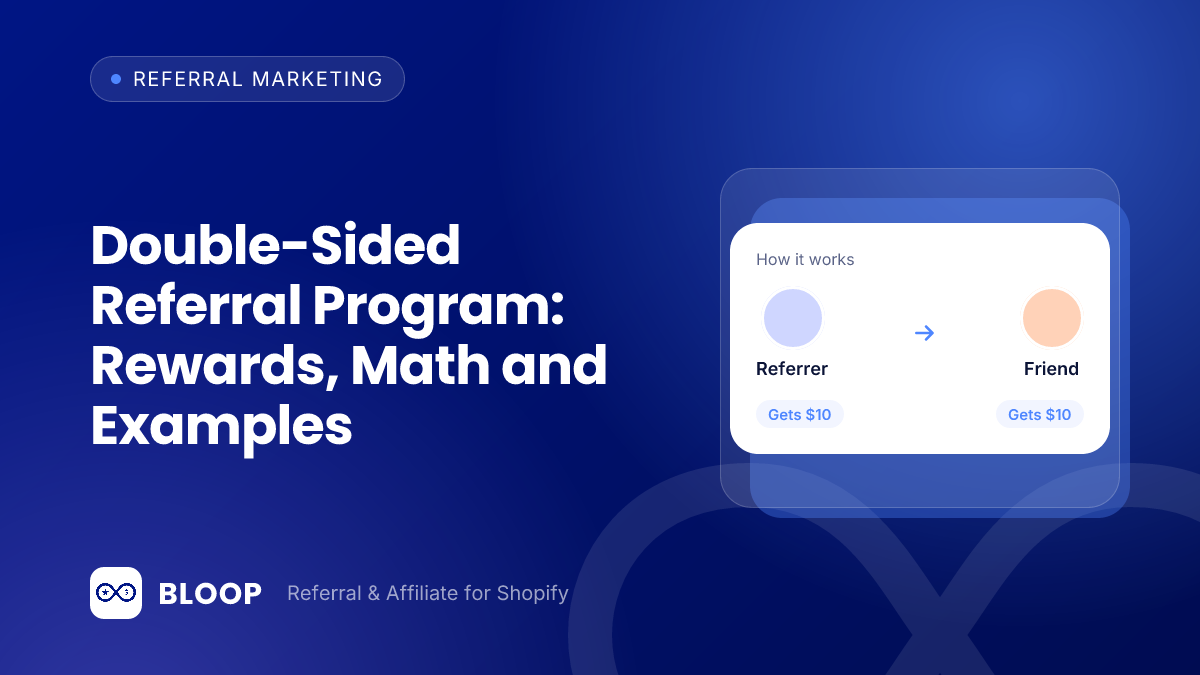
A double-sided referral program rewards both people in a referral: the existing customer who shares (the referrer) and the new customer who buys (the referee). The friend gets a reason to try your store, the referrer gets a reason to share, and neither side is asked to do a favor for free. A one-sided program rewards only one of them, usually the referrer.
For a Shopify store the question is not whether to reward the friend, but how to split a fixed reward budget so both sides feel it. This guide covers the difference between one-sided and double-sided programs, how real brands pair their rewards, the cost math with illustrative numbers, the rules to write down, and how to set it up in BLOOP.
Key takeaways
- Double-sided means two rewards, not twice the cost. In our illustrative example, a $5 friend discount plus a $5 referrer credit costs the same $10 as a one-sided $10 credit, but gives the friend a reason to click.
- The margin rule still applies. BLOOP’s docs say the referrer reward plus the referee reward should stay below the profit you make on a referred order.
- Real programs do not all split evenly. Huel and Athletic Brewing offer matching rewards, while Dollar Shave Club and Sitka Seafood Market give the two sides different things.
- The evidence is encouraging but not specific to your reward split. Referred customers were at least 16% more valuable in one bank study, and 83% of respondents in a Nielsen survey trust recommendations from friends and family.
What a double-sided referral program is
In a double-sided program, a completed referral triggers two rewards at once. The referrer gets a referrer reward after the friend buys, and the friend gets a referee reward on that first purchase. BLOOP’s glossary entry for a double-sided reward describes it the same way, and BLOOP’s documentation puts it plainly: a referral program turns your existing customers into a sales channel, and “you reward both sides for it.”
The two roles have their own glossary terms: the referrer reward and the referee reward. They do different jobs. The friend reward lowers the risk of trying a brand they have never bought from. The referrer reward pays the customer for the introduction and keeps them buying. If you want a wider view of what rewards exist, our guide to the best referral incentives covers the full menu.
One-sided versus double-sided at a glance
| One-sided (referrer only) | One-sided (friend only) | Double-sided | |
|---|---|---|---|
| Who is rewarded | The customer who shares | The new customer | Both |
| What the sharer can say | “I get credit if you buy” | “You get a deal” | “We both get something” |
| Main risk | The friend sees a favor for the sharer’s benefit | The sharer has no reason to bother | Cost of two rewards if you do not budget |
| Fits best | Products with a high price and a strong brand | Pure acquisition offers, like a welcome code | Most consumer stores |
| Tracking need | Referral link or code | Referral link or code | Referral link or code, plus eligibility rules for the friend |
The friend-only column is closer to a welcome discount than a referral program, because nothing rewards the person who did the work. We include it so the choice is clear: the real decision is between paying the referrer alone and paying both.
Why rewarding both sides makes sense
Be careful with claims here. Nobody can promise you a lift from adding a friend reward, and the studies below measure related things, not the exact choice between one and two sides. Here is what the sources do support.
- Trust sits with friends. Nielsen’s Global Trust in Advertising report says “More than eight-in-10 global respondents (83%) say they completely or somewhat trust the recommendations of friends and family.” The survey polled 30,000 online respondents in 60 countries in 2015, so treat it as a broad signal rather than a current figure for your market.
- Referred customers can be worth more. Tracking approximately 10,000 customers of a leading German bank, Schmitt, Skiera and Van den Bulte find that “The average value of a referred customer is at least 16% higher than that of a nonreferred customer with similar demographics and time of acquisition.” The same abstract warns that “the size of the value differential varies across customer segments,” which is a polite way of saying your results will differ.
- Recommenders may stay longer. In a field experiment using data from a global telecommunications provider, recommenders’ defection rates fell from 19% to 7% within a year, and their average monthly revenue grew by 11.4% compared with a matched control group, as reported by the W. P. Carey School of Business.
None of these studies compares one-sided and double-sided rewards, and two come from banking and telecom rather than ecommerce. Read them as reasons to run a referral program at all. The reward split is a decision you test in your own store.
A simple argument for the friend reward is social. When a customer texts a link to a friend, the message reads differently if the friend benefits. “Here, you get 15% off” is a gift. “Use my link so I get credit” is an ask. That is an argument, not a measured result, so check it with your own data.
What real brands offer on both sides
The rows below come from each brand’s own page or terms, read in October 2026. Offers change, so confirm on the live page before copying anything. We list only what each page states.
| Brand (own page) | Friend gets | Referrer gets | Notable rule |
|---|---|---|---|
| Huel | 25% off | 25% off | “18+, US only”; single-use codes; referee must be new |
| Athletic Brewing | $15 off $50 coupon | $15 off $50 coupon, after the friend redeems and buys | Excludes subscriptions and gift cards |
| Dollar Shave Club | 30% off a new subscription | 50% off one eligible non-razor product per valid referral, up to nine, then a free product at the 10th | Codes are single-use and have no cash value |
| Sitka Seafood Market | $35 off first box plus free salmon burgers for the first year | $35 account credit per friend who subscribes | $100 minimum order; credit does not expire |
| Gymshark | £10/$10 off first order | “a reward too” (amount not stated in the content we read) | £50/$50 minimum; 60 days validity; new customers only |
| Dropbox | 500 MB of extra storage | 500 MB per referral on Basic, 1 GB on Plus, Family and Professional, with caps | Not a store, but a clean example of both-sides rewards |
Three patterns stand out.
First, symmetry is common but not required. Huel and Athletic Brewing give both sides the same thing, which is easy to explain in one line. Dollar Shave Club and Sitka give the sides different rewards, which lets them aim each reward at a different goal: a lower price for the new subscriber, and credit or a product for the loyal customer.
Second, the referrer reward often arrives only after the friend finishes buying. Athletic Brewing’s referrer coupon is issued after the friend redeems and completes the purchase, and Sitka credits the referrer for a friend who subscribes. That protects the budget from non-buyers.
Third, every offer comes with rules in plain view: new customers only, minimum orders, exclusions and single use. The offer itself is simple. The conditions are what keep it affordable.
Shopify’s own merchant referral terms follow the same shape. The referrer earns Referral Credits and the friend also earns credits, both usable for subscription plan fees, with amounts that “may vary.” We mention it as another example of a two-sided design, not as a model for a store.
Reward pairing ideas
BLOOP lets you set the two sides separately. Per its rewards documentation, the referrer can receive a discount coupon, store credit, a free product, cash (tracked in BLOOP, but you process the payment yourself) or a custom reward you fulfill yourself. The referee can receive a discount coupon or free products, and only first-time customers can claim it. Here are pairings that fit different stores.
| Store situation | Friend reward | Referrer reward | Why it fits |
|---|---|---|---|
| Frequent, low-ticket purchases | Small percentage off | Modest store credit | Credit stays in your store and costs you margin, not face value |
| Rare, high-ticket purchases | Fixed amount off | Discount coupon or cash | BLOOP notes that credit toward a future order “feels weak” for one-off buyers |
| Products that are cheap to make | Free product on the first order | Free product on the next order | A free product costs you your unit cost, not its retail price |
| Brand with a story and a community | Discount coupon | Custom reward (a gift or swag) | Avoids discounting, but you fulfill it by hand |
| Subscription or repeat-order model | Discount on the first cycle | Store credit or a free billing cycle | Matches BLOOP’s guidance for recurring revenue |
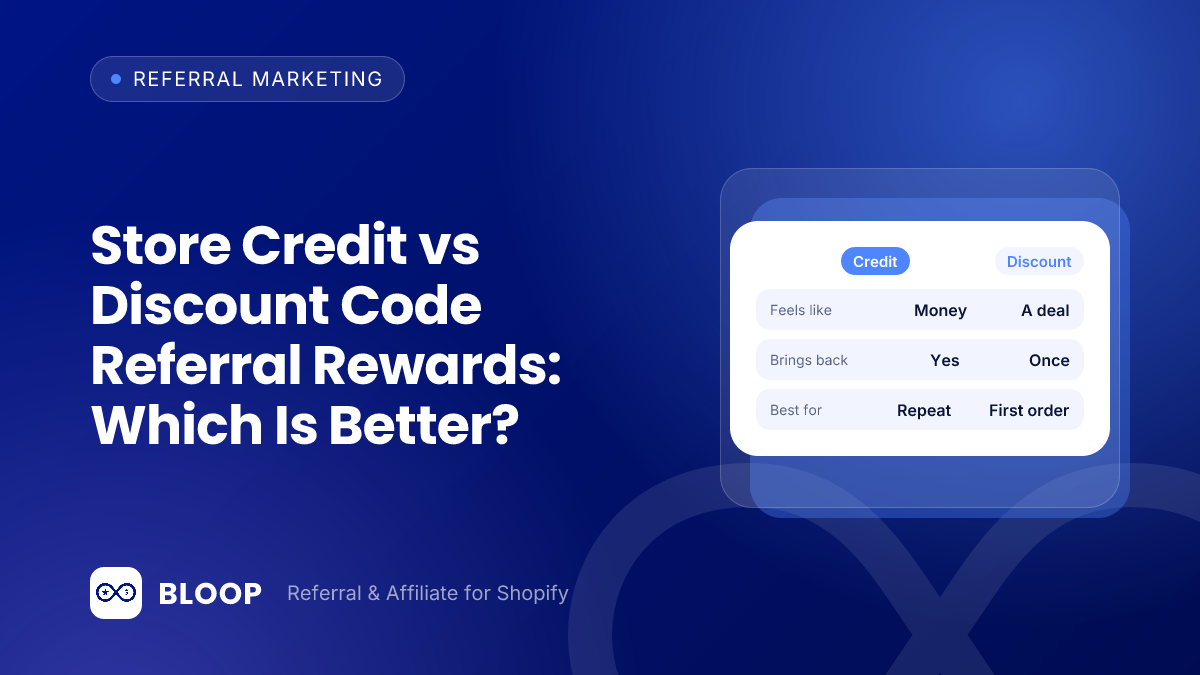
A few notes on this table. BLOOP’s choosing-rewards guide describes store credit as a good fit for frequent purchasers because it “keeps the reward inside your store, which protects cash,” and says a free product “costs you your unit cost rather than a slice of revenue.” There is no gift card reward type in BLOOP, so use store credit or a custom reward if you want something like it. For more on credit versus discount codes, read store credit vs discount referral rewards.
One more Shopify detail matters for credit. Shopify’s store credit help says that “Only the full store credit amount can be applied as a payment method” and that expiry is “set per issuance.” If your friend reward is a coupon and your referrer reward is credit, the customer experience at checkout is different for each. Test both before launch.
The cost math (illustrative)
All numbers in this section are assumptions for illustration, not benchmarks. Replace them with your own. Assume an average first order of $50 and a gross profit of $20 on it after product cost, shipping and payment fees.
| Option | Friend reward | Referrer reward | Total reward | Profit left on the first order |
|---|---|---|---|---|
| A. One-sided | None | $10 store credit | $10 | $10 |
| B. Double-sided, same budget | 10% off ($5) | $5 store credit | $10 | $10 |
| C. Double-sided, richer | 10% off ($5) | $10 store credit | $15 | $5 |
| D. Double-sided, too rich | $10 off | $10 store credit | $20 | $0 |
Option D breaks the margin rule, because the rewards equal the whole profit and leave nothing. Options B and C stay below $20. Note that the figures use the full face value of store credit. BLOOP’s docs point out that credit’s “real cost is your margin on that order, not its face value,” so the true cost of A, B and C is lower than shown.
Now the question that matters: how much more volume does the second reward need to bring? Suppose 1,000 people see your share prompt, and option A converts 2% of them to purchases, which is 20 referred orders. Those 20 orders leave $10 each, or $200.
- Option B costs the same per order as A. If it converts even slightly more, say 3%, you get 30 orders and $300. If it converts less than 2%, B loses to A. The reward budget is equal, so the only variable is conversion.
- Option C leaves $5 per order, half of A. It needs twice as many orders just to match A’s $200. At 2%, C earns 20 x $5 = $100. To reach $200 it must convert at 4% (40 orders x $5 = $200). That is the break-even: doubling the conversion rate.
The lesson is general. When you add a reward on top of an existing one, the new reward must pay for itself in extra orders. When you move budget from one side to the other, you only need to be better at converting. Moving budget is the cheaper experiment, and BLOOP’s A/B testing lets you compare two reward setups. Run your own numbers in the free referral ROI calculator. Compare option totals against your own first-order profit, not against this example.
A second cost is leakage. A friend reward only helps if it goes to new customers. BLOOP’s documentation says “Only first-time customers can claim a referee reward,” and the audience page says an existing customer cannot claim referral rewards even with a referrer’s code. Even so, abuse happens, which is why the fraud checks below matter.
Rules to write down before you launch
The brand pages above all show their conditions up front. Decide these before you design anything:
- Who counts as a friend. New customers only is the standard, and BLOOP enforces it for the referee reward.
- A minimum purchase for the friend. Athletic Brewing uses $15 off $50, Gymshark uses £10/$10 off £50/$50 and Sitka uses a $100 order minimum. BLOOP supports a minimum purchase amount, item count or number of referrals before a reward is issued.
- When the referrer is rewarded. BLOOP lets you choose whether a referral counts when the order is Paid (the default and the fastest) or Fulfilled (it waits until you ship). The review period delays approval by a number of hours, with a default of 6 hours.
- What happens on a refund or cancellation. You can revoke rewards on cancel and refund, on cancel only, or on refund only. BLOOP treats an order as refunded when 90% or more of its item value has been refunded (shipping is not counted), so a smaller partial refund keeps the reward.
- Expiry. Sitka says its credit does not expire, and Gymshark’s codes last 60 days. Shopify store credit expiry is set each time you issue it.
- What cannot be combined. Gymshark allows one code per order and Dollar Shave Club makes codes single-use. Decide whether your referral discount can stack with other offers, and say so.
Put the answers in plain words on your referral page. Write them as short, plain sentences rather than legal text, and have an advisor review the final wording.
Keep the reward honest: disclosure and fraud
When a customer shares a link because they will be rewarded, they have a financial relationship with your brand. The FTC’s Disclosures 101 guide says to “Disclose when you have any financial, employment, personal, or family relationship” with a brand, and to place the disclosure “with the endorsement message itself” so “it’s hard to miss.” Its Endorsement Guides Q&A says the test for incentives is whether knowing about it “would affect the weight or credibility your readers give to your recommendation,” and adds that “Your company is ultimately responsible for what others do on your behalf.” For a referral program, the practical move is to write the default share message yourself and mention the reward in it. This is general information, not legal advice.
On the fraud side, a double-sided offer gives people two reasons to cheat. BLOOP’s Fraud center flags signals such as the same email apart from dots, plus-tag aliases or trailing digits, matching last names, identical shipping addresses and shared IP addresses or browsers. When a referral triggers a signal, BLOOP holds the reward for 14 days, tags the order in Shopify as “BLOOP suspicious referral” and opens a case. If the purchaser’s email is the referrer’s own address, BLOOP rejects the referral straight away. Two prevention checks, one for IP address and one for browser, are off by default. Turn them on only if you accept that they can also block a real referral between two people on the same network. Read our guides to referral fraud and self-referral for the patterns.
How to set up a double-sided program in BLOOP
These steps come from BLOOP’s documentation. A campaign manages the audience, rewards, sharing methods, branding and emails, and you can run up to five campaigns at once.
- Choose who can refer. The options are all customers (including guests), members only, or a Shopify customer segment. BLOOP’s advice is to open wide at launch to learn who refers, and tighten only when quality or fraud becomes a real concern. A segment such as
number_of_orders >= 1limits referrers to people who have bought. - Set the referrer reward. Pick a discount coupon, store credit, free product, cash or custom reward. You can also choose No reward to turn this side off, which gives you a friend-only offer.
- Set the friend reward. Pick a discount coupon or free products. You can restrict a coupon to specific products or collections, and add a minimum purchase.
- Choose how people share. Links capture the friend’s email and suit email, DMs, social and chat. Codes need no extra step at checkout and work in person, on the phone or on podcasts. Each referrer gets a unique 8-character share code automatically, and BLOOP tracks shares by both link and code. See referral codes vs referral links for the trade-offs.
- Set timing and revocation. Choose Paid or Fulfilled, the review period and the revoke rules.
- Add the entry points. The referral page is built from a main join-and-share section, a guide section and a reward section, and BLOOP advises adding it to your main menu or footer before launch. The thank-you page block asks at the moment the customer is happiest.
- Write the message. For the post-purchase block, BLOOP’s advice is to lead with the friend’s reward rather than your request, in one sentence with one button, for example “Give a friend $10 off – and earn $10 yourself.” Our referral message examples give more wording.
- Edit the emails. BLOOP sends referrers a welcome message with their link, reward confirmations and reminders, and sends referees invitations and discount claim confirmations. Each template can be edited, and a test send previews it with real data.
The referral rewards feature page lists every reward type, and the referral program overview shows the whole flow.
Common mistakes with two-sided rewards
- Making the friend reward bigger than the referrer reward by default. It can be right, but decide it with margin math, not instinct.
- Hiding conditions until checkout. Every brand page above states its eligibility rules next to the offer. If your reward applies only to some products, say so in the reward text instead of letting the customer find out at checkout.
- Skipping the minimum purchase. A small first order can trigger two rewards that together exceed the profit.
- Testing everything at once. Change one thing, such as the friend discount, and keep the rest fixed. BLOOP’s tiered rewards (FlexiTiers) and A/B testing are mutually exclusive, so you cannot run both in one campaign.
- Copying a brand’s numbers. Huel’s 25% works for Huel’s margins. Yours may not.
For a longer list, see referral program best practices.
Limits and honest caveats
- The studies above support running a referral program. None isolates the effect of a friend reward, so test the split yourself.
- The brand examples show what each page says in October 2026. We did not measure how well any of them perform.
- Gymshark’s page did not state the referrer reward amount in the content we read, so we do not report one.
- BLOOP does not pay cash rewards for you. Cash is tracked in BLOOP, and you process the payment yourself.
- BLOOP’s documentation lists integrations with Klaviyo and Mailchimp. If you use another email tool, plan to send referral emails from BLOOP or by hand.
What it costs to run with BLOOP
BLOOP has a Free plan at $0 with 10 referral orders and 10 affiliate orders, and the Shopify listing names fraud prevention and A/B testing among its features. Premium is $59.90 per month with unlimited orders and a 7-day free trial. The pricing page has the current details. The Free plan is enough to test a two-sided offer on a handful of orders.
Ready to try it? Install BLOOP from the Shopify App Store, set both rewards below your first-order profit, and test the split before you scale it.
Frequently Asked Questions
What is a double-sided referral program?
It is a referral program that rewards both the existing customer who shares and the new customer who buys. The referrer gets a referrer reward after the friend buys, and the friend gets a discount or free product on their first order.
Is a double-sided referral program better than a one-sided one?
We cannot say it is better for every store, and none of the sources we read compares the two directly. It usually makes sharing easier to explain, because the friend benefits too. Test it against a referrer-only setup using the same total budget, as in options A and B above.
How much should each side get?
Keep the referrer reward plus the friend reward below the profit on a referred first order. That is BLOOP’s margin rule. In the illustrative example, $20 of profit supports a $5 friend discount plus a $5 or $10 referrer credit, but not $10 plus $10.
Can I give the friend a free product instead of a discount?
Yes. In BLOOP the friend reward can be a discount coupon or a free product, and the free product reward supports up to five products with a quantity of 1 to 999 each. Only first-time customers can claim it.
Do both people get the reward at the same time?
Not necessarily. The friend’s reward applies to their first purchase, while the referrer’s reward is issued after the referred order passes the review period and any fraud hold. Athletic Brewing and Sitka also reward the referrer only after the friend buys or subscribes.
Can I turn off one side later?
In BLOOP you can choose No reward for the referrer side. The documentation does not describe a way to turn off the friend side, so check the live settings before you plan a friend-only or referrer-only test.