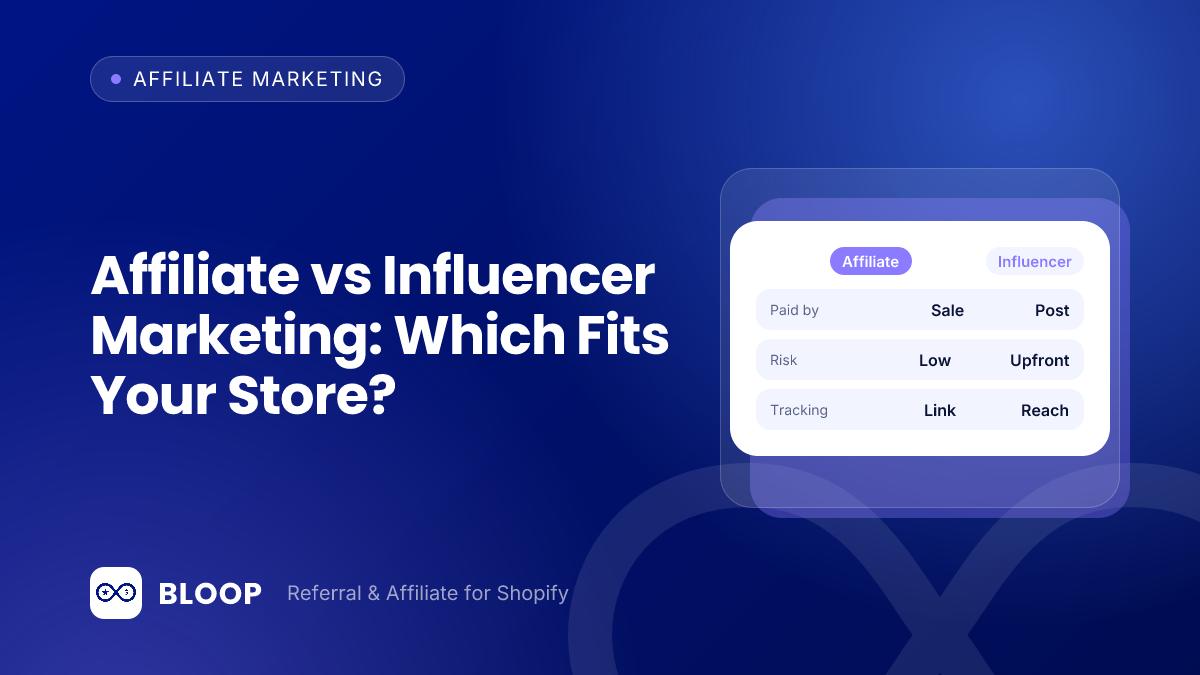
Affiliate marketing is a payment model: a partner gets a tracked link and earns a commission on each sale it drives. Influencer marketing is a type of partner: a creator with an audience, usually paid a flat fee or given free product to make content. The two overlap all the time, because many influencers are paid through affiliate links, so the practical choice is whether you pay for content, pay for sales, or do both.
This guide compares the two for Shopify stores. It defines each, works through the cost of every payment model with one set of numbers and shows the exact arithmetic, summarizes published industry data, covers measurement and FTC disclosure rules, and ends with a decision matrix and a way to combine both without overpaying. If you are also weighing customer referrals against affiliates, our comparison of referral program vs affiliate program covers that separate question.
Key takeaways
- Affiliate marketing pays for sales after they happen. Influencer marketing usually pays for content before you know what it will sell.
- In the worked example below, a $500 flat-fee post only beats a 15% commission once it brings in about 56 orders. A hybrid of $150 plus 10% beats commission-only above 50 orders.
- The safest path for most small stores is to start with commission-only affiliates, then pay fees only to creators who have already proven they sell.
The core difference in plain terms
What affiliate marketing is
In an affiliate program you recruit outside partners, such as bloggers, review sites, newsletter writers and creators. Each one gets a unique link, and often a discount code. When a shopper clicks the link and buys within the tracking window, the partner earns a commission. You pay only for orders that actually happen. The partner decides what content to make and when.
The cost model here is cost per acquisition (CPA): your marketing cost is tied to a completed order. A commission can be a percentage of the sale, a fixed amount per order or a fixed amount per item, and it can be tiered so that partners who sell more earn more.
What influencer marketing is
Influencer marketing is about the person and the audience. You pick a creator whose followers match your customers, and you agree on a deliverable: a video, a post, a story, a review. The usual payment is a flat fee, free product, or both. You are buying attention and content, and the payment does not depend on how many sales follow.
The cost model here is a fixed fee per deliverable. Your cost per order is the fee divided by whatever orders result, which you only learn afterward. Gifting is the low-cash version: you pay in product and shipping, and you are not guaranteed a post.
Where they overlap
An influencer can also be an affiliate. A creator who posts a sponsored video and shares a tracked link is doing influencer marketing with an affiliate payment attached. That is why the two terms get mixed up. The table shows the four setups you will actually see:
| Setup | What the creator gets | What you pay for | Who carries the risk |
|---|---|---|---|
| Gifting only | Free product | A chance at a post | You |
| Flat-fee post | A fixed fee | Content delivered | You |
| Affiliate only | Commission on tracked sales | Sales | The creator |
| Hybrid | A smaller fee plus commission | Content and sales | Shared |
Affiliate vs influencer marketing: side by side
| Factor | Affiliate marketing | Influencer marketing |
|---|---|---|
| You pay for | Tracked sales | Content and reach |
| When you pay | After the order, usually after returns clear | Before or when the content goes live |
| Typical partners | Bloggers, publishers, niche creators, loyal customers with an audience | Creators chosen for audience fit and style |
| Budget risk | Low: no sale, no cost | Higher: the fee is spent whatever happens |
| Content control | Low: partners post on their own terms | Higher: you can brief, review and approve |
| Measurement | Clicks, orders, commission per partner | Needs a tracked link or code added to see sales |
| Best for | Steady, performance-based acquisition | Launches, awareness and content you can reuse |
The biggest practical difference is who holds the risk. With a flat fee you absorb the risk that the post does not sell. With a commission the creator does, which is why some creators will decline commission-only deals and why many stores end up with a hybrid.
What the published data says
Industry numbers will not tell you what to do with your own margins, but they show where the market is heading. The surveys cover marketers of all sizes, not only Shopify stores, so read them as context.
Creator and influencer spend
The IAB’s 2025 Creator Economy Ad Spend & Strategy Report projects U.S. creator ad spend at $37 billion in 2025, up 26% year-over-year. The same report says creator advertising grew from $13.9B in 2021 to $29.5B in 2024, and that 48% of all creator ad buyers now consider creators a must buy. It also names identifying the right creators to partner with as the top challenge for advertisers. That last point matters for small stores: the hard part is selection, which is where a performance-based model helps, because a poor fit costs you nothing under commission.
Influencer Marketing Hub’s 2026 benchmark report (600+ respondents) adds how marketers plan and measure. 87.49% of respondents expect their influencer marketing budget to increase, while only 5.55% expect a decrease. 65.9% expect payback within 1 month, including 48.4% within 2 weeks. And 66.3% run influencer marketing entirely in-house, so most of your peers are doing this without an agency.
Affiliate spend
For affiliate, the most recent U.S. study I could trace to its publisher is the Performance Marketing Association’s 2022 Performance Marketing Industry Study, conducted with underlying data from PwC. It found that affiliate marketing investment reached $9.1 billion in 2021 and drove $71 billion in e-commerce sales. It reports an average return on ad spend of 12:1, and says content and subnetwork publishers accounted for 27% of total channel investment. Two cautions: the data is from 2021, and it comes from seven large affiliate networks, so it reflects networked programs and not necessarily a small store running its own program.
One more number is worth a pause. In the same Influencer Marketing Hub report, brand awareness is the most selected KPI (55.1% of those answering), while revenue and sales KPIs are chosen less often. If your goal is sales, that is a reason to insist on the tracked link: many programs are set up around reach, and a tracked link is what ties your spend to orders.
What each one costs: a worked example
Assume a store with a $60 average order value and a 50% gross margin, so each order earns $30 in gross profit. The three deals below are illustrative, not benchmarks. The figures count first-order profit only and ignore repeat purchases and brand value.
| Deal | Upfront cost | Cost per order | Profit per order after commission | Orders needed to cover the upfront cost |
|---|---|---|---|---|
| Flat fee: $500 for one post | $500 | $0 | $30 | 17 |
| Affiliate only: 15% | $0 | $9 | $21 | None, profitable from order one |
| Hybrid: $150 fee plus 10% | $150 | $6 | $24 | 7 |
The arithmetic behind the table: 15% of $60 is $9, so profit per order is $30 minus $9, or $21. 10% of $60 is $6, so the hybrid keeps $24 per order. The flat fee needs $500 divided by $30 per order, which is 16.7, so 17 orders. The hybrid needs $150 divided by $24, which is 6.25, so 7 orders.
Now test them against a weak result. Suppose the post brings in 5 orders:
- Flat fee: 5 orders earn $150 of gross profit against a $500 fee, so you are $350 down.
- Affiliate only: you pay $45 in commission and keep $105.
- Hybrid: 5 orders earn $120 after commission against a $150 fee, so you are $30 down.
And against a strong result of 40 orders: the flat fee leaves you $700 ahead ($1,200 profit minus $500), the affiliate deal leaves you $840 ahead (40 times $21), and the hybrid leaves you $810 ahead (40 times $24, minus $150).
Break-even points between the deals
Let n be the number of orders a creator brings in. Net profit is 30n minus 500 for the flat fee, 21n for affiliate only, and 24n minus 150 for the hybrid. Setting these equal gives the crossover points:
- Flat fee vs affiliate: 30n minus 500 equals 21n when 9n equals 500, so n is 55.6. The flat fee only wins above about 56 orders.
- Hybrid vs affiliate: 24n minus 150 equals 21n when 3n equals 150, so n is 50. The hybrid wins above 50 orders.
- Flat fee vs hybrid: 30n minus 500 equals 24n minus 150 when 6n equals 350, so n is 58.3. The flat fee wins above 58 orders.
Below 50 orders commission-only is best for you, between 50 and 58 the hybrid is, and above that the flat fee is. You cannot know in advance which zone a creator will land in, which is the argument for starting with commission. Net profit across five outcomes:
| Orders from the creator | Flat fee net profit | Affiliate only net profit | Hybrid net profit |
|---|---|---|---|
| 5 | -$350 | $105 | -$30 |
| 20 | $100 | $420 | $330 |
| 40 | $700 | $840 | $810 |
| 60 | $1,300 | $1,260 | $1,290 |
| 100 | $2,500 | $2,100 | $2,250 |
Compare cost per order with your $30 of gross profit per order. A $500 flat-fee post that brings 10 orders costs $50 per order ($500 divided by 10) to win $30 of profit: a loss on the first order, recovered only if those customers come back. That is a legitimate bet for a high-repeat product, but it is a bet. For help picking the commission side of a deal, referral commission walks through margin-based rates, and affiliate commission rates for Shopify covers typical ranges by category.
What your commission is actually calculated on
One detail changes the arithmetic. In BLOOP, by default the commission is calculated on what the customer paid: product prices after discounts, plus shipping, taxes and tips. You can exclude products, discounts, shipping, taxes and tips from that base. Take the $60 order again, bought with a 10% affiliate code and $6 shipping, and assume no tax. The customer pays $54 for the product plus $6 shipping, so $60. At 15% on the default base, commission is $9.00. If you exclude shipping, the base is $54 and the commission is $8.10. A discount and a commission stack on the same order, so budget for both.
A decision matrix
Use your situation, not a rule of thumb, to choose. Find the rows that describe your store and see which model they point to:
| Your situation | Lean toward | Why |
|---|---|---|
| Monthly marketing budget under what a single creator fee would cost | Affiliate, commission only | No upfront cash, so a miss costs nothing |
| No data yet on which partners convert | Affiliate, then gifting to the best | Commission tests many partners at once |
| Fixed launch date, strong visuals needed | Influencer, flat fee with tracked link | You control timing and creative |
| Gross margin under about 30% | Affiliate with a fixed amount per order, or a low rate | A percentage can eat most of the profit |
| Product reorders often | Hybrid or fee | Repeat purchases recover a break-even first order |
| Creator is established and unlikely to take commission only | Hybrid | A small fee plus commission shares the risk |
If rows point different ways, that usually means a hybrid: affiliates as the base, and fees reserved for a few creators who earn them.
Hybrid programs in practice
Brands publish the terms of their programs, and the pages below show the range. Rates and terms can change, so check each page before relying on it. Everything here is as of October 2026 and states only what the page itself says.
| Brand | What its public page says | Model |
|---|---|---|
| NAADAM (ambassador program) | Ambassadors receive free knitwear and new arrivals, early access to drops, sales and launches, and commission on each sale made through their content. No percentage is stated. Creators are asked to post at least monthly on Instagram, TikTok or YouTube. | Gifting plus commission |
| Beardbrand (affiliate program) | A 15% commission on every qualified buyer, a 30-day cookie duration, run through the AvantLink affiliate network, with applications made through AvantLink. | Commission only |
| Shopify Collabs (a tool, not a brand) | Merchants can offer gifting and commission. Shopify says commissions and discounts on Collabs usually are set at around 10% on average. Creators who reach a $25 minimum are paid after a holding period that merchants can adjust between seven and 90 days. | Gifting plus commission |
First, the gifting-plus-commission combination NAADAM describes is a simple hybrid: the product costs you its landed cost, and the commission is only paid if a sale results. Second, Beardbrand lists a plain percentage and a cookie length, so the terms are clear to partners before they apply. Third, Shopify’s tool makes the holding period an adjustable setting and removes the commission if an order is returned within it, so the payment follows the return window.
How to build a hybrid without overpaying
A hybrid does not have to start as a hybrid. This sequence keeps the risk low until a partner has shown results:
- Recruit a wide group of small creators and publishers into an affiliate program, each with a tracked link and, if you like, a discount code. Start with customers who already post about you; our guide to how to find affiliates for your Shopify store lists where to look.
- Pay commission only at first. Fit the rate to your margin and start lower than you think you need to.
- After a couple of cycles, look at who actually drives orders, not who has the biggest following.
- Move proven partners to a higher-rate campaign, or offer a modest fee for a specific piece of content on top of their commission.
- Set any fee with real numbers: if a partner’s last three posts averaged a certain number of orders at your profit per order, that is what a fee should be measured against.
- Cap the fee at what the partner’s typical result can repay. For example, 12 orders at $24 each is $288, so a $150 fee leaves headroom and a $400 fee does not.
Even when you pay an influencer a flat fee, give them a tracked link. Without one you have no way to see what the fee bought.
Measurement and attribution
Both models depend on attribution, and the weak point is usually the discount code. Codes get shared, posted on coupon sites and used by people the partner never reached, so a link is a better primary signal and a code a useful second one. The market leans the other way: in Influencer Marketing Hub’s 2026 report, promo or discount codes lead measurement adoption at 45.9% of those answering, followed by affiliate links at 26.0% and native shop features at 25.0%. Using both a link and a code gives you a cross-check that most marketers lack.
The numbers to track per partner
| Metric | Formula | What it tells you |
|---|---|---|
| Conversion rate | Orders divided by clicks | Whether the partner’s audience fits your product |
| Cost per order | Total paid (fee plus commission) divided by orders | The figure to compare with other channels |
| Return on ad spend | Revenue divided by total paid | A quick check on whether the partner pays back |
| Net profit | Orders times gross profit per order, minus total paid | The number that decides whether to renew |
A worked example. A creator is paid a $500 flat fee and posts a tracked link that gets 2,000 clicks. At a 2% conversion rate that is 2,000 times 0.02, or 40 orders, and 40 orders at $60 is $2,400 of revenue. Cost per order is $500 divided by 40, or $12.50. Return on ad spend is $2,400 divided by $500, or 4.8. Net profit is 40 times $30, minus $500, which is $700. At 1% conversion the same post brings 20 orders and only $100 of net profit (20 times $30, minus $500), so ask for click data from past posts and not just follower counts.
Our free referral ROI calculator will run this kind of comparison for you with your own order value and margin.
How BLOOP records affiliate sales
BLOOP gives each approved affiliate a unique link and, optionally, a discount coupon, and records the sales that result. A click stays credited for the cookie window of the affiliate’s campaign, which defaults to 30 days and can be changed per campaign. Longer windows such as 60 to 90 days suit higher-priced products, and shorter ones suit impulse buys. A new sale starts as pending, and you approve it once the return window has passed. With the default settings, when an order is cancelled or fully refunded, BLOOP rejects the sale automatically and shows the affiliate why. A partial refund lowers the commission instead of removing it, and commissions already marked paid are not revoked afterward. If the buyer’s email matches the affiliate’s own, the sale is held for your review, which is a basic safeguard against self-referral.
Protecting your program from abuse
Performance programs attract bad actors, so review sales before paying: BLOOP lets you reject orders showing suspicious patterns such as self-referral, coupon abuse or a spike of tiny orders from one affiliate, and approving weekly after the return period avoids paying on reversed orders. Our guide on referral fraud covers the patterns to look for. Flat fees carry their own risk, inflated reach, and the FTC’s final rule on fake reviews prohibits anyone from selling or buying fake indicators of social media influence, such as followers or views.
Disclosure applies to both
Whether you pay a fee, a commission or in free product, the creator has a relationship with your brand that their audience should know about. This section is general information, not legal advice, and the FTC pages linked here are the places to confirm the details.
- What counts. The FTC’s guidance for influencers says a material connection includes a financial relationship, such as the brand paying you or giving you free or discounted products or services. It also says to disclose when you have any financial, employment, personal or family relationship with a brand.
- The rule itself. Under 16 CFR 255.5, a connection that might materially affect the weight or credibility of an endorsement, and is not reasonably expected by the audience, must be disclosed clearly and conspicuously. The rule lists payments and free products among the connections that count.
- Affiliate links. The same section includes an example of a blogger paid through affiliate links, and concludes that the reviews should clearly and conspicuously disclose the compensation. So an affiliate commission is treated like any other payment, which is the reason to disclose affiliate links even when no fee changes hands.
- Your responsibility as the brand. The FTC’s Endorsement Guides Q&A says that your company is ultimately responsible for what others do on its behalf, and suggests switching to pre-approval of posts if regular monitoring is too much for you.
- Placement. The same Q&A treats an #ad, Ad: or ad at the beginning of a post as probably all equal.
For your own program, this translates into four habits: put a disclosure requirement in your partner terms, repeat it in each creator brief, ask to see posts before they go live when you are paying a fee, and check a sample after launch.
Running the affiliate side with BLOOP
BLOOP handles the affiliate half of this setup on Shopify: campaigns with their own commission rules, partner approval, tracked sales and payout records. Commission can be a percentage of sales, a fixed amount per order or a fixed amount per item, with a default of 15%, and advanced mode lets you set tiers by order total (for example 10% as a base, 15% at $100 and above and 20% at $250 and above). You can also cap the maximum commission per customer and run several campaigns for different partner segments. You pay partners outside the app (PayPal, bank transfer or another method) and record the payout; BLOOP never moves money itself. Any upfront creator fee is simply a separate arrangement between you and the creator.
The Free plan is $0 and includes 10 referee orders and 10 affiliate orders, which is enough to test the model with a few partners. Premium is $59.90 per month with unlimited orders and a 7-day free trial; see the pricing page for details. More than 2,000 Shopify merchants use BLOOP, which has 190+ ratings on the Shopify App Store.
When you are ready to try the affiliate side, the BLOOP affiliate program page shows how it works.
Frequently Asked Questions
Is affiliate marketing the same as influencer marketing?
No. Affiliate marketing is a commission-based payment model, while influencer marketing is a way of working with creators for their audience. They overlap when an influencer promotes you through a tracked affiliate link.
Can an influencer also be an affiliate?
Yes, and it is common. The creator makes content and shares a unique link or code, and you pay a commission on the sales it drives, either instead of a fee or on top of a smaller one.
Which is cheaper for a small Shopify store?
Affiliate marketing is usually the lower-risk starting point because you pay nothing until an order is placed. Influencer fees are paid whether or not the post sells, so they need a budget you can afford to lose.
Should I pay influencers a flat fee or a commission?
It depends on how well you can predict their results. If you cannot, a commission or a small fee plus commission shares the risk. If a creator has a record of driving orders at your margin, a flat fee for specific content can make sense, and you can check it by dividing the fee by the orders their past posts brought you.
Do I need to disclose affiliate and influencer partnerships?
The FTC says that a material connection, such as payment or free products, should be clearly disclosed, and its rule text includes an example showing that affiliate-link compensation should be disclosed too. The FTC also says a brand is ultimately responsible for what others do on its behalf. Ask every partner to disclose in a way that is easy to see, and write it into your terms.
How do I measure influencer results?
Give each creator a unique tracked link and, if you like, a discount code. Then compare orders and net profit per partner against what you paid them, using the same attribution window for everyone. Cost per order and return on ad spend are the two numbers to put next to your other channels.