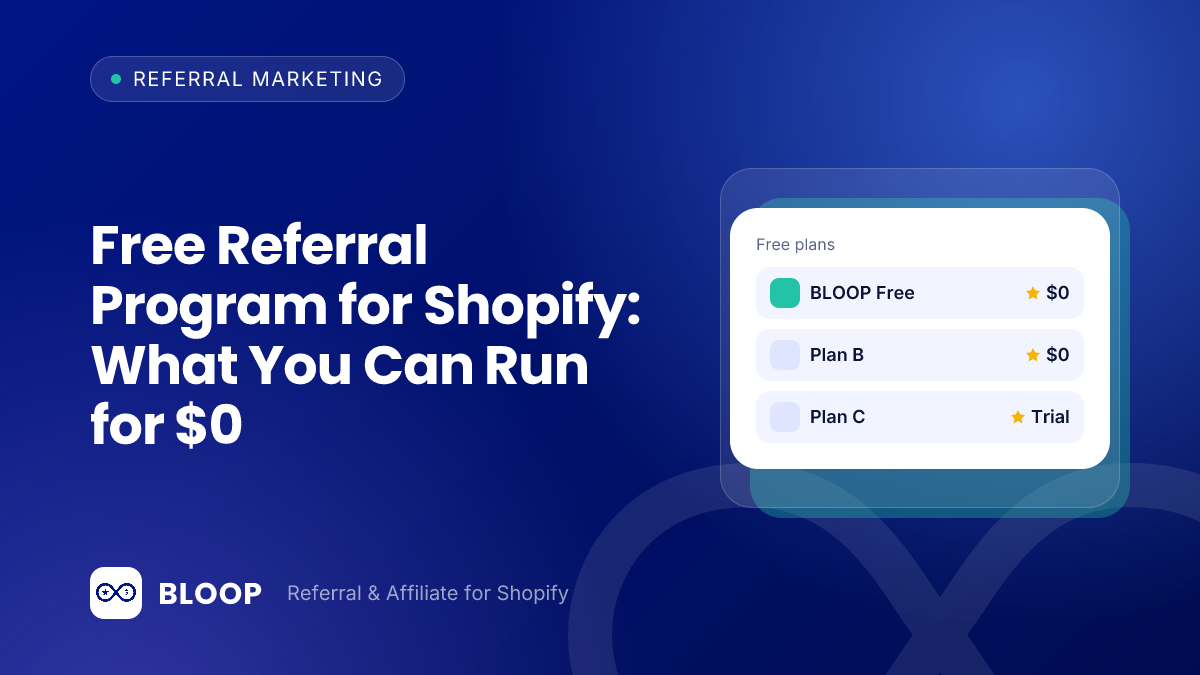
Yes, you can run a free referral program for Shopify, and there are three ways to do it: hand out discount codes you create yourself, use a free plan from a referral app, or combine both. Manual codes cost nothing but do not track who referred whom. A free app plan automates the tracking, but it caps the number of orders it covers, so it works best as a way to test the idea before you pay.
This guide covers what each option really includes, what free plans usually limit, a table of free plans taken from each app’s current Shopify App Store listing (checked on October 5, 2026), the costs that do not appear on a pricing page, and the point at which upgrading makes sense. We make BLOOP, so it is in the table, and we state its limits next to everyone else’s.
Key takeaways
- Free is possible, but free is not unlimited. Every free plan we checked caps something: BLOOP caps referral and affiliate orders at 10 each, Smile, Rivo and Growave cap monthly orders at 200, and LoyaltyLion caps them at 400.
- Manual discount codes work for a small test. Shopify gives you the codes, expiry dates, usage limits and minimum order amounts, but not referrer tracking or reward automation.
- Check where referrals sit in the plan. On some listings, referrals are in the free plan. On others, the referral program is listed on a paid tier.
- The reward is your biggest cost. A free tool does not make a $10 reward free. Budget the reward, the time you spend reviewing orders, and the fraud you will not catch by hand.
- Upgrade when the cap blocks proven results, not before. If referred orders are arriving and you are close to the limit, the paid plan is paying for itself.
Can you run a referral program on Shopify for free?
A referral program has four jobs: give each customer a way to share, recognize when a friend buys, decide whether the referral is valid, and deliver the reward. Shopify itself handles the discount part and the order part. The sharing, recognizing and deciding parts are what an app adds. So “free” depends on how much of that work you are willing to do yourself.
You can get a program live today with no app at all. The question is only how long that stays manageable. If you expect a handful of referrals a month, spreadsheets are fine. If the program works, they stop being fine quickly, because every referral means a manual lookup, a manual reward, and a manual check that the friend is not the referrer.
Option 1: Manual discount codes
Create a code in Shopify for each customer you want as a referrer, and give the friend a matching code. Shopify’s discount code settings let you control the dates a code is valid, the number of times it can be used, and a minimum order amount. A store can hold a cumulative limit of 20,000,000 unique discount codes, so volume is not the constraint.
What it does well: it costs nothing, it takes minutes, and there is no third-party app in your checkout. It is a reasonable way to test whether your customers will share at all.
What it does not do:
- No attribution. Shopify does not link a code to a referrer, so you have to keep that mapping yourself.
- No automatic reward. When a friend uses the code, you have to notice it, then issue the referrer’s reward by hand.
- No fraud checks. Nothing stops someone from referring themselves with a second email address.
- Customer limits. Shopify’s help page says a discount can apply to specific customers, with a cap of 100 specific customers, products and variants. A single code per customer therefore does not scale to a large list.
Option 2: Shopify’s built-in discounts, used cleverly
Shopify’s discount types are amount off, buy X get Y and free shipping, and each can be a code or an automatic discount. Automatic discounts apply in the cart when conditions are met, which can simplify checkout, but a store can keep a maximum of 25 active automatic discounts, and that count includes app-based discounts. In the discount types documentation, Shopify itself notes that built-in features do not address tiered discounts, multi-logic step discounts or custom eligibility requirements, and points merchants to third-party apps for those.
Notice what is missing from that list: nothing in the pages we fetched describes a built-in customer-referral feature that tracks who referred whom. We did not find one in Shopify’s help center, so treat Shopify’s own tools as the discount layer, not the referral layer.
You can also issue store credit as a referrer reward. Shopify lets you issue it from a customer profile and set the expiry per issuance. One thing to know: for stores created from May 12, 2025 onward, orders paid with store credit incur third-party transaction fees on the amount paid that way. That is a real, if small, cost of “free” store credit rewards. Our post on store credit vs discount referral rewards compares the two in detail.
Option 3: A free plan from a referral or loyalty app
Several apps include a free tier. The next section shows them side by side. Apps in this group fall into two types. Dedicated referral apps, such as BLOOP, build the whole program around referrals. Loyalty apps, such as Smile, Rivo, Growave and LoyaltyLion, bundle referrals with points and VIP tiers, and their free plans are sized by monthly orders.
Free plans compared (from live listings)
Every number below comes from the app’s own Shopify App Store listing, which we opened on October 5, 2026. Where a listing does not say something, we write “Not listed”. Plans and prices change often, so confirm on the listing before you commit.
| App | Free plan | What the free plan caps | Lowest paid plan | Trial | Referral program on free plan? |
|---|---|---|---|---|---|
| BLOOP | Yes, $0 | 10 referral orders and 10 affiliate orders | Premium, $59.90 per month (unlimited orders) | 7 days | Yes: discount, store credit and cash rewards, fraud prevention, A/B testing |
| Smile | Yes | Up to 200 monthly orders | Essential, $15 per month (up to 500 orders) | 14 days on paid plans | Yes: listed as “Points, rewards & referrals” |
| Growave | Yes, $0 | 200 orders per month | Entry, $15 per month (500 orders) | 14 days on paid plans | Not on Free: the referral program is listed from Entry |
| Rivo | Yes, “100% FREE FOREVER” | Up to 200 monthly orders | Essential, $15 per month (500 orders) | 14 days on paid plans | No: referrals are listed from Scale ($49 per month) |
| LoyaltyLion | Yes, “Free to install” | 400 monthly orders | Classic, $199 per month | 14 days | Not listed under Free: the free plan lists points and discount rewards |
| ReferralCandy | No | Not applicable | Basic, $9 per month plus a 10.5% success fee | 7 days | Not applicable |
| SC Conjured Referral Program | No | Not applicable | Starter, $19 per month, $200 revenue limit, then 8% | 5 days | Not applicable |
A few things stand out. First, “free” for loyalty apps is generous on volume (200 to 400 orders a month) but may not include the feature you want, so read the plan line by line. On Smile’s listing the free plan does name referrals. On Growave’s it does not: referrals appear from the Entry plan. On Rivo’s listing, the referral program is listed under Scale, and Essential lists a dedicated loyalty page but no referrals. On LoyaltyLion’s, the free plan lists points and discount rewards, and we did not see referrals named in either plan’s feature list.
Second, the dedicated referral app with a free plan, BLOOP, has the lowest order cap here (10 referral orders and 10 affiliate orders), but includes the referral features on the free plan, including fraud prevention and A/B testing. That is a trial-sized program, not a permanent one, and we would rather say so up front. Third, two referral-first apps have no free plan at all, and they charge by revenue or success fee instead: ReferralCandy’s Basic adds a 10.5% success fee to $9 a month, and SC Conjured’s Starter plan adds 8% after $200 of revenue.
What free plans usually limit
Across the listings, the same five limits show up. Check each before you build around a plan.
| Limit | Examples from the listings | Why it matters |
|---|---|---|
| Order volume | 10 referral orders (BLOOP); 200 monthly orders (Smile, Rivo, Growave); 400 monthly orders (LoyaltyLion) | Success pushes you into the paid plan. A cap on all monthly orders hits a busy store sooner than a cap on referred orders. |
| Feature tier | Growave lists the referral program from the $15 Entry plan; Rivo lists Referrals under the $49 Scale plan | A free plan may not include referrals at all. |
| Revenue or success fees | ReferralCandy Basic: 10.5% success fee; SC Conjured Starter: 8% after $200 revenue | Cost scales with your results, not only your plan price. |
| Branding and domain | BLOOP removes the “Powered by BLOOP” watermark and enables a custom email sender address on Premium | Free plans often show the vendor’s brand to your customers. |
| Support and data tools | BLOOP’s Premium adds priority support and data import | Slower support or no migration help matters when something breaks at launch. |
The order cap is a limit on proof, not on effort
Because the cap counts orders, not customers or time, a successful month can use it up in days. That is not a flaw, it is how freemium works. What matters is what happens at the cap. In BLOOP’s case, the FAQ states that you upgrade to Premium for unlimited orders and that your data remains intact when switching plans. Ask every vendor the same question: what happens to existing referrers and rewards when I hit the limit, and when I upgrade?
What a free referral program really costs
A free plan removes the software bill. It does not remove four other costs.
1. The rewards themselves
If you give a $10 discount to the friend and a $10 store credit to the referrer, each referred order costs you $20 before product, shipping and payment fees. BLOOP’s docs advise adding the referrer and referee rewards together and keeping that combined cost below your profit on a referred order. A free tool makes this easy to forget. Run the numbers in our free referral ROI calculator or read how to calculate referral program ROI before you pick reward sizes.
There is a strong reason to expect the economics to work. Nielsen’s Global Trust in Advertising Survey, which polled 30,000 online respondents in 60 countries, found that 83% say they completely or somewhat trust the recommendations of friends and family. Trust like that is a reason to test referrals, but it does not tell you your own conversion rate, so start with a small reward.
2. Your time
On a manual setup you review each order, issue each reward and answer each “where is my reward?” email. In an app, most of that is automatic. BLOOP’s troubleshooting docs show rewards moving through statuses such as pending (an active review window) and suspicious (a 14-day fraud hold that needs manual review). Even in an app, cash rewards are tracked but you pay them yourself. Count your hours at a real rate.
3. Fraud and abuse
The cheapest referral program to run is also the easiest to game. Self-referral (a customer referring a second email address of their own) is the obvious risk, and manual codes give you no defense except spotting it by eye. BLOOP’s best-practice docs recommend keeping automatic fraud signals on and name three structural levers: minimum purchase requirements (which make self-referral uneconomical), review periods, and audience restrictions. They also say to match your scrutiny to the size of the reward. Read our guide to referral fraud and the Fraud Center page for how holds and reviews work. Note that on BLOOP, the fraud hold lasts 14 days and expires into an approval if nobody reviews it, so a flag you ignore protects nothing.
4. Compliance
Customers who get a reward for recommending your store are in a material relationship with you. The FTC’s endorsement guidance says a connection that a significant minority of consumers would not expect, and that would affect how they weigh the endorsement, should be disclosed clearly and conspicuously. Make sure your referral page and share messages tell referrers to say they get a reward. If you email referrers or friends, CAN-SPAM applies: each violating email can draw penalties of up to $53,088, you must honor opt-outs within 10 business days, and you cannot contract away your responsibility by hiring another company to send the email. Our referral program best practices guide covers the clauses to write down.
Manual codes or a free app? A decision guide
| Situation | Better fit | Reason |
|---|---|---|
| Fewer than about 10 referrals a month, testing the idea | Manual codes | No setup, nothing to learn, but plan to track by spreadsheet |
| You want attribution and automatic rewards from day one | Free app plan | The app does matching and delivery |
| You need referrals specifically (not points or VIP tiers) | A referral-first app | Listings for loyalty apps may place referrals on paid tiers |
| You already run loyalty points | Your loyalty app’s referral feature | One customer-facing program is simpler to explain |
| High-value or cash rewards | App with fraud rules and holds | Manual review does not scale with risk |
When to upgrade from a free plan
Upgrade when a limit blocks something that is already working, not because a plan sounds more serious. Four signals tell you it is time:
- You are hitting the order cap with referrals still arriving. If the program produces revenue and the next referral would be blocked or uncovered, the upgrade pays for itself.
- You need branding the free plan does not allow. A custom sender address and removal of the vendor watermark matter once you promote the program widely. For BLOOP these are Premium features.
- You have a reward you cannot afford to pay out to the wrong person. That is the moment to pay for stronger review tools, a longer hold, or a more careful reward timing setup.
- Manual work is eating your week. If you spend more than an hour a day on referral admin, the app’s price is cheaper than your time.
For BLOOP specifically: the Free plan is $0 for 10 referral and 10 affiliate orders, and Premium is $59.90 per month with unlimited orders and a 7-day trial. You can compare the plans on the pricing page. For a wider comparison of referral apps, including loyalty apps, see our guide to the best Shopify referral apps.
A free launch plan in five steps
- Pick a reward you can afford on every referred order. Add the referrer and referee rewards together, subtract from your profit on a typical order, and keep the result positive. A minimum order amount protects margin.
- Choose the tool for a test, not for ever. A free app plan if you want tracking, manual codes if you only want to learn whether customers share.
- Limit the first version. Start with one campaign and a simple offer. BLOOP allows up to five campaigns per store, but you only need one to learn.
- Test with a real small purchase. BLOOP’s launch checklist recommends a complete end-to-end test using the actual customer flow before you promote, because a broken first impression is hard to win back.
- Set a decision rule. For example: “If 20 referred orders arrive and the program profit is positive, move to the paid plan.” Writing the rule down stops you from drifting.
For the build steps in more detail, see how to build a referral program.
Hidden gotchas in free plans
- Trial versus free. A “free trial” is not a free plan. ReferralCandy, for example, lists a 7-day trial on all plans and no free plan.
- Success fees. A low monthly price can sit next to a percentage of revenue. Use a worked example with your own average order value.
- Cash rewards. Tracking a cash reward is not the same as paying it. On BLOOP you pay referrers yourself and mark the reward as paid.
- Subscriptions. If your products are subscriptions, a discount may repeat on renewals. BLOOP lets you set a recurring cycle limit from 0 to 99, where 0 means unlimited, so decide that on purpose.
- Refunds. BLOOP treats an order as refunded when 90% or more of its item value is refunded, and by default revokes rewards for cancelled or refunded orders. Check how any tool you use handles returns before it pays a reward.
Frequently asked questions (FAQ)
Is there a free referral program for Shopify?
Yes. You can run one with manual Shopify discount codes at no cost, or use the free plan of a referral or loyalty app. Free plans cap something: BLOOP covers 10 referral orders and 10 affiliate orders, and Smile, Rivo and Growave list 200 monthly orders. Read each listing, because some free plans leave referrals to paid tiers.
Does Shopify have a built-in referral program for customers?
Shopify provides discount codes, automatic discounts and store credit, but we did not find a built-in customer referral feature that tracks who referred whom in the help pages we reviewed. You can build a rough version with codes, or use an app for tracking and rewards.
What is the best free referral app for Shopify?
It depends on what else you need. Choose a referral-first app if referrals are the goal, and a loyalty app if you also want points and VIP tiers. Compare the listing’s plan details, not the headline price. Our referral app comparison lists the options.
Can I run a referral program without paying for rewards?
Not really. Even when the app is free, rewards cost you margin: a discount, store credit, a free product or cash. You can limit the cost with minimum order amounts, expiry dates and a reward you can afford on every order.
What happens when I reach the limit of a free plan?
It depends on the app. For BLOOP, you upgrade to Premium for unlimited orders and your data remains intact. Ask any vendor in advance whether existing referrers and pending rewards carry over.
Start with a free plan
If you want attribution, automatic rewards and fraud checks without a monthly bill while you test, install BLOOP from the Shopify App Store. The Free plan covers 10 referral orders and 10 affiliate orders, and Premium has a 7-day free trial. See the pricing page for details.