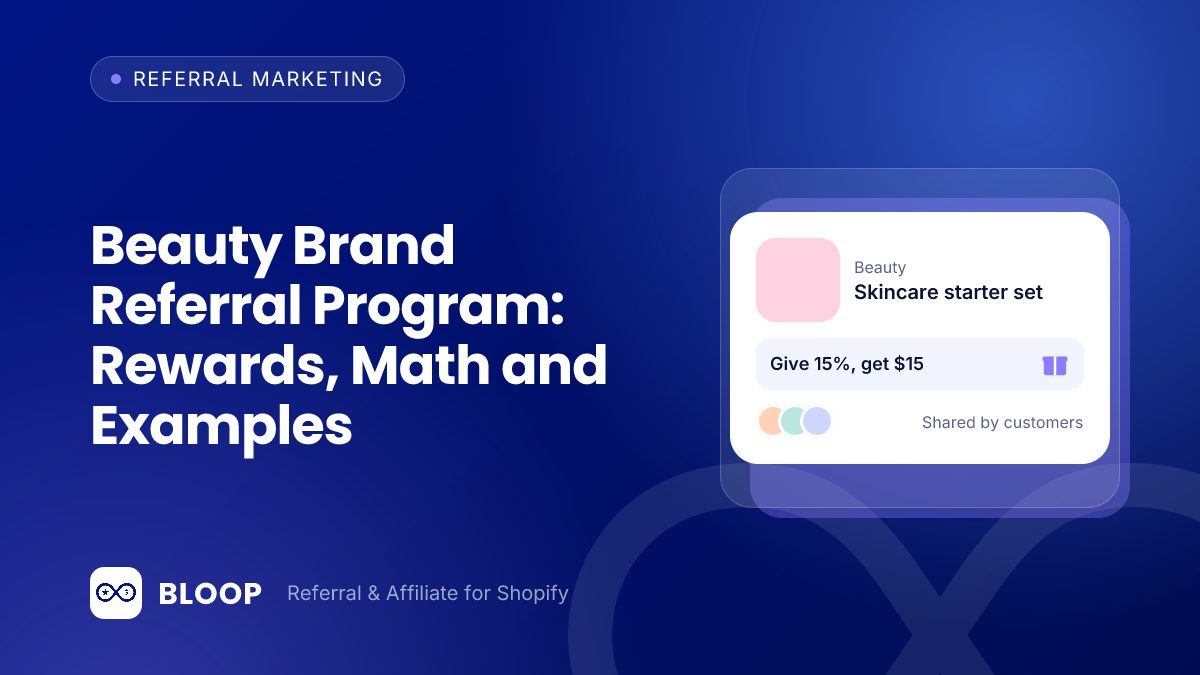
A beauty brand referral program works best when the reward is a product, the timing follows how fast a bottle runs out, and the numbers are checked before launch. The sections below show how real brands set theirs up, how to choose between a discount, store credit and a free sample, and how to do the reward math on a Shopify store.
Beauty is an unusual category for referrals because customers run out of the product. A moisturizer or cleanser has a known use-up date, so there is a natural moment to ask for a recommendation and a natural moment to offer a refill. This guide builds the program around it, with hypothetical numbers clearly labeled and every research figure linked to the page where we read it. If you are new to the basics, start with our guide to referral programs versus affiliate programs and come back here for the beauty-specific parts.
Key takeaways
- Time the ask to the bottle. Ask for a referral at roughly 60% of the product’s use-up time and offer the refill at 80%. The timing table below shows five typical products.
- Free product rewards cost less than they feel. In the worked example a travel-size reward costs $4.20 but is perceived at its $14.00 retail price, a 3.3-to-1 ratio. A $10 credit is 1-to-1.
- Check the margin first. BLOOP’s own docs say to keep the combined referrer and referee reward below your profit on a referred order. In the example, profit before rewards is $40.26 and structure B spends $13.50.
- Test for incrementality. In the 100-customer example the program breaks even if about 26.9% of referred customers are genuinely new demand.
- Disclose and handle returns. Creators must disclose commissions, and rewards should be revoked on refunds.
Why referrals suit beauty brands
Three facts explain most of the opportunity: beauty shoppers already buy online in large numbers, they trust people they know, and referred customers tend to stay longer. None of the figures below is specific to a referral program, so treat them as context rather than a forecast for your store.
Circana reports that prestige beauty retail dollar sales grew by 4%, year over year, to reach $36 billion in 2025, while beauty sales in mass retail experienced a dollar increase of 5% to $72.7 billion. The same release says prestige skincare concluded the year with 3% dollar growth and as the fastest-growing category based on units sold. Skincare is the category where repeat purchase and routine matter most, which is exactly where referral timing helps.
On the online side, the Census Bureau series published through FRED shows e-commerce at 17.1% of total retail sales in the second quarter of 2026, compared with 16.3% in the second quarter of 2025. That is all retail, not beauty alone, so it tells you the channel is growing, not how large your niche is.
The trust figure is old but still the clearest large-sample number on the topic. The Nielsen survey polled 30,000 online respondents in 60 countries and found that 83% say they completely or somewhat trust the recommendations of friends and family. It dates from 2015, so treat it as directional.
The value claim comes from a peer-reviewed study of a German bank, not a beauty brand, so the exact figures will not transfer. Still, it is a well-documented comparison of referred and non-referred customers. The authors found that the average value of a referred customer is at least 16% higher than that of a nonreferred customer with similar demographics and time of acquisition, that the probability of being an active customer after 33 months is 82.0% for referred customers and 79.2% for nonreferred customers, and that the contribution margin advantage disappears after 857 days, or approximately 29 months. For a full method, see our guide to calculating referral program ROI.
What real beauty brands offer (as of October 2026)
Each program below is described from the brand’s own terms page, which we opened for this article. Terms change, so check the linked page before copying anything. We chose four with different structures: a free product, a service credit, a fixed voucher and a points reward.
| Brand | Friend gets | Referrer gets | Notable terms |
|---|---|---|---|
| Medik8 | 20% off first purchase on medik8.com | One free travel-sized product from four options, up to the value of £19 | No minimum spend on the next order; reward comes with the next order after a 30-day period; no limit on referrals |
| Heyday | $40 off an Essential Facial (first-time clients) | $20 credit when the friend completes a first facial; another $20 if the friend becomes a member | No limit on referrals; credits cannot be used on online purchases |
| Ella Baché | $10 voucher off first online product purchase | $10 off next purchase once the friend has made a paid online purchase | New clients only; $10 offer cannot be refunded or transferred to cash; no limit on multiple offers |
| Skin Cupid | £5 off first order | 500 points once the friend’s order is placed | Reward may be voided if the order is later returned or cancelled; no limit on referrals |
Medik8 is the closest match to the sample-reward idea. Its terms say referrers get one free travel-sized product out of four options available on medik8.com, up to the value of £19, and that the friend gets 20% off their first purchase of products on medik8.com. Referrers receive their selected Referral Reward with their next order with no minimum spend. The friend’s discount code cannot be used on travel-sized products, so the reward product never stacks with the discount.
Heyday sells facials, but its structure carries over. The friend receives $40 off an Essential Facial, and the referrer gets a $20 credit to their account once the friend completes a first facial, so the reward follows actual use. Ella Baché gives a $10 voucher off their first Ella Baché product purchase online and the referrer $10 off their next purchase when their referred friend has made a paid purchase online. Skin Cupid’s page says the friend saves £5 on their first Skin Cupid order and the referrer earns 500 points, and that the reward may be voided if their order is later returned or cancelled. That last clause matters in beauty, where returns of opened products are a real cost.
Three patterns repeat. All four pay the referrer only after a purchase or completed service, all four limit the offer to new customers, and none caps the number of referrals, which suits a category where one loyal customer can recommend you many times. We found no verifiable per-brand conversion rate on these pages, so we quote none.
Build the program around the replenishment cycle
A replenishment cycle is the number of days between buying a product and needing it again. You can estimate it for each product from the size of the bottle and how much a customer uses per day. The American Academy of Dermatology gives one anchor: at a minimum, most adults need about 1 ounce of sunscreen to fully cover skin not covered by clothing, and for the face, use at least 1 teaspoon. It also advises to reapply sunscreen every two hours, and immediately after swimming or sweating. Sunscreen is the fast end of the range; a night cream is the slow end.
The table below uses hypothetical bottle sizes and daily use to show the method. Replace them with your own sizes and, better, with the real gap between first and second orders in your Shopify data. The timing columns apply two rules we suggest: ask for a referral at 60% of the days to empty, and send the reorder reminder at 80%.
| Product (hypothetical) | Size | Use per day | Days to empty | Referral ask (60%) | Refill reminder (80%) |
|---|---|---|---|---|---|
| Face cleanser | 150 mL | 3 mL | 150 ÷ 3 = 50 | 50 × 0.6 = day 30 | 50 × 0.8 = day 40 |
| Face moisturizer | 50 mL | 1 mL | 50 ÷ 1 = 50 | 50 × 0.6 = day 30 | 50 × 0.8 = day 40 |
| Vitamin C serum | 30 mL | 0.5 mL | 30 ÷ 0.5 = 60 | 60 × 0.6 = day 36 | 60 × 0.8 = day 48 |
| Face sunscreen | 100 mL | 5 mL (about 1 teaspoon, our rounding) | 100 ÷ 5 = 20 | 20 × 0.6 = day 12 | 20 × 0.8 = day 16 |
| Eye cream | 15 mL | 0.25 mL | 15 ÷ 0.25 = 60 | 60 × 0.6 = day 36 | 60 × 0.8 = day 48 |
The two percentages are our starting suggestion, not a measured benchmark, so test them against your own data.
How to put the timing into practice
- Pull your last 12 months of orders and find the median number of days between a customer’s first and second order for your best-selling product.
- Take 60% of that number as the day for your referral email. For example, a median gap of 50 days gives day 30.
- Send a short email that shows the customer’s referral link and states both rewards in one line. Our referral email templates cover the wording.
- Send the refill reminder at 80% of the gap, so the two emails never land on the same day.
- After 90 days, compare second-order rates for customers who received both emails against those who received only the reminder.
Choose the reward: discount, credit or free product
BLOOP lets you pick the referrer reward from a discount coupon, store credit, free product, cash or a custom reward. The referee (the friend) can receive a discount coupon or a free product. In BLOOP, a free product reward can include up to five products, and the docs note that the perceived value is the product’s full retail price, not your cost. That sentence is the heart of the beauty case: a $14 travel-size item may cost you a fraction of that.
For the trade-offs between credit and discounts, seestore credit versus discount referral rewards.
Reward cost versus perceived value
The table uses one hypothetical travel-size product and shows the ratio of what the customer sees to what you spend. The cost figure for the travel-size product assumes $3.20 in product cost plus $1.00 of added shipping weight when it ships with the next order.
| Referrer reward | What the customer sees | Your cost | Perceived value ÷ cost |
|---|---|---|---|
| $10 store credit | $10.00 | $10.00 if fully redeemed | 10.00 ÷ 10.00 = 1.0 |
| 15% off the next order (AOV $62) | 62 × 0.15 = $9.30 | $9.30 | 9.30 ÷ 9.30 = 1.0 |
| Free travel-size serum (retail $14.00) | $14.00 | 3.20 + 1.00 = $4.20 | 14.00 ÷ 4.20 = 3.3 |
| Free 5 mL sample for the friend (hypothetical cost $2.40) | A free gift with the first order | $2.40 | Not priced at retail by the customer |
A caveat: credit and discounts only cost you when used, and some are never redeemed, so a $10 credit can cost less than $10. We count it in full to stay conservative. A free product is a certain cost once the referral qualifies, so pick a best-seller, which doubles as sampling for a full-size repurchase.
Worked example: the unit economics of one referred order
Everything in this section is hypothetical. The numbers are chosen to be round enough to follow, and you should replace each one with your own. The store sells skincare with an average order value (AOV) of $62.
Step 1: profit on an order with no reward
| Line | Calculation | Amount |
|---|---|---|
| Revenue | AOV | $62.00 |
| Product cost (22% of revenue) | 62.00 × 0.22 | $13.64 |
| Shipping and packaging | Assumed | $6.00 |
| Payment fee (2.9% + $0.30, assumed) | 62.00 × 0.029 = 1.80, plus 0.30 | $2.10 |
| Profit before any reward | 62.00 – 13.64 – 6.00 – 2.10 | $40.26 |
The payment-fee rates are an assumption for the example; use the rate on your own Shopify plan. The key number is $40.26, the profit on a full-price order. BLOOP’s reward docs say to add the referrer and referee rewards together, and keep that combined cost below your profit on a referred order. So the combined reward in this store must stay below $40.26, and in practice well below it.
Step 2: profit after a 15% friend discount
| Line | Calculation | Amount |
|---|---|---|
| Discount given to the friend | 62.00 × 0.15 | $9.30 |
| Revenue after discount | 62.00 – 9.30 | $52.70 |
| Product cost | Unchanged | $13.64 |
| Shipping and packaging | Unchanged | $6.00 |
| Payment fee | 52.70 × 0.029 = 1.53, plus 0.30 | $1.83 |
| Profit after friend discount | 52.70 – 13.64 – 6.00 – 1.83 | $31.23 |
Step 3: compare three reward structures
Now add the referrer reward. Structure A pairs the 15% friend discount with a $10 store credit. Structure B pairs it with a free travel-size serum costing $4.20. Structure C gives the friend a free 5 mL sample (cost $2.40) with no discount, plus the same travel-size serum for the referrer.
| Structure | Friend reward cost | Referrer reward cost | Profit per referred order | Calculation |
|---|---|---|---|---|
| A: 15% off + $10 credit | $9.30 | $10.00 | $21.23 | 31.23 – 10.00 |
| B: 15% off + free travel size | $9.30 | $4.20 | $27.03 | 31.23 – 4.20 |
| C: free sample + free travel size | $2.40 | $4.20 | $33.66 | 40.26 – 2.40 – 4.20 |
Structure C earns the most per order, but it also gives the friend the weakest price incentive, so it may convert fewer people. Structure B keeps a price hook and still beats A by 27.03 – 21.23 = $5.80 per order. The right choice depends on how your audience responds, which is why you test.
Worked example: 100 referred customers over their first two orders
One order does not capture a replenishment business, so extend the example. Assume 100 referred customers join in one month through structure B. Assume 38 of them place a second, full-price order at an average of $58. The 38% repeat rate is hypothetical; use your own.
Step 1: profit on one second order
| Line | Calculation | Amount |
|---|---|---|
| Revenue | Average second order | $58.00 |
| Product cost (22%) | 58.00 × 0.22 | $12.76 |
| Shipping and packaging | Assumed | $5.00 |
| Payment fee | 58.00 × 0.029 = 1.68, plus 0.30 | $1.98 |
| Profit per second order | 58.00 – 12.76 – 5.00 – 1.98 | $38.26 |
Step 2: add up the cohort
| Line | Calculation | Amount |
|---|---|---|
| First-order profit after rewards | 100 × 27.03 | $2,703.00 |
| Second-order profit | 38 × 38.26 | $1,453.88 |
| Total profit from the cohort | 2,703.00 + 1,453.88 | $4,156.88 |
| BLOOP Growth plan for the month | Plan price | $149.00 |
| Net profit after the app fee | 4,156.88 – 149.00 | $4,007.88 |
The cohort brings in about $7,474.00 of attributed revenue in the month: 100 first orders at the discounted $52.70 is $5,270.00, plus 38 repeat orders at $58.00 is $2,204.00. That falls in BLOOP’s Growth plan, which is $149 a month for up to $10,000 of attributed revenue per 30 days, with unlimited orders. The Free plan is $0 up to $400 and Starter is $39 a month up to $2,500, so a store this size is past both. At this volume the fee is 149 ÷ 4,156.88 = 3.6% of cohort profit.
Step 3: compare with paid acquisition
To judge the result, compare it with acquiring the same 100 customers through ads. Assume a customer acquisition cost (CAC) of $28 per customer, which is hypothetical. Ad customers pay full price on the first order, so their first-order profit is $40.26.
| Line | Referral program | Paid ads |
|---|---|---|
| First-order profit (100 customers) | 100 × 27.03 = $2,703.00 | 100 × 40.26 = $4,026.00 |
| Second-order profit (38 repeat) | 38 × 38.26 = $1,453.88 | 38 × 38.26 = $1,453.88 |
| Acquisition cost | Included in rewards; app fee $149.00 | 100 × 28.00 = $2,800.00 |
| Net profit | 4,156.88 – 149.00 = $4,007.88 | 4,026.00 + 1,453.88 – 2,800.00 = $2,679.88 |
| Difference | 4,007.88 – 2,679.88 = $1,328.00 in favor of referrals |
Under these assumptions, referrals net $1,328.00 more than ads for the same cohort. That result depends on one assumption you should challenge: that every referred customer is a customer you would not otherwise have won.
Test for incrementality before you trust the result
Some of your referred customers would have bought from you anyway, for example because a friend simply told them about your brand and they would have searched for you. Those customers still receive the rewards, but they do not add new profit. The share of referred customers who are truly new demand is called incrementality.
The formula for the cohort above is: net profit = (share incremental × $5,479.88) – $1,472.00. The $5,479.88 is the full-price profit of the cohort with no rewards: 100 × 40.26 + 38 × 38.26 = 4,026.00 + 1,453.88. The $1,382.90 is the program cost: rewards of 100 × 9.30 + 100 × 4.20 = 930.00 + 420.00 = 1,350.00, plus the $149.00 app fee, minus the $27.00 saved in payment fees on the discounted orders (100 × 0.27), which gives 1,350.00 + 149.00 – 27.00 = 1,472.00.
| Share incremental | Calculation | Net profit |
|---|---|---|
| 100% | 1.00 × 5,479.88 – 1,472.00 | $4,007.88 |
| 80% | 0.80 × 5,479.88 = 4,383.90; minus 1,472.00 | $2,911.90 |
| 60% | 0.60 × 5,479.88 = 3,287.93; minus 1,472.00 | $1,815.93 |
| 40% | 0.40 × 5,479.88 = 2,191.95; minus 1,472.00 | $719.95 |
| 20% | 0.20 × 5,479.88 = 1,095.98; minus 1,472.00 | -$376.02 |
The break-even share is 1,472.00 ÷ 5,479.88 = 26.9%. Below roughly 27% of referred customers being truly new, the program loses money in this example. To estimate your own number, ask new customers on the thank-you page how they heard about you, then compare referral-code orders against a holdout month. Our referral program ROI guide goes deeper, and the free referral ROI calculator lets you try your own inputs.
Set up the program in BLOOP, step by step
- Set the friend reward. Choose a discount coupon (fixed amount or percentage) or a free product. Only first-time customers can claim a referee reward, per the rewards docs.
- Set the referrer reward. For the example above, pick free product and add the travel-size serum. Keep the combined cost under the profit figure you calculated.
- Choose when rewards are granted. The reward timing page says rewards can be granted when an order is paid (the default) or fulfilled. Beauty stores with a long return window may prefer fulfilled.
- Set the review period. The default is 6 hours, and the same page says you can raise it for high-value rewards. For rewards worth more than a mini, consider extending it to cover your return window.
- Keep the revocation default. The default revokes a reward when the order is canceled or refunded, and a refund counts once it covers 90% or more of the item value. This matches the clause Skin Cupid uses in its terms.
- Schedule the emails. Use the timing table above to send the referral ask and the refill reminder on different days.
Opened products complicate returns, so decide your policy first. If you accept returns on opened items, a longer review period protects you from paying for orders that come back. If you do not, say so in the program terms. For protection against people referring themselves, read our guides on referral fraud and write the rules into your terms.
Add creators and estheticians with an affiliate program
Customers refer a few friends. Creators, estheticians and bloggers can reach many people, and they expect to be paid per sale. In BLOOP, affiliates earn a commission rather than a one-time reward. You choose the commission rate, and the default attribution window is 30 days.
For the same $62 order, a hypothetical 15% commission is 62.00 × 0.15 = $9.30. Your profit before commission is $40.26, so after commission it is 40.26 – 9.30 = $30.96. Docs from BLOOP advise excluding shipping and taxes from the base, since you rarely want to pay commission on money that never lands as profit. For help choosing between the two programs, see referral program vs affiliate program.
Disclosure rules for beauty creators
Beauty creators often receive free product, which makes disclosure a legal matter in the United States. The FTC’s guidance says that if there’s a connection between an endorser and the marketer that a significant minority of consumers wouldn’t expect and it would affect how they evaluate the endorsement, that connection should be disclosed. On affiliate commissions it says you should disclose your relationship to the retailer clearly and conspicuously on your site, and it explains that the bare term “affiliate link” may not tell consumers that the person placing the link is getting paid for purchases made through it. Put these rules in your affiliate terms; our guide to affiliate program terms and conditions shows where. This is general information, not legal advice.
Next step
Start with one structure, run it for 60 days, and measure second-order rate and incrementality before changing anything. If you want to set it up in a Shopify store, BLOOP’s referral program supports the reward types described here, and the Free plan (up to $400 of attributed revenue per 30 days, unlimited orders) lets you test before you pay anything.
Frequently Asked Questions
What is a good reward for a beauty brand referral program?
The best reward is one that costs you little and feels valuable, which usually means a free travel-size or best-selling mini for the referrer and a first-order discount for the friend. Whatever you choose, keep the combined reward below your profit on a referred order.
How long should I wait before asking for a referral?
Ask when the customer has used the product long enough to judge it, which we suggest is about 60% of the time it takes to run out. For a 50-day moisturizer that is day 30. Treat the percentage as a starting point and test it against your own repeat-purchase data.
Are free samples better than discounts as referral rewards?
They can be, because the customer sees the retail value while you pay only the cost, as in the 3.3-to-1 example above. We found no primary study that proves samples outperform discounts in beauty, so compare both in your own store.
Do I need to disclose affiliate commissions on beauty content?
Yes, in the United States. The FTC says a connection between an endorser and a marketer that consumers would not expect should be disclosed clearly and conspicuously, and that the words “affiliate link” alone may not be understood. Write the requirement into your affiliate terms.
What happens if a referred customer returns the order?
In BLOOP, rewards are revoked by default when an order is canceled or refunded, and a refund counts once it covers 90% or more of the item value. You can also lengthen the review period so rewards wait until your return window has passed.
Can a small beauty brand run this on the free plan?
Yes, to start. The Free plan costs $0 and covers up to $400 of attributed revenue per 30 days, with unlimited orders. Paid plans start at $39 a month (Starter, up to $2,500). In the 100-customer example the cohort falls in the Growth plan at $149 a month, which was 3.6% of cohort profit, so cost is rarely the limiting factor.