Affiliate marketing is a performance-based channel where you pay independent partners a commission when their audience buys from your store. The partner promotes your products through a tracked link or code, you pay only when a tracked sale happens, and the partner earns a share of that sale. For a Shopify merchant it works like a commission-only sales team made up of creators, bloggers, review sites and loyal customers.
This guide explains the idea from the merchant’s side: who is involved, how a sale is tracked from click to payout, which commission models exist, what it costs, where the risks are, and how to start on Shopify. It is the overview for our affiliate marketing guides, and each section points to a deeper article when you are ready for details. Figures from other companies come from their own public pages, which we opened on October 5, 2026. BLOOP is our app, so we label BLOOP facts and state its limits.
Key takeaways
- Pay for results, not for promises. You owe a commission only when a tracked sale is approved. Shopify’s guide describes pay per sale as a percentage of order value or a fixed amount for each approved purchase.
- Five parts make it work: a merchant, an affiliate, a customer, a tracking link or code, and a rule that says how long a click is credited and what share the affiliate earns.
- The channel is large. Shopify’s guide reports the global affiliate industry at $18.5 billion in 2024, and US advertiser spend projected at $13.81 billion for 2026.
- It has real costs. Commission, discounts, app or network fees, payout time and fraud review all count. Model them per order before you launch.
- Disclosure is not optional. The FTC expects affiliates to disclose their financial relationship with you, and expects you to train and monitor them.
- Start small. One campaign, a margin-based commission, 10 to 20 hand-picked partners and a clean approval flow beat a big launch with no controls.
What is affiliate marketing?
Shopify defines affiliate marketing as “an arrangement between a business and independent partners where the partner promotes products to their audience and earns an affiliate commission on every sale they generate.” Three words in that definition matter for a store owner.
- Independent. Affiliates are not employees. They choose how and where to promote you, which is why you need clear program terms.
- Audience. The value of an affiliate is the trust they already hold with a group of buyers: subscribers, viewers, readers or friends.
- Every sale they generate. Payment is tied to a tracked outcome. If the partner sends traffic that never buys, you owe nothing under a pay-per-sale model.
Compare that with paid ads, where you pay for impressions or clicks whether or not anyone buys. Affiliate marketing moves part of the risk from you to the partner. The trade is that you give up some margin on each sale, and you depend on partners you do not control.
How affiliate marketing works
Every affiliate program, whatever the software, follows the same chain of events.
- The merchant sets the offer: a commission rate, a cookie window, and any discount the customer receives.
- An affiliate joins, either by invitation or by applying through a registration page, and receives a unique tracking link or code.
- The affiliate publishes content that includes the link or code: a review, a video, a newsletter, a social post.
- A shopper clicks the link. A cookie, a code or a stored identifier records which affiliate sent them.
- The shopper buys, now or later within the window. The order is matched to the affiliate and logged as a commission.
- The merchant reviews the sale, usually after the refund window, and approves or rejects it.
- The merchant pays the approved commissions on a schedule.
The five parts in plain terms
| Part | What it is | Who controls it |
|---|---|---|
| Merchant | You, the store that sells the product and pays commission | You |
| Affiliate | The partner who promotes your products to their audience | The partner, within your terms |
| Customer | The shopper who clicks, buys and may use a discount | The shopper |
| Tracking link or code | A unique URL or discount code that identifies the affiliate | Your affiliate software |
| Rules | Commission rate, cookie window, approval period, payout schedule | You |
Cookie windows and attribution
The cookie window, also called the attribution window, is how long after a click an affiliate can still be credited. BLOOP’s docs say the default is 30 days, and note that a long window of 60 to 90 days credits the affiliate even for purchases weeks after the click, while shorter windows of 7 to 14 days suit impulse purchases. Shopify’s own affiliate program also uses 30 days.
Windows vary widely by company. Amazon Associates credits a session for 24 hours from the click, though an item added to the cart can be bought up to 89 days later. When you compare programs, look at the window and the attribution rule together. Our glossary explains attribution window, cookie duration and last-click attribution in a few lines each.
Browsers shorten some of these windows on their own. WebKit says Safari’s tracking prevention deletes script-written cookies and other script-writeable storage after 7 days without user interaction, and caps cookies set from a decorated link at 24 hours. In practice, a tool that only sets a JavaScript cookie can lose attribution for Safari shoppers who return after a few days. Ask any vendor how it handles this, and test it yourself with a real order.
Commission, approval and payout
The commission is the affiliate’s share of the sale. In BLOOP, by default it covers product prices after discounts plus shipping, taxes and tips, and you can exclude specific products or collections, discounts, shipping, taxes or tips. Each campaign can also set a maximum commission per customer, with a default of 100 currency units.
Approval is the safety step between a tracked sale and a payable commission. In BLOOP, a new sale is Pending (“Recorded and awaiting your review. Not yet payable.”), becomes Approved when valid, Rejected when declined, and Paid when included in a completed payout. A cancelled or fully refunded order is rejected automatically, while a partial refund recalculates the commission. Once a sale is paid, a later refund cannot claw it back, so many merchants approve only after their return window closes.
Payout is the part many new merchants misjudge. BLOOP’s docs are explicit: “Bloop never moves money itself.” You send the money from your bank, PayPal or another tool, then record the payout in BLOOP. Other tools automate payouts, and a few charge for it. We cover the options in our guide to Shopify affiliate apps.
Affiliate vs referral vs influencer marketing
People use these three terms loosely, and the difference changes how you set up your program.
| Who promotes | External partners with an audience | Your existing customers | Creators, often paid up front or in product |
|---|---|---|---|
| Typical reward | Commission on sales | Discount, store credit or cash for both sides | Flat fee, free product, sometimes commission |
| Recruiting | You find and approve partners | Open to every customer | You select and negotiate |
| Relationship | Ongoing, performance based | One-off or repeat, friend to friend | Campaign based |
| Main risk | Low-quality traffic, coupon abuse | Self-referral, discount stacking | Cost with no tracked sales |
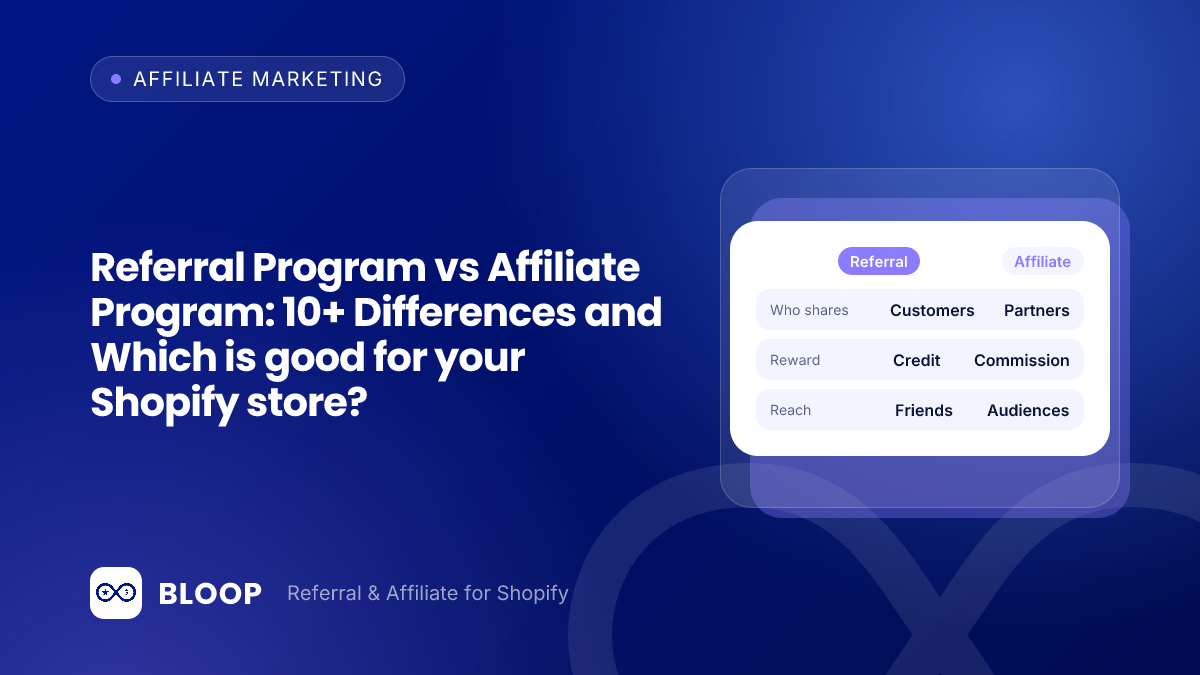
The boundaries blur. An influencer paid only by commission is functionally an affiliate, and a loyal customer who earns cash per sale behaves like one. The practical test is who promotes and how you pay them. Our guide on referral program vs affiliate program goes deeper on the customer side, and BLOOP lets you run both in one app.
Commission models
Commission design decides whether the program is profitable. Shopify’s guide describes pay per sale, pay per click, pay per action and recurring commissions, and the table adds fixed-amount and tiered variants. Pay per sale is the simplest to explain.
| Model | How the affiliate earns | Best fit | Watch out for |
|---|---|---|---|
| Pay per sale (percentage) | A percentage of the order value | Most stores, simple to explain | Rate must fit your margin after discounts |
| Pay per sale (fixed amount) | A flat amount per approved order | Stores with similar order values | Weak incentive for high-value orders |
| Pay per action | A fixed payment when a referral completes a defined action, such as a sign-up | Lead generation, trials | Defining a valid action |
| Pay per click | Money for each valid click, with or without a sale | Rarely right for stores | Pays for traffic that never buys |
| Recurring | A share while a referred customer keeps a subscription | Subscription products | Long-term liability |
| Tiered | A higher rate after the affiliate hits a sales level | Rewarding top performers | Complexity |
BLOOP supports percentage, fixed per order, fixed per item, tiered and product-specific commissions, based on our feature pages and docs. The affiliate commission tracking feature shows how rules are applied.
A simple example shows why margin matters. On a $100 order with a $20 product cost, $8 shipping and $3.20 payment fees, the gross margin before any commission is $68.80. A 15% commission is $15, leaving $53.80. If the customer also gets a 10% discount, the order is $90, the commission is $13.50 and the margin is lower again. These are our own illustrative numbers, not a benchmark, so rerun them with your costs.
What does an affiliate program cost?
The commission is only one line. Plan for five.
- Commission. The share you pay on approved sales.
- Customer discount. Many programs give shoppers a code or auto-applied discount, which reduces the order value.
- Software or network fees. Affiliate apps charge flat monthly fees, percentage fees or both. Awin, for example, lists an Access plan at $49 per month plus a 3.5% tracking fee per transaction. Shopify Collabs is free to install, but a 2.9% commission processing fee on automatic payments may apply. BLOOP’s Free plan covers 10 referral orders and 10 affiliate orders, and Premium is a flat $59.90 per month with unlimited orders and a 7-day trial.
- Payout costs. Transfer fees, currency conversion and the time to pay people on schedule.
- Management time. Reviewing applications, approving sales, answering partners and checking for abuse.
The IRS adds a tax task in the United States. Form 1099-NEC is filed for each person you paid at least $2,000 for services in the course of your business during the year, with filing due by January 31. Whether your affiliate payments fall under that rule depends on your situation, so confirm with an accountant. Collecting a W-9 from US affiliates before the first payout makes that conversation easier.
Benefits and risks
Benefits
- Lower acquisition risk. You pay after the sale, not before.
- Trust you cannot buy. A recommendation from a reviewer or creator carries more weight than a banner.
- Content that keeps working. A review article or video can send buyers for months.
- Predictable unit economics. The commission is a known percentage per order.
Risks
- Coupon and deal sites capturing sales you would have made. A visitor who already has a cart finds a code on a coupon site, and the site earns a commission on a sale you had already won. Decide up front whether such sites are allowed.
- Cookie stuffing and brand bidding. Shopify’s affiliate rules ban hidden cookie injection and bidding on its branded search terms. Cookie stuffing has also led to criminal cases: Ben Edelman’s litigation record notes a 2012 guilty plea in a scheme that targeted eBay through the Commission Junction network, with a prison sentence and a $25,000 fine.
- Self-referral. An affiliate buys through their own link to collect a commission. In BLOOP, a sale where the buyer’s email matches the affiliate’s email is held as Pending for your review.
- Refunds after payment. If you pay before the return window ends, you cannot recover the commission in BLOOP once the sale is paid.
- Brand risk. An affiliate who misrepresents your product speaks in your name. Terms and monitoring protect you.
BLOOP’s fraud guidance adds practical steps: a minimum purchase requirement makes self-referral unprofitable, a reward review period adds a delay before approval so signals can surface, and a tighter audience narrows who can game the program. It also says “A flag is a prompt to look, not a verdict.” For referral abuse patterns, see our guide to referral fraud.
Legal basics: FTC disclosure
In the United States, the FTC’s Endorsement Guides apply to affiliate content. The FTC says a material connection includes “a financial relationship – such as the brand paying you or giving you free or discounted products or services.” An affiliate commission is such a relationship, so the affiliate has to disclose it.
The FTC is specific about how. “The disclosure should be placed with the endorsement message itself,” and it is likely to be missed if it appears only on an About Me page, at the end of a post, or anywhere that needs a click on MORE. It warns against vague labels such as “sp,” “spon,” or “collab,” and against stand-alone words like “thanks” or “ambassador.” For affiliate links, the FTC says to “disclose your relationship to the retailer clearly and conspicuously on your site, so readers can decide how much weight to give your endorsement.”
The merchant has a duty as well. The FTC states: “Advertisers need to have reasonable programs in place to train and monitor members of their network.” In practice that means three things.
- Write the rule into your terms. Require clear disclosure in every post, video or message that carries your link.
- Show examples. Give affiliates sample wording such as “I earn a commission if you buy through this link.”
- Check and act. Review partner content now and then and remove those who ignore the rule.
Our glossary entry on FTC disclosure summarizes the idea, and a full set of rules belongs in your program terms. This section is general information, not legal advice. Rules differ outside the US, so check your market.
How to start an affiliate program on Shopify
You do not need a large team. A first program fits in an afternoon of setup and a few weeks of testing. The steps below are the short version, and the full walkthrough is in our guide on how to start an affiliate program on Shopify.
- Set a commission from your margin. Work out profit per order after product cost, shipping, fees and discount, then choose a rate you can afford.
- Choose your tracking method. Links, codes or both, with a cookie window that fits your purchase cycle.
- Pick the software. Compare free plans, fees, payout support and limits.
- Publish terms and a registration page. Cover allowed promotion methods, disclosure, refunds and payout timing.
- Recruit a small first group. Start with customers who already post about you, creators in your niche and a few relevant content sites.
- Approve, pay and review. Check sales, pay on a fixed day, then adjust.
In BLOOP, each affiliate belongs to one campaign that holds the commission rule, and affiliates work from a branded portal where they get links and see their results. Applications can be approved or rejected one by one or in bulk. There is no pause status: to stop an affiliate earning, move them to Rejected, and set them back to Approved to reinstate them. The BLOOP affiliate program page summarizes the setup.
Tools: apps, networks and Shopify Collabs
You have three ways to run the program.
| Option | What it is | Typical cost structure | Good for |
|---|---|---|---|
| Shopify affiliate app | Installed in your store, you recruit and manage partners | Monthly fee, sometimes plus a percentage | Most small and mid-size stores |
| Shopify Collabs | Shopify’s creator tool for recruiting and paying commissions | Free to install, with a possible 2.9% processing fee on automatic payments | Stores that want creator discovery inside Shopify |
| Affiliate network | A marketplace of publishers with its own tracking | Joining or monthly fees plus a network fee per sale | Brands that want reach across many publishers |
Networks bring ready-made publishers, at the price of extra fees. For apps, our comparison of the best Shopify affiliate apps lists nine tools with prices and limits from their own App Store listings. Check BLOOP pricing for the current plans.
Common mistakes
- Picking a commission without doing the margin math. A rate that looks generous can make each sale unprofitable once discounts and shipping are counted.
- Paying before the refund window closes. Pay after the return period, not on the day of the order.
- No written terms. Without rules on coupons, brand bidding and disclosure, you have nothing to enforce.
- Recruiting only coupon sites. They are the easiest to find and the least likely to bring new buyers.
- Ignoring partner enablement. Affiliates who get product photos, a discount code and a short brief perform better than those left to guess.
- Never reviewing results. Check revenue per affiliate monthly and cut or coach the bottom of the list.
FAQ
What is affiliate marketing in simple terms?
It is a way to sell through partners and pay them only when a sale happens. A partner shares your product with their audience using a tracked link or code. If a shopper buys through it and the order is approved, the partner earns a commission. You pay for results instead of for ad space.
How does an affiliate get paid?
The affiliate earns a commission on each approved sale, and the merchant pays it on a schedule. Some tools pay automatically through PayPal or bank transfer. With BLOOP you send the money yourself and record the payout, because BLOOP never moves money. Shopify’s own affiliate program pays on the 22nd of each month for the prior month’s referrals, with a $10 minimum balance.
Is affiliate marketing worth it for a small Shopify store?
It can be, if your margin supports a commission and you have a product people talk about. Because you pay after the sale, the downside is smaller than with ads. Begin with a handful of partners, track results for 60 to 90 days, then decide whether to grow it.
How much commission should I offer?
Choose a rate from your margin after product cost, shipping, payment fees and any customer discount. BLOOP’s docs use 15% on an $80 basket as an example of a fine rate. Test it on a few real orders before you publish it, and keep room to raise it for top partners.
Is affiliate marketing the same as influencer marketing?
No, but they overlap. Affiliate marketing pays for tracked sales. Influencer marketing often pays a fee or product up front for content, whether or not it sells. Many creators do both. See our guide on referral vs affiliate programs for how customer-led programs compare.
Do affiliates have to disclose that they earn a commission?
Yes, in the United States. The FTC says a financial relationship with a brand must be disclosed clearly, next to the endorsement and not hidden on a profile page. The FTC also expects advertisers to train and monitor their network, so put the rule in your terms.
Can I run affiliate marketing without an app?
For two or three friendly partners you can use discount codes and a spreadsheet. Beyond that, an app is safer because it creates unique links, credits sales within a cookie window, tracks commissions and gives partners a dashboard. Doing that by hand tends to break at the first dispute.
Start your affiliate program with BLOOP
If you want affiliates and customer referrals in one Shopify app, install BLOOP from the Shopify App Store. The Free plan covers 10 referral orders and 10 affiliate orders, and Premium has a 7-day free trial. Remember that you send payouts yourself.