Referral Fraud in Shopify Stores: What It Is and How to Prevent It
Referral programs are a powerhouse for Shopify store growth. They tap into word-of-mouth marketing, reduce customer acquisition costs, and create genuine brand advocates. But here’s the problem: as your referral program gains traction, so does the attention of fraudsters.
Referral fraud is silently costing Shopify store owners hundreds of thousands of dollars annually. Whether it’s through fake accounts, bots, coupon code leaks, or coordinated fraud rings, dishonest actors are exploiting referral programs faster than most merchants can defend against them.
In this guide, we’ll walk you through everything you need to know about referral fraud—what it is, why it’s particularly dangerous for Shopify stores, how to spot it, and most importantly, how to stop it cold. By the end, you’ll have a practical playbook to protect your revenue, maintain customer trust, and scale your referral program with confidence.
What Is Referral Fraud?
Referral fraud is the deceptive manipulation of referral programs for personal gain. Rather than earning rewards through legitimate customer referrals, fraudsters artificially generate fake referrals to claim undeserved incentives—whether that’s store credit, discounts, cash payouts, or products.
Types of referral fraud include:
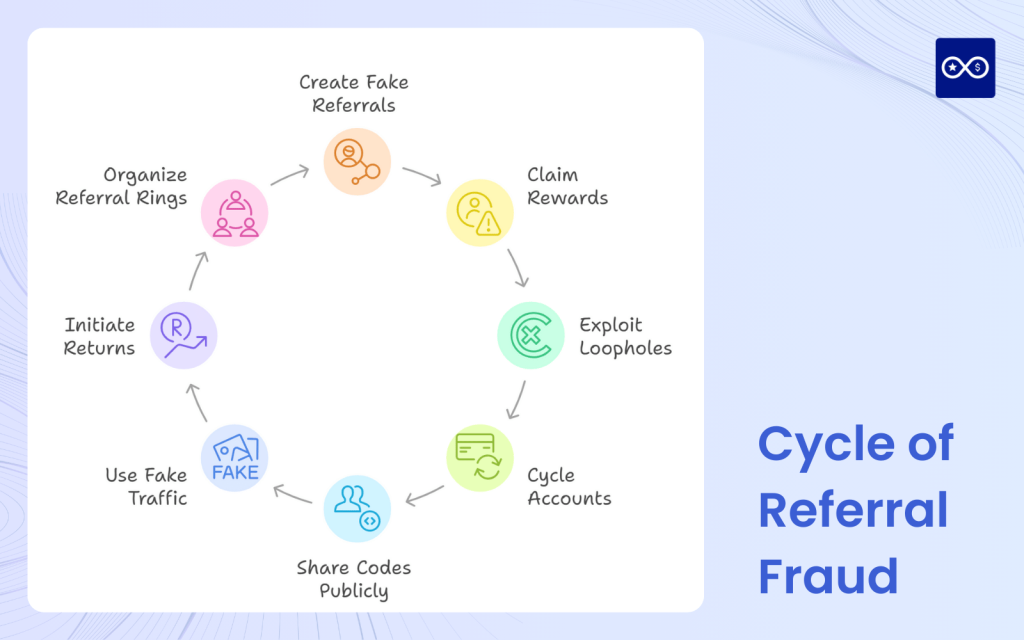
- Self-referrals & duplicate accounts: One person creating multiple accounts to refer themselves and claim both sides of rewards
- Exploitation of referral rewards: Finding loopholes in program rules (e.g., no minimum purchase requirement) to maximize payouts
- Account cycling: Creating an account, claiming the referral bonus, returning the purchase, then repeating with a new account
- Broadcasting & coupon sharing: Posting referral codes or discount coupons on public forums, enabling strangers to abuse them at scale
- Affiliate fraud: Using fake traffic, paid ads, or bots to drive fake referrals through affiliate networks
- Return/chargeback abuse: Referring fraudulent transactions, claiming rewards, then initiating returns or chargebacks to get the payout without the loss
- Referral rings: Organized groups of fraudsters working together to cross-refer each other and multiply payouts
- Repeat/multi-accounting: Continuously creating new accounts from the same person/device to exploit recurring rewards
Why Shopify Stores Are Vulnerable?
Shopify stores are particularly vulnerable to referral fraud for several reasons:
First, many Shopify merchants rely heavily on referral programs as a core customer acquisition channel. This high reliance makes them attractive targets for organized fraud rings that can generate significant payouts.
Second, the ease of creating multiple Shopify customer accounts without robust verification makes it trivial for fraudsters to spin up dozens of fake profiles. Add basic bot automation into the mix, and a single bad actor can generate thousands of fraudulent referrals in hours.
Third, many Shopify store owners underestimate the sophistication of modern fraud tactics. Fraudsters aren’t amateurs—they’re using synthetic identities, stolen payment methods, VPNs, device farms, and coordinated networks to bypass basic defenses.
Why Referral Fraud Harms Shopify Stores?
Financial Impact (Lost Revenue, Chargebacks)
The most obvious harm is direct revenue loss. If a fraudster claims a $50 referral bonus through fake accounts, you’ve lost $50 plus the time cost to investigate. Scale that across 100 or 1,000 fraudulent referrals, and you’re looking at thousands or tens of thousands in losses.
But it gets worse. Chargebacks are the silent killer. Fraudsters often use stolen payment methods or make fraudulent purchases to trigger referral rewards. When the cardholder disputes the charge, your store eats the chargeback fee (typically $15-$100 per transaction), loses the merchandise, and still paid out the referral reward. That’s a triple hit.
High chargeback rates can also trigger payment processor penalties or account restrictions, further damaging your bottom line.
Skewed Attribution and Marketing Metrics
Your referral program data is supposed to tell you how many customers you’re acquiring through word-of-mouth, what your CAC (customer acquisition cost) is, and how much lifetime value those referred customers generate.
Referral fraud corrupts this data. When 20% of your referrals are fake, your metrics become unreliable. You might think your referral program is performing brilliantly when it’s actually hemorrhaging money. This leads to poor strategic decisions—doubling down on a broken program, miscalculating ROI, or misallocating budget across channels.
Damaged Store Reputations
When customers discover that your referral program has been abused—or worse, that you haven’t noticed—it erodes trust. Word spreads quickly in online communities. Genuine customers who referred friends fairly feel cheated knowing others gamed the system. Your brand reputation takes a hit, and customer retention suffers.
Waste of Team Resources
Investigating fraud takes time. Manual reviews of suspicious accounts, cross-referencing transactions, investigating chargeback disputes—it’s tedious, error-prone work that pulls your team away from growth initiatives. For small teams, this drain is particularly painful.
Regulatory and Compliance Risks
Depending on your jurisdiction and the nature of fraud you’re experiencing, there can be regulatory implications. Consistent chargebacks can trigger compliance reviews. In some regions, failing to prevent fraud adequately can result in fines or penalties. It’s not just about ethics—it’s also about legal liability.
How Referral Fraud Actually Happens on Shopify?
Attack #1: Multi-Accounting with Automation
- Fraudster uses a bot or script to automatically create 50 Shopify customer accounts
- Uses slight email variations ([email protected], [email protected], etc.) to bypass basic email checks
- References a single “master” account as the referrer on all 50 accounts
- Bot completes fake purchases using stolen or virtual credit cards
- Fraudster claims all referral bonuses for the referrer account
- Returns all purchases to avoid inventory/payment processing flags
Attack #2: Referral Code Broadcasting
- Fraudster discovers your referral code (either their own or from a partner network)
- Posts it on Reddit, Facebook groups, Twitter, and coupon sites like RetailMeNot
- Hundreds of random people (many who may not be genuine customers) use the code
- Some complete purchases legitimately; others are bot-driven or fraudulent
- The referrer (fraudster) collects rewards on all of them
- Your data becomes polluted with fake/low-quality referrals
Attack #3: Chargeback Exploitation
- Fraudster creates an account and refers a friend (real or fake)
- The “friend” makes a purchase using a stolen credit card
- Fraudster claims the referral reward
- Cardholder disputes the charge; you issue a refund and eat the chargeback fee
- Fraudster keeps the referral reward; you lose money twice
- Rinse and repeat with new accounts
How to Detect Referral Fraud on Shopify
Red Flags in Shopify Analytics
Train yourself to spot these warning signs in your Shopify dashboard and referral app:
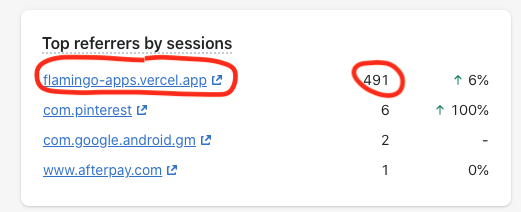
- Sudden spikes in referrals: A 300% jump in referrals overnight (without a corresponding marketing campaign) is suspicious
- Multiple signups from one IP/device/email pattern: If 20 accounts have similar IPs, device fingerprints, or email patterns, that’s a red flag
- Fast repeat reward claims: One customer claiming referral rewards multiple times in rapid succession
- Coupon code leaks: Your referral codes appearing on public coupon sites or forums
- Geographic anomalies: Referrals from countries where you don’t operate or serve
- High return/chargeback rates from referred users: If referred customers have 10x higher return rates than average, investigate
- Low purchase values or cart patterns: Referrals with $0 purchases, minimal orders, or identical cart contents across accounts
Fraud Detection Technologies
Modern fraud detection tools can automate much of this work:
- Automated fraud scoring: Machine learning models that assign a fraud risk score to each referral based on patterns
- IP/device fingerprinting: Identifying if multiple accounts originate from the same physical device or IP address
- Velocity checks: Flagging accounts that perform actions (signups, purchases, reward claims) at inhuman speeds
- Email validation: Checking if emails are from temporary/disposable services (10minutemail.com, etc.) or known fraud rings
- Manual review protocols: A tiered review system where flagged accounts are manually verified before reward payout
Many modern referral apps (like Bloop) have these tools built-in, reducing the manual work on your end.
Actionable Strategies to Prevent Referral Fraud in Your Store
Smart Program Setup & Terms
Start with a bulletproof program structure:
- Enforce strong terms & conditions: Clearly state what constitutes fraud, consequences for violators, and your right to cancel accounts and claw back rewards
- Cap referral rewards per customer/account: Limit how many times a single person can claim rewards (e.g., max 10 referral bonuses per customer)
- Restrict code usage: Make codes one-time use, single-user only, or require a minimum purchase threshold before rewards unlock
- Require minimum purchase values: Don’t give referral credit for $0 purchases or orders below a threshold (e.g., minimum $20 order)
- Add review periods: Don’t pay rewards instantly; hold them for 14-30 days to allow time for fraud detection and chargeback windows
>> See more: How to set up referral program on Shopify step by step
Strong Verification Techniques
Tighten identity verification:
- Email verification: Require customers to verify email addresses before accounts are fully active
- Phone verification: For higher-value rewards, consider SMS or phone verification
- Address matching: Verify billing and shipping addresses match; flag mismatches
- Block disposable emails: Automatically reject signups from temp email providers
- Customer identity matching: Use third-party identity verification services for programs with high reward values
- Cross-reference customer data: Check if new customers match known fraud patterns or stolen identity databases
Technical Safeguards
Deploy technical barriers:
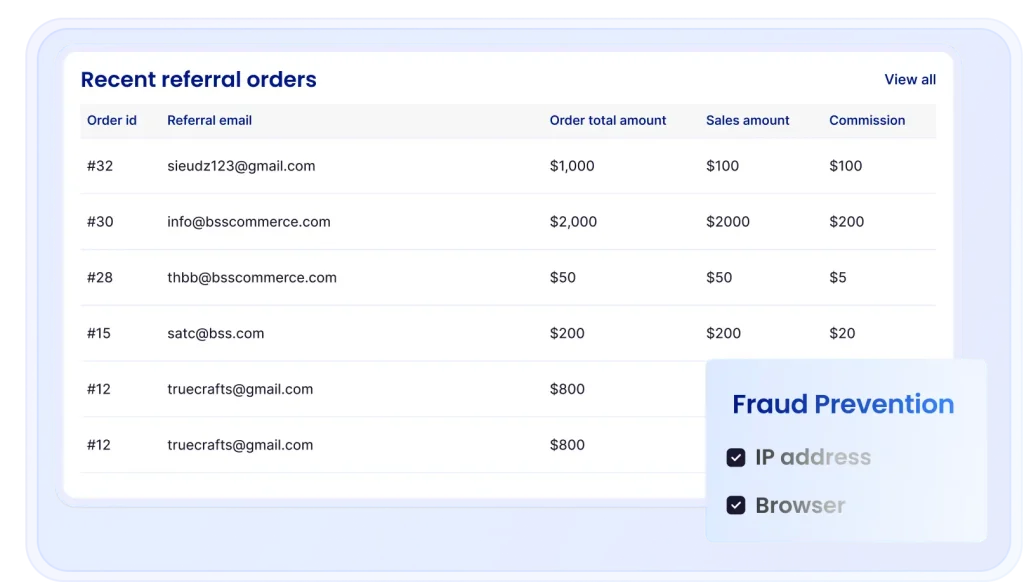
- Device & IP tracking: Track device IDs and IP addresses; flag multiple accounts from the same source
- CAPTCHA & bot mitigation: Use CAPTCHA on signup and reward claim pages; implement bot detection scripts
- Rate limiting: Limit signup attempts, password resets, and reward claims per IP/device within a time window
- Abuse prevention for reward timing: Stagger reward payouts; don’t process multiple claims from the same account within minutes
Reward Structure Best Practices
Design rewards that are harder to abuse:
- Store credit over cash: Award store credit or discount codes instead of cash payouts; it’s harder to monetize fraud
- Points systems: Use tiered point systems where customers must accumulate points and redeem in batches
- Require conversion actions: Don’t award referral bonuses for signups alone; require the referred customer to make a purchase (not just add to cart)
- Double-sided reward limitations: Cap rewards for both referrer and referee; don’t allow both sides to claim unlimited bonuses
- Time-lock rewards: Delay reward availability; customers can’t claim bonuses until after a waiting period
>> See more: What the Data Says: The Most Effective Referral Incentives in 2026
Ongoing Monitoring & Optimization
Make fraud detection continuous:
- Regular audits of referral data: Monthly reviews of referral transactions, looking for patterns
- Analytics review for odd patterns: Track metrics like average order value, return rate, and customer lifetime value for referred users
- A/B testing fraud-detection logic: Test different thresholds and rules; measure false positive rates
- Customer feedback loops: Ask referred customers if they actually know the referrer; reduce false positives that block legitimate referrals
- Competitive intelligence: Stay updated on new fraud tactics in your industry
Real-World Examples & Case Studies
An infamous example of referral fraud involving Uber occurred in 2014 when a user modified his Uber referral code so search engines more easily found it. He broadcasted this code widely via email and posted it on Reddit, making it accessible not just to his friends but to many strangers searching for Uber discounts online. This led to the user accumulating over $50,000 in free Uber ride credits before being caught. This case is a clear example of “discount broadcasting,” where a referral code intended for personal use or limited sharing is publicly posted to exploit the referral system for large-scale fraudulent gain.
Additionally, more extreme cases have been reported, such as a man from Queens allegedly using hundreds of stolen and false identities to defraud a ride-sharing business (like Uber) of $500,000 in referral and ride credits.
FAQ on Referral Fraud for Shopify
Any referral that is not a genuine word-of-mouth recommendation made by a real customer. This includes self-referrals, bot-generated signups, stolen identities, and coordinated fraud rings.
Costs compound. Fraud typically grows 10-20% month-over-month if unchecked. You also face reputational damage, compliance risks, and wasted team resources.
Use tiered defenses. Light verification (email) for most users; stricter checks (phone, address) only for high-value claims. Accept a small fraud rate if it means 90% of real customers get through.
Flag accounts, investigate, contact the customer, give them 48 hours to respond, then clawback rewards and ban if guilty. Document everything for legal protection.
How Bloop Referrals & Affiliates App Can Help
Bloop is built with Shopify store owners in mind. Unlike generic referral tools, Bloop combines ease-of-use with professional-grade fraud prevention:
- Easy setup: Branded referral programs live in minutes, not weeks
- Affordability: Pricing scales with your business; no enterprise markups for small stores
- Seamless Shopify integration: Pulls customer data, tracks purchases, and syncs referrals automatically
Here’s where Bloop shines for fraud protection:
- Automated fraud scoring: Machine learning flags suspicious referrals before payout
- IP/device fingerprinting: Detects multi-accounting from the same person
- Email validation: Blocks temporary and known fraud email patterns
- Manual review queue: Flag suspicious referrals for your team to review before payout
- Reward caps & rules engine: Set limits on referrals per customer, minimum purchase thresholds, and waiting periods
- Custom referral links: Unique links for each customer; easier to track abuse
- Integrations: Syncs with top email platforms (Klaviyo, Mailchimp) for targeted campaigns
Bloop’s support team helps you configure fraud settings, train your team, and optimize for conversions. Most stores see 20-40% increase in referral revenue within 90 days of implementing anti-fraud rules, because legitimate customers are more confident in the program’s integrity.
Conclusion
Referral fraud isn’t a theoretical threat—it’s happening right now in Shopify stores around the world. But the good news is that it’s preventable. By understanding the tactics fraudsters use, implementing smart verification and technical controls, and choosing the right tools to scale your defenses, you can protect your revenue, maintain customer trust, and build a referral program that actually drives growth.
Start with the fundamentals: tighten your program terms, verify customer identities, and monitor for red flags. Then layer in technology—whether that’s fraud detection tools like Bloop or custom integrations—to automate the process as you scale.
Referral fraud doesn’t have to derail your growth. With the right strategy and tools in place, you’ll attract legitimate customers through word-of-mouth while keeping fraudsters out.

Hien Tran
Hien Tran is a Product Marketing specialist at Bloop, where she translates product features into growth-driven solutions for Shopify merchants. By combining market insights with clear messaging, Hien ensures that store owners not only understand Bloop’s value but also know how to apply it to boost revenue, loyalty, and customer acquisition.