Referral Commission For Shopify Stores: Complete Guide 2026
Referral commission in Shopify stores is the payment you give to customers, partners, or affiliates who successfully bring new buyers to your shop—typically structured as a percentage of sales, flat fees, or store credit that rewards people for spreading the word about your products. This performance-based referral incentive model turns your happiest customers and most engaged promoters into a reliable acquisition channel that often converts 3-4x better than traditional advertising because recommendations come from trusted sources rather than cold outreach.
Setting up and managing these commissions might sound complex, but the mechanics are straightforward once you understand the different program types, payout structures, and tools available on Shopify. This guide breaks down everything from choosing commission rates that protect your margins to preventing fraud, comparing top referral apps, and launching your first campaign in under 15 minutes.
>> You may also like:
- 12+ Referral Incentives Ideas With Real-world Examples
- 7 Best Gift Card Referral Program Templates You Can Copy 2026
- 10 Best Ways to Promote Referral Links Free for Shopify Stores
What Referral Commission Means for Shopify Stores?
Referral commissions in Shopify stores are essentially the payments you offer to customers, influencers, or partners who refer new buyers to your shop. This compensation typically appears as a percentage of each sale or a flat fee paid out when someone’s recommendation results in a qualifying purchase. The model works whether you’re running your own store’s referral program (where existing customers refer friends) or participating as a Shopify Partner or Affiliate (where you refer merchants to the Shopify platform itself).
Here’s how it breaks down in practice. Store owners set their own commission rates and payout terms based on profit margins, customer lifetime value, and what competitors are offering. The referrer gets a unique tracking link or code that attributes any resulting purchases back to them, making sure they get paid for their promotional efforts. Meanwhile, the store benefits from trusted word-of-mouth recommendations that convert better than cold traffic—often 3-4x better than standard ads—because people trust suggestions from friends or credible sources they already follow.
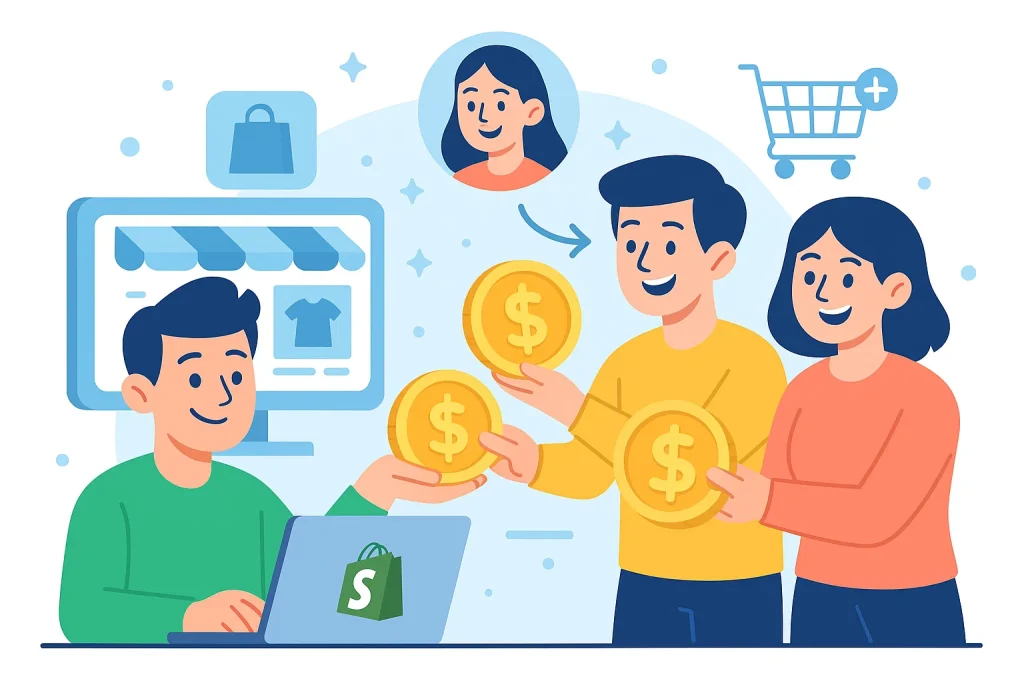
Customer Referral vs Affiliate vs Partner Commission
Though people mix up these terms all the time, the three main commission models serve different purposes and attract different types of promoters.
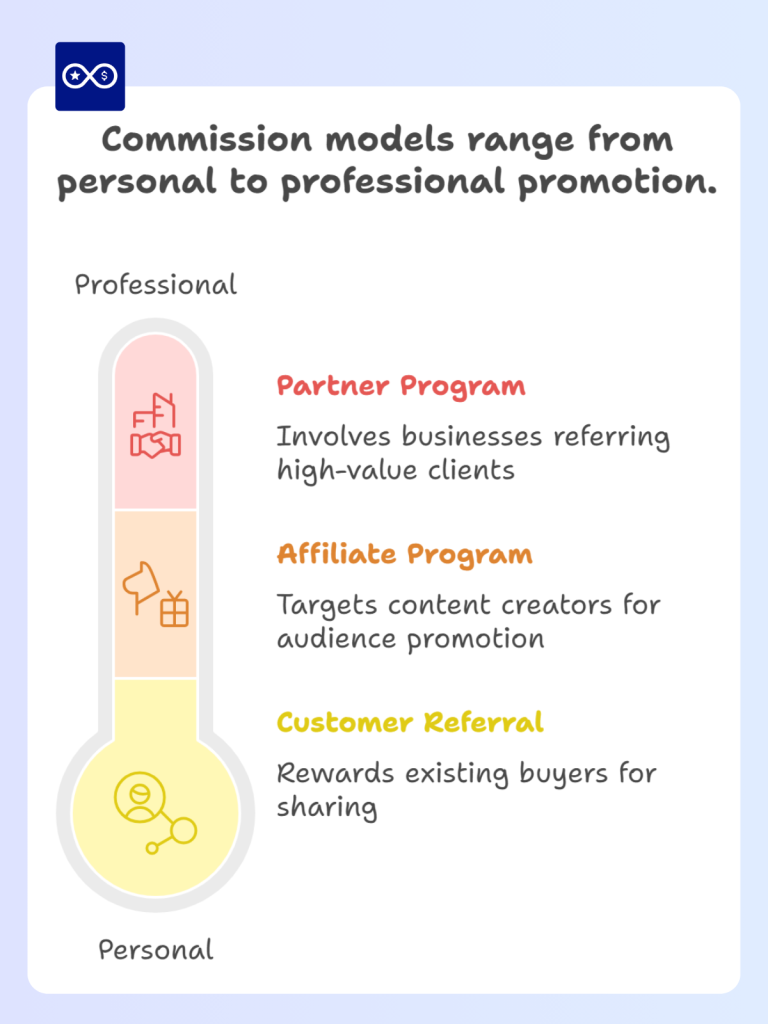
Customer referral programs reward your existing buyers for telling friends about products they’ve already purchased and loved. Commissions here tend to be modest—usually 5-15% or fixed discounts like $10 off—because the referrer is motivated more by sharing a good find than building a business. You’ll often see two-sided rewards where both the referrer and their friend get a discount, which boosts participation since everyone wins something tangible.
Affiliate programs target content creators, bloggers, and influencers who promote your products to their audiences in exchange for higher commissions, typically 10-30% depending on your margins. These partners treat promotion as a revenue stream, so they expect professional tracking tools, marketing assets, and reliable payouts. The relationship is more transactional than customer referrals—affiliates might promote dozens of brands simultaneously and focus on whatever converts best for their audience.
Partner programs involve business-to-business arrangements where agencies, consultants, or complementary service providers refer clients as part of their offering. Commissions can be substantial—sometimes 20% recurring or even flat fees of $500+ per referral—because partners are introducing high-value customers who stick around. Shopify’s own Partner Program exemplifies this model, paying developers and agencies ongoing commissions for merchants they bring to the platform.
The model you pick depends on your goals: customer referrals build community and loyalty, affiliate programs scale reach quickly through established audiences, and partner programs deliver fewer but higher-value customers through trusted business relationships.
>> Read more: Referral Program vs Affiliate Program: 10+ Differences and Which is good for your Shopify store?
How Referral Commission Is Calculated and Paid
Commission structures come in three main flavors, each with tradeoffs between simplicity and alignment with your business model.
Percentage-based commissions tie rewards directly to order value—like 10% of each sale—which means referrers earn more when they drive bigger purchases. This approach works beautifully for stores with varying price points because it automatically scales rewards with transaction size, keeping your payout ratio consistent. The downside? Calculating percentages can feel less concrete to referrers than fixed amounts, and you’ll have to decide whether to base it on subtotal, total after discounts, or some other figure.
Flat-rate rewards offer the same amount regardless of purchase size—say $15 per successful referral—which makes budgeting predictable and messaging crystal clear. Customers immediately understand “refer a friend, get $15” without doing math, which can boost participation. However, flat rates might overpay on small orders or underpay on large ones relative to your margins, so they work best when your average order value clusters tightly around a specific range.
Recurring commissions pay out repeatedly for subscription products or services, rewarding referrers with 10-20% every billing cycle as long as the customer stays active. This model aligns incentives beautifully—referrers are motivated to bring quality customers who stick around rather than one-time bargain hunters. The complexity comes in tracking renewals, handling cancellations, and managing longer-term payout obligations, but for subscription boxes or membership sites, recurring commissions often generate the most enthusiastic promoters.
Most successful programs start with one structure and test variations after gathering data on what motivates their specific audience and protects profit margins.
Typical Payout Timeline and Lock Periods
The journey from referral to payment involves deliberate delays that protect both you and legitimate referrers from fraud and returns.
Step 1: Pending Period
This window begins the moment a referred customer completes their purchase, placing the commission in a holding status while you verify the order is legitimate. The pending period typically lasts 7-30 days depending on your return policy and fraud risk, giving you time to confirm the customer isn’t gaming the system with fake accounts or stolen payment methods. During this phase, referrers can usually see their pending earnings in a dashboard but can’t withdraw funds yet.
Step 2: Approval
Approval happens when the pending period expires without issues—no returns, no chargebacks, no suspicious activity flagged by your fraud prevention rules. At this point, the commission moves from “pending” to “approved” or “payable,” meaning you’ve committed to paying it out. Some apps automate this transition based on time elapsed, while others let you manually review high-value referrals before approval, adding an extra layer of security for expensive products.
Step 3: Payout
Payout occurs on your chosen schedule—monthly, quarterly, or when referrers hit a minimum threshold like $50 accumulated earnings. Most Shopify referral apps integrate with PayPal, bank transfers, or issue store credit automatically, though some stores still handle payouts manually for smaller programs. The key is communicating your payout cadence clearly upfront so referrers know when to expect their rewards and don’t feel like they’re chasing payments.
This staged timeline protects you from paying commissions on returned items while giving referrers confidence that their efforts will eventually be rewarded once orders prove legitimate.
Recommended Commission Rates for eCommerce Niches
Commission rates vary wildly by industry based on margins, competition, and customer acquisition costs, so benchmarking against your niche helps you stay competitive without overpaying.
Fashion and Beauty
Fashion and beauty stores typically offer 10-20% commissions because these categories have decent margins and high repeat purchase rates. The visual nature of these products also makes them easy for influencers to showcase, so you’re competing for affiliate attention with generous rates. However, return rates can hit 30-40% in fashion, so factor that into your effective commission cost and extend your pending period to account for returns.
Consumer Electronics
Consumer electronics usually cap commissions at 3-8% due to razor-thin margins and high product costs—a $1,000 laptop generates meaningful dollars even at 5%. These products also have longer consideration cycles, so referrers might touch prospects multiple times before conversion, which affects how you structure cookie duration (the tracking window). The upside is lower return rates and customers who rarely dispute charges on big-ticket items they researched thoroughly.
Digital Products and Subscriptions
Digital products and subscriptions can afford 20-50% commissions because there’s no inventory cost, shipping, or physical fulfillment eating into margins. Software, courses, and memberships have incredible unit economics once you’ve covered creation costs, making generous commissions a smart investment in customer acquisition. Plus, digital products often involve recurring revenue, so you might offer 20% on the first month and 10% ongoing, which keeps affiliates motivated to promote actively.
The sweet spot for your store lies where commissions attract quality promoters without eroding profitability—typically landing somewhere between 10-15% of your average order value for most physical product businesses.
Step-By-Step Setup of a Shopify Referral Program
Launching a referral program takes less time than you’d think, especially with Shopify’s app ecosystem handling the technical heavy lifting.
Step 1: Choose an App
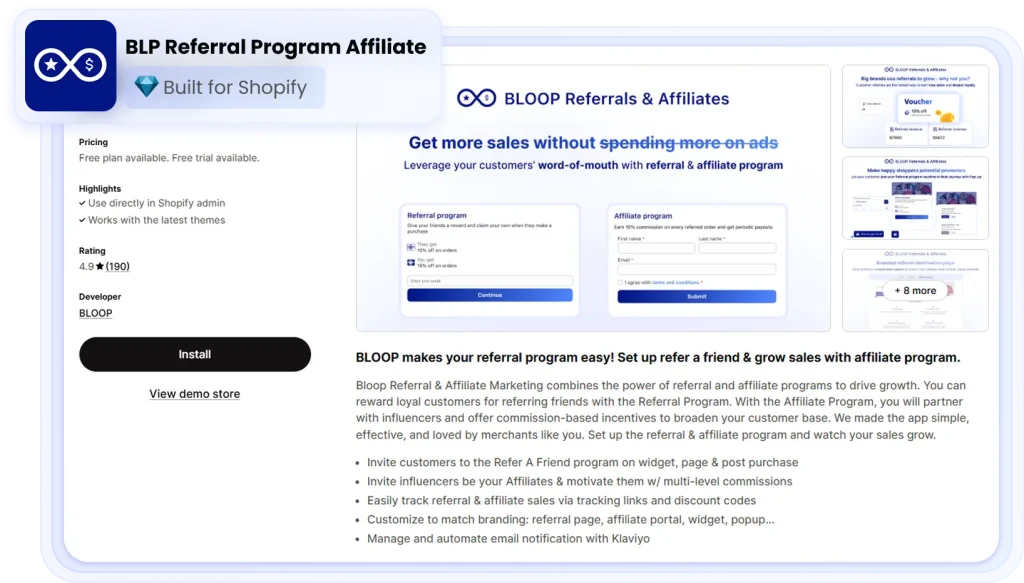
Pick an app that matches your budget and feature needs, looking specifically at whether it supports your preferred commission structure (percentage vs. flat), integrates with your email platform, and offers fraud prevention tools. Apps like Bloop Referrals & Affiliates combine referral and affiliate functionality in one dashboard starting under $50/month, while enterprise options like Refersion offer advanced attribution at higher price points. Read recent reviews to gauge how responsive the developer is to support requests, since you’ll likely want help during setup.
Step 2: Define Your Offer
Calculate how much you can afford to pay per acquisition while staying profitable—a good rule of thumb is keeping total referral costs under 20% of your average order value. Decide whether you’ll reward just the referrer, just the new customer, or both (two-sided programs typically see 30% higher participation). Test different reward types too: some audiences prefer cash or store credit, while others respond better to exclusive products or early access to sales.
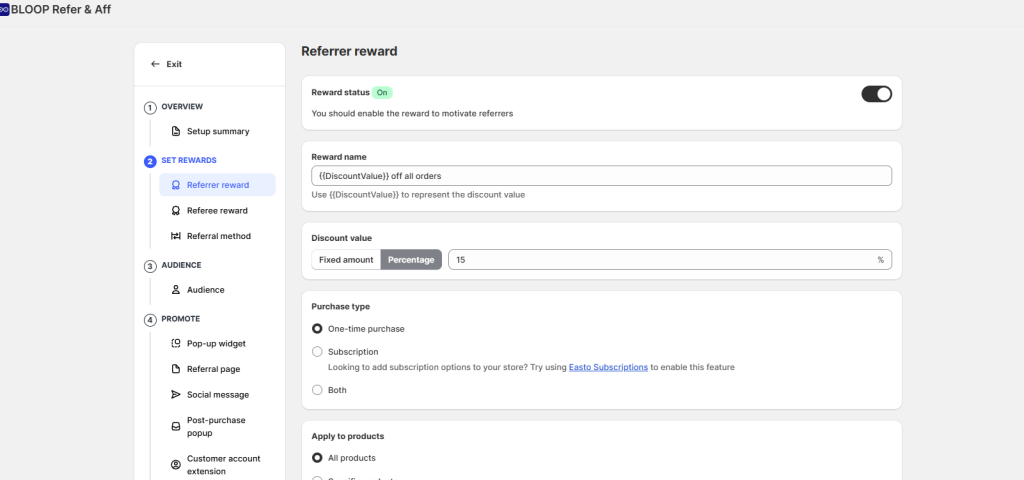
Step 3: Customize Branding
Make your referral program feel like a natural extension of your store rather than a tacked-on feature with generic templates. Upload your logo, match colors to your theme, and write copy in your brand voice—this consistency builds trust and makes customers more likely to share. Most apps let you customize email templates, landing pages, and even the referral widget that appears on your site.
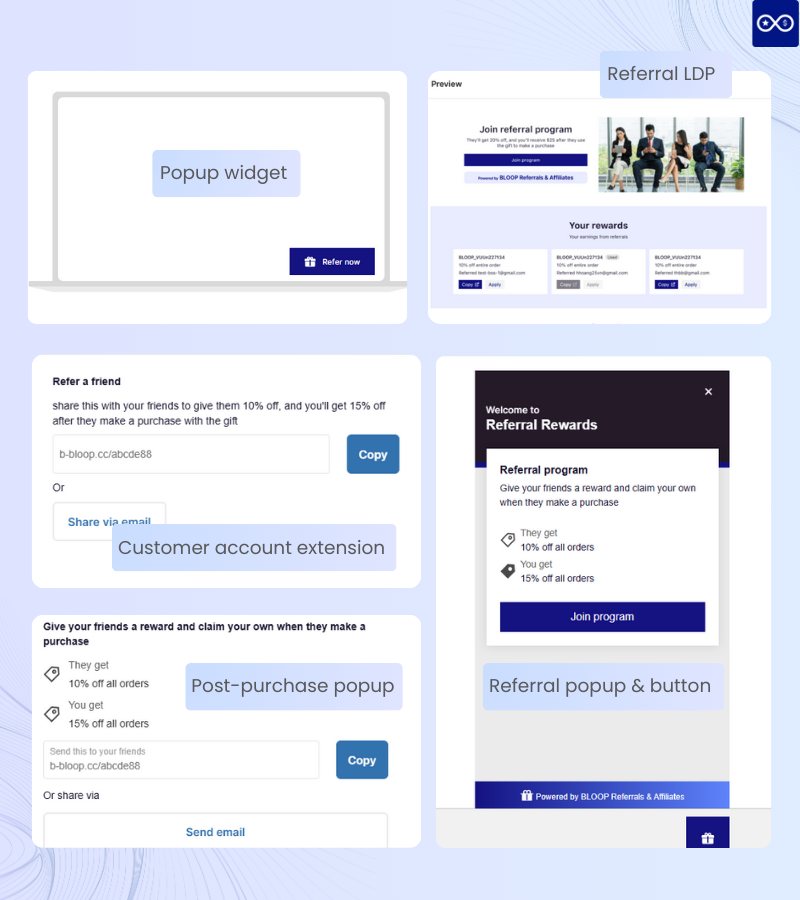
Step 4: Launch and Promote
Announce the program to your existing customer base through email, social media, and post-purchase follow-ups when satisfaction is highest. Consider offering a limited-time bonus like double rewards for the first month to generate initial momentum and data. The biggest mistake is building a program and assuming customers will discover it organically—you’ll want to actively market the program itself to drive participation.
Step 5: Track and Optimize
Monitor key metrics like referral rate (what percentage of customers refer), conversion rate (how many referrals become buyers), and ROI (revenue generated vs. commissions paid). After 30-60 days, you’ll have enough data to test variations in reward amounts, messaging, or promotion channels. The most successful programs treat referrals as an ongoing channel that gets continuous attention rather than a set-it-and-forget-it tactic.
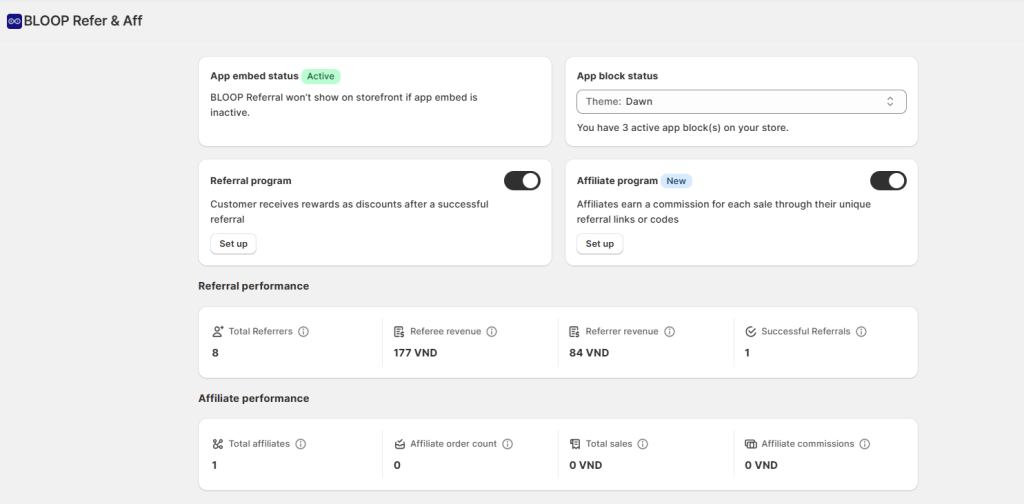
>>> Get started free with Bloop’s referral program app and launch your first campaign in under 15 minutes.
Top Referral Apps Compared on Cost and Features
Picking the right app means balancing features against budget while considering how much time you’ll spend managing the program.
| App | Starting Price | Key Strength | Best For |
| Bloop | $19.9/month | Combined referral + affiliate in one dashboard | Small to mid-size stores wanting simplicity |
| ReferralCandy | $29/ monthwith 10.5% success fee on referral sales | Advanced customization and A/B testing | Brands with dedicated marketing teams |
| UpPromote | Free tier available | Multi-channel promotion tools | Stores focused on influencer partnerships |
| Smile.io | $49/month | Loyalty program integration | Brands building comprehensive retention strategies |
| Refersion | $39/ month (3% of affiliate generated sales) | Enterprise tracking and reporting | High-volume stores with complex attribution |
Bloop stands out for merchants who want both referral and affiliate capabilities without paying for two separate apps or wrestling with complicated dashboards. The platform includes fraud prevention, customizable rewards, and seamless Shopify integration at a price point that makes sense for growing businesses. With over 2,000 merchants and 190+ five-star ratings, it’s proven reliable for stores that value straightforward setup over enterprise bells and whistles.
Preventing Fraud and Tracking Referrals Accurately
Referral fraud can drain budgets fast if you don’t build safeguards into your program from day one, though most issues are preventable with standard precautions.
Unique Codes and Links
Unique codes and links form the foundation of accurate tracking by giving each referrer a personalized identifier that attributes purchases back to them automatically. When someone clicks a referral link, the app drops a cookie in their browser that persists for your chosen duration—typically 30-60 days—so even if they don’t buy immediately, the referrer still gets credit. Codes work similarly but require manual entry at checkout, which adds friction but can be useful for offline sharing or when link tracking fails.
IP and Cookie Rules
IP and cookie rules prevent the most common fraud attempts, like customers referring themselves from different devices or clearing cookies to trigger multiple first-purchase bonuses. Most apps automatically flag referrals where the referrer and referee share an IP address, physical address, or payment method, letting you review these cases before approving commissions. You can also set limits on how many referrals from a single person you’ll accept in a given timeframe, catching suspicious patterns before they cost you money.
Manual Review Flags
Manual review flags give you final say over high-value or questionable referrals, adding a human check before payouts go out. While automation handles 95% of referrals smoothly, flagging orders over a certain amount or from new referrers who suddenly drive multiple sales helps catch sophisticated fraud that rules-based systems might miss. The tradeoff is time spent reviewing, so set your threshold high enough that you’re only manually checking truly unusual activity.
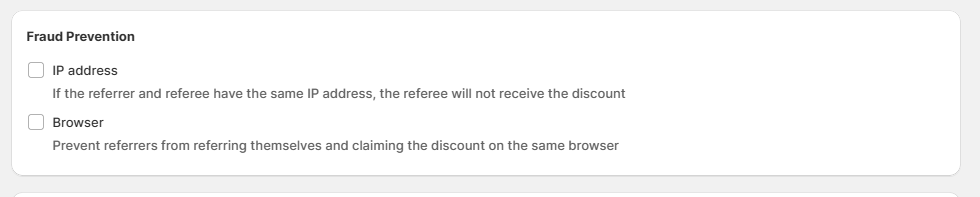
Transparent terms of service that explicitly prohibit self-referrals, fake accounts, and coupon abuse give you legal standing to deny fraudulent commissions and ban bad actors from your program.
Proven Ways to Boost Referral Earnings Fast
Even well-designed programs can languish without active promotion and creative tactics that remind customers to share.
Limited-Time Double Rewards
Limited-time double rewards create urgency that cuts through inaction—announcing “earn $20 instead of $10 for referrals this week only” often sparks immediate sharing from customers who’ve been meaning to tell friends. The time constraint triggers fear of missing out while the increased reward justifies the effort of actually sending messages. Run these promotions quarterly or around major shopping events when your brand is already top-of-mind and people are primed to buy.
Post-Purchase Nudges
Post-purchase nudges catch customers at peak satisfaction, right after they’ve received and loved their order, making it the perfect moment to ask for referrals. Automated emails 7-14 days after delivery (once they’ve used the product) can include their unique referral link with a simple message like “Love it? Share it and earn $15.” This timing dramatically outperforms generic promotional emails because you’re asking people to share something they’ve actually experienced rather than hypothetically endorsing your brand.
Influencer Collabs
Influencer collabs extend your referral program beyond your existing customer base by partnering with content creators who already have engaged audiences in your niche. Rather than one-off sponsored posts, give influencers their own referral codes with higher commission rates (20-30%) and let them promote authentically over time. This approach works especially well when you provide influencers with exclusive discount codes for their followers, creating a two-sided incentive where the audience saves money and the influencer earns commission.
The common thread across these tactics is making referral opportunities visible and timely rather than buried in a footer link customers never notice.
Why Bloop Makes Referral Commission Simple and Affordable
Managing referral commissions doesn’t require a degree in marketing automation or a budget that only makes sense for enterprise brands.
All-In-One Dashboard
The all-in-one dashboard means you’re running both customer referrals and affiliate partnerships from the same interface instead of juggling multiple apps with separate logins, data silos, and conflicting settings. This unified approach saves time during daily management and gives you a complete picture of your word-of-mouth channels in one place. You can see at a glance which promoters drive the most revenue, compare performance between referral types, and make strategic decisions without exporting data from three different platforms.
Free Trial and Transparent Pricing
The free trial and transparent pricing let you test Bloop’s full feature set without commitment, and plans start at just $19/month—a fraction of what enterprise alternatives charge for similar functionality. There are no hidden fees, percentage-based pricing that scales with your success, or surprise charges when you hit certain volume thresholds. The straightforward pricing makes budgeting simple and keeps referral programs profitable even as they grow.
Get Started Free
Getting started free means installing Bloop from the Shopify App Store and launching your first campaign in under 15 minutes, with templates and guidance that eliminate guesswork. Try Bloop free and see how easy referral commission management can be when the tools are built specifically for Shopify merchants who value simplicity over complexity.
Frequently Asked Questions About Shopify Referral Commission
Can I offer store credit instead of cash?
Yes, store credit is actually one of the most popular referral rewards because it keeps revenue within your business while still giving referrers something valuable they can use on future purchases. Many stores find credit generates higher participation rates since the perceived value often exceeds the actual cost to you, and it encourages repeat purchases from your best advocates.
Does commission count toward Shopify transaction fees?
No, commission payments are separate business expenses that happen outside your Shopify sales transactions, so they don’t affect the transaction fees Shopify charges on your revenue. You’ll record commissions as marketing costs in your accounting, similar to how you’d treat ad spend or influencer payments.
How do I handle returns when commission was already paid?
Most referral apps automatically reverse or deduct commissions when referred orders are refunded or returned within your tracking period, either subtracting from the referrer’s future earnings or flagging a negative balance if they’ve already withdrawn funds. This is why pending periods exist—they give you a buffer to catch returns before paying out commissions.
What happens if someone uses multiple referral links?
Referral apps typically credit the last valid referral link clicked before purchase, following a “last-click attribution” model that’s standard in affiliate marketing. Some apps let you customize this to first-click or other attribution models, but last-click is most common since it credits whoever most recently influenced the buying decision.
Can I set different commission rates for different products?
Yes, many referral apps including Bloop allow product-specific or collection-specific commission rates, letting you offer higher rewards for high-margin items, new launches you want to push, or products that generate strong repeat purchases. This flexibility helps you maintain profitability across your catalog while still incentivizing promotion of strategic items.

Hien Tran
Hien Tran is a Product Marketing specialist at Bloop, where she translates product features into growth-driven solutions for Shopify merchants. By combining market insights with clear messaging, Hien ensures that store owners not only understand Bloop’s value but also know how to apply it to boost revenue, loyalty, and customer acquisition.